

Equity experts are warning about the regulatory risks of putting money into individual Hong Kong stocks, saying investors should focus on equity indexes and old-economy shares. Oswald Chan reports from Hong Kong.

China’s intensifying crackdown on technology behemoths, on the heels of the probes into ride-hailing giant Didi Chuxing Technology Co and education companies, coincides with the mounting scrutiny of Chinese enterprises seeking to raise funds in the United States.
The moves by the mainland and US regulators have sent shock waves across Hong Kong’s equity market. The benchmark Hang Seng Index tumbled from its highs in the first quarter of this year before consolidating in the second quarter.
Amid lingering regulatory risks on the mainland and global uncertainties arising from COVID-19, the HSI took a beating for two consecutive days — plunging a total of more than 8 percent on July 26 and July 27. The Hang Seng TECH Index, which represents the 30 largest technology companies listed in Hong Kong, has lost nearly all its gains since its inception more than a year ago. Southbound fund flows under the Stock Connect programs between Hong Kong and the mainland saw the largest net outflows on record of HK$63.5 billion (US$8.16 billion) last month, according to OCBC Wing Hang Bank.
On Aug 12, the benchmark index closed at 26,517, 2.62 percent lower than it was at the end of December, even though the index had rebounded from the previous low level at the end of July.
READ MORE: China's securities regulator fines three for illicit trading
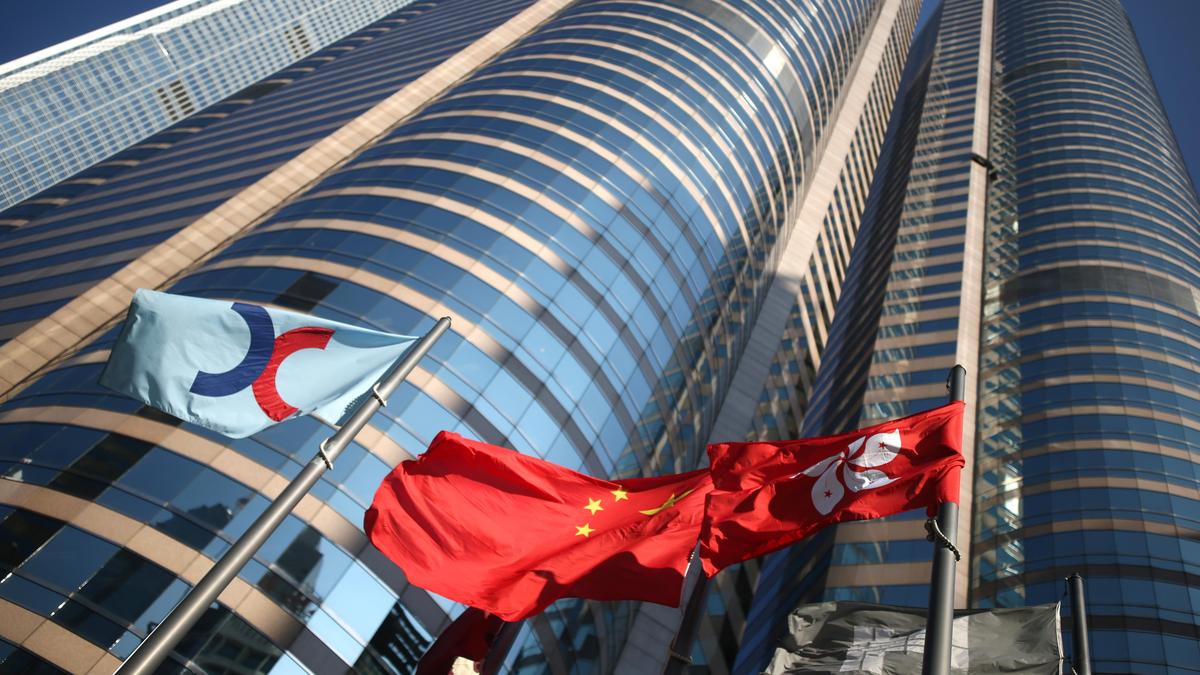 The Hong Kong Exchanges and Clearing Ltd (HKEx) flag, flies outside the Exchange Square in Hong Kong on Jan 20, 2017. (EDMOND TANG / CHINA DAILY)
Hang Seng Investment Management — a wholly owned subsidiary of Hang Seng Bank — warned investors of a string of risks in the Hong Kong stock market: Would the worsening pandemic affect customs clearance procedures between the special administrative region and the mainland? Would the mainland’s tough supervision of technology companies hurt the valuation of Hong Kong stocks? Would Hong Kong’s economic recovery be slower than expected? And would the People’s Bank of China substantially tighten its monetary policies?
Mandatory Provident Fund advisory services provider Gain Miles expects mainland authorities to continue clamping down on the real estate and education industries, with the technology and livelihood sectors seeing a higher degree of supervision and intervention.
Swiss-based asset manager UBS rates Hong Kong’s equity market as the “least preferred”, saying the market’s fundamentals are relatively weak, and the city is more sensitive to the overall trend of US interest rates and the greenback.
However, experts’ predictions for the local stock market’s performance by year-end are mixed, with the HSI projected to stay between 27,000 and 30,000 points, and the Hang Seng TECH Index ranging from 6,500 to 8,000.
Equity analysts suggest that investors should adopt a thematic or exchange-trade fund approach, rather than putting their money into individual stocks, as a risk diversification strategy. Traditional old-economy shares also will offer good investment potential when their market valuations become attractive again after the recent market jitters
Equity analysts suggest that investors should adopt a thematic or exchange-trade fund approach, rather than putting their money into individual stocks, as a risk diversification strategy. Traditional old-economy shares also will offer good investment potential when their market valuations become attractive again after the recent market jitters.
Bloomberg sees the forward price-earnings ratio of the HSI and the Hang Seng Chinese Enterprise Index standing at 11.8 times and 9.6 times respectively, indicating that Hong Kong stock indexes are inexpensive compared with their global peers, as policy uncertainties have driven large share valuation discounts.
French-based asset manager BNP Paribas said that thematic stock baskets, such as green energy, economic reopening and reflation (capital goods, autos, technology and materials), and internal circulation (technology, consumer, healthcare and industrial) can continue to outperform in the near term as broad-based equity indexes are likely to remain range-bound until regulatory policies can be further clarified.
“Mainland technology stocks of platform economy players with market monopoly positions, as well as technology shares relating to national security or livelihood, will be targeted in the current regulatory probes. On the other hand, shares relating to domestic demand, consumption and semiconductor-related stocks may benefit from the country’s regulatory policies,” Venture Smart Asia Limited Managing Partner Kenny Tang told China Daily.
Dickie Wong, executive director of research department at Kingston Securities, said investors should avoid purchasing individual mainland technology stocks.
“The valuations of the HSI and the Hang Seng TECH Index have dropped to attractive levels, so investors can consider investing in ETFs, such as Tracker Fund of Hong Kong, and ETFs tracking the Hang Seng TECH Index,” Wong said.
In his view, traditional old-economy stocks still offer good investment potential for the rest of the year. Such companies include real-estate investment trusts, Hong Kong-based developers, telecom shares, and utility companies, as their shares offer stable investment yields.
Sincere Securities Chief Executive Officer Louie Shum agreed. “Those undervalued old-economy stocks should fare better and attract capital that can boost the HSI.”
Hong Kong Exchanges and Clearing should be one of the beneficiaries, Shum said. “Mainland technology companies intending to list their shares in the Hong Kong offshore equity market may boost the revenue and profit of the stock exchange operator,” he said.
Other market strategists are upbeat about the overall momentum of the city’s stock market, saying the central government’s monetary and fiscal stimulus policies as well as strong corporate earnings, should support the HSI’s medium- and long-term performance.
“We are confident about mainland and Hong Kong equities. We think they will be supported by the economic recovery trend, a loose monetary environment, and the continued improvement in corporate profitability,” the Deutsche Bank Chief Investment Office said.
US-based investment management firm T. Rowe Price is on the same page, saying that Chinese equity consolidation seems overdone in the wake of supportive flow dynamics and clarification of technology regulations.
ALSO READ: It still makes a bull market after all
Besides policy stimulus and corporate profitability, market liquidity should also lend support to the equity market by the end of this year.
Timothy Fung, Asia head of equity advisory at BNP Paribas Wealth Management, said the impact of the forthcoming US Federal Reserve’s tapering is expected to be less disruptive than that in 2013.
“The influence of mainland capital in the Hong Kong stock market has increased significantly in the past 10 years. Generally speaking, mainland liquidity is less correlated to the US rates cycle, and against the COVID-19 backdrop, any adverse growth outcomes could trigger an immediate shift in central bank rhetoric back to a more dovish mode,” Fung said.
“Thus, we see the Fed continuing to support risk assets this year by discussing its bond buying again at its next meetings in September and November, but only announcing in December that it will start tapering from January onwards,” said Mansoor Mohi-uddin, chief economist at the Bank of Singapore.
The US Federal Reserve maintained its cautious stance at its meeting last month, keeping its federal funds rate at zero to 0.25 percent and continuing to print money and buy US$120 billion in bonds each month. The US central bank reiterated that the domestic labor market still needs to improve further before it can start tapering its quantitative easing.
Contact the writer at oswald@chinadailyhk.com
