

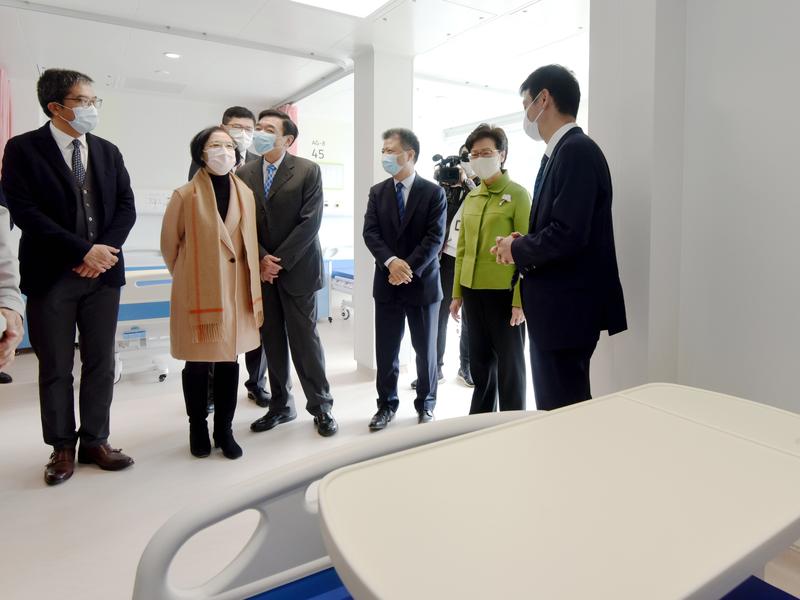
 Hong Kong Chief Executive Carrie Lam Cheng Yuet-ngor (second right) inspects a negative pressure ward at the North Lantau Hospital Hong Kong Infection Control Centre on Jan 20, 2021. The completion and handover ceremony of the construction project supported by the central government was held on the same day. (INFORMATION SERVICES DEPARTMENT)
Hong Kong’s healthcare system has enhanced its defense against COVID-19 after a new temporary hospital with over 800 beds built with the central government’s support was handed over on Wednesday to the Hong Kong Special Administrative Region government, raising the city’s complement of negative pressure beds to over 2,000.
The completion of North Lantau Hospital Hong Kong Infection Control Centre, adjacent to AsiaWorld-Expo on Lantau Island, is the third major project that the central government has provided for the city to quell the health crisis
The completion of North Lantau Hospital Hong Kong Infection Control Centre, adjacent to AsiaWorld-Expo on Lantau Island, is the third major project that the central government has provided for the city to quell the health crisis.
Together with the earlier construction of a mobile-cabin community treatment center in October, the central government has provided an additional 1,800 beds.
Previously, the central government had sent medical experts and resources for the city’s first mass testing program which tested 1.78 million residents within 14 days in September.
In a video speech at the completion ceremony, Huang Liuquan, deputy director of the Hong Kong and Macao Affairs Office of the State Council, said that the project embodies how the central government is always the backbone of the special administrative region’s anti-pandemic work.
Ever since the pandemic broke out in the city, the central government has made every effort to support Hong Kong in its fight, including prioritizing the supply of vaccines and providing resources for mass testing, Huang noted.
He urged Hong Kong society to stand in solidarity to “take all necessary measures” to “clear the infections” in the city and restore economic and livelihood order.
ALSO READ: CE stresses targeted testing, HK virus curbs to be extended
Hong Kong Chief Executive Carrie Lam Cheng Yuet-ngor thanked the mainland officials and construction teams for their “hard work and painstaking efforts” that “rendered Hong Kong great confidence in fighting against the pandemic”.
“The resources, nucleic acid tests and vaccines as well as the temporary hospital completed today, have all demonstrated the central government’s care to the SAR,” Lam said.
With the speed of construction, improved quality, and high safety standard, the project provided a precious experience for the future construction of Hong Kong’s medical facilities, she said.
Adapting cutting-edge Modular Integrated Construction methods, the Guangdong provincial government and the Shenzhen municipal government completed the project, which normally would take three to four years, in just four months.
The hospital, expected to be put in use in February, consists of six ward buildings, a medical center, and supporting facilities. It provides 136 wards, comprising 816 negative pressure beds, which are designed for patients with infectious diseases.
Governor of Guangdong Ma Xingrui and Party Secretary of Shenzhen Wang Weizhong also attended the ceremony via online video conferencing.
On Wednesday, Hong Kong reported 77 new COVID-19 infections, bringing the tally to 9,797, while 659 patients remain in hospital
On Wednesday, Hong Kong reported 77 new COVID-19 infections, bringing the tally to 9,797, while 659 patients remain in hospital.
Among them, 41 patients live in Yau Tsim Mong District of Kowloon, the hardest-hit area of the recent outbreak, where the SAR government has imposed mandatory tests on more than 70 buildings.
INFOGRAPHIC: The right dose
Ko Wing-man, former secretary for food and health, told China Daily that the temporary hospital can help to overcome the previous problem faced by inadequate treatment facilities in July.
At the time, more than 100 COVID-19 patients could not be immediately hospitalized after testing positive, and continued to live with their families, posing a threat to the community.
Leung Chi-chiu, chairman of the advisory committee on communicable diseases of the Hong Kong Medical Association, said a designated hospital for COVID-19 patients could reduce the risk of cross-infection in public hospitals.
Both doctors noted that the three projects supported by the central government played an important role in Hong Kong’s fight against the pandemic.
The universal testing program in September activated Hong Kong’s mobilization capacity in facing an outbreak and provided experience and facilities for large-scale testing, they said.
“Without it, the current mass testing of high-risk areas might not have been possible,” Leung said, adding that the AsiaWorld-Expo Community Treatment Centre helped avert the city’s healthcare system from collapsing during the third and fourth waves, when more than 500 cases were confirmed within a week.
