

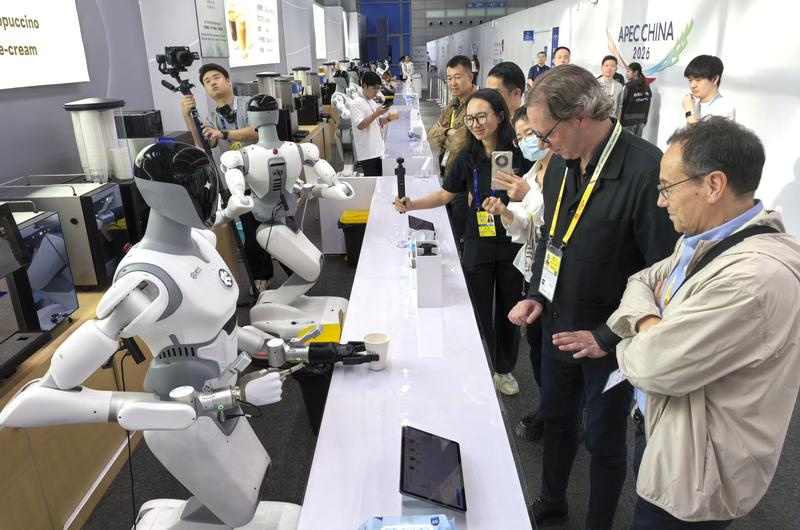
China is spearheading the world's first international standards for generative artificial intelligence governance, and has taken the lead in developing 29 foundational AI international standards, the State Administration for Market Regulation said on Tuesday.
The progress reflects China's growing engagement in international AI standards-setting, as well as the country's efforts in translating its technological and industrial strengths into greater contributions to global AI governance, industry experts said.
Sun Wei, deputy head of standards innovation at the SAMR, said China has been actively contributing to the development of a global AI standards framework under the International Organization for Standardization and the International Electrotechnical Commission, two of the major international standard-setting organizations.
READ MORE: Chinese minister calls for AI risk control system
China has brought together leading tech companies and research institutions to spearhead 29 foundational international standards in key areas spanning data governance, human-machine interaction, safety and trustworthiness, Sun said.
The country has also coordinated 15 technical standardization bodies to lead the development of 49 international standards for AI applications ranging from smart cities to intelligent manufacturing, she said.
In addition, China was working with several countries to develop the world's first international standards proposal specifically addressing generative AI governance, targeting common risks such as deepfakes and model poisoning. The proposed standards aim to help build international consensus on AI risk management and translate broad governance principles into practical measures.
Notably, an international standard on AI data quality led by China has been adopted by European standardization bodies.
Fan Kefeng, vice-president of the China Electronics Standardization Institute, said, "It means that this China-led standard will serve as an important technical reference for AI compliance assessments in the European Union. It underscored China's significant role in shaping international data governance rules."
Meanwhile, an international standard on the security of large AI model inference services has been put forward by China to address emerging security threats such as prompt injection, context poisoning and cross-tenant data leakage.
China's growing role in international standardization is also reflected in its expanding pool of experts. The latest data from the SAMR showed that nearly 400 Chinese experts are registered with ISO and IEC bodies specializing in AI.
International standards, according to Shen Yi, director of the International Research Institute of Global Cyberspace Governance at Fudan University, could turn governance principles into operational practices that are comparable and verifiable across markets.
ALSO READ: China pushes toward task-oriented AI
"Such standards could help reduce duplicated testing and compliance costs for multinational companies, while lowering barriers for developing countries to participate in global AI governance," Shen said.
Beyond spearheading individual international standards, China is also stepping up efforts to make its domestic AI standards accessible to overseas markets. The country has released foreign-language versions of 15 national AI standards covering areas including large AI models and server performance testing, and plans to translate 78 national standards into 12 languages.
Contact the writers at chengyu@chinadaily.com.cn
