

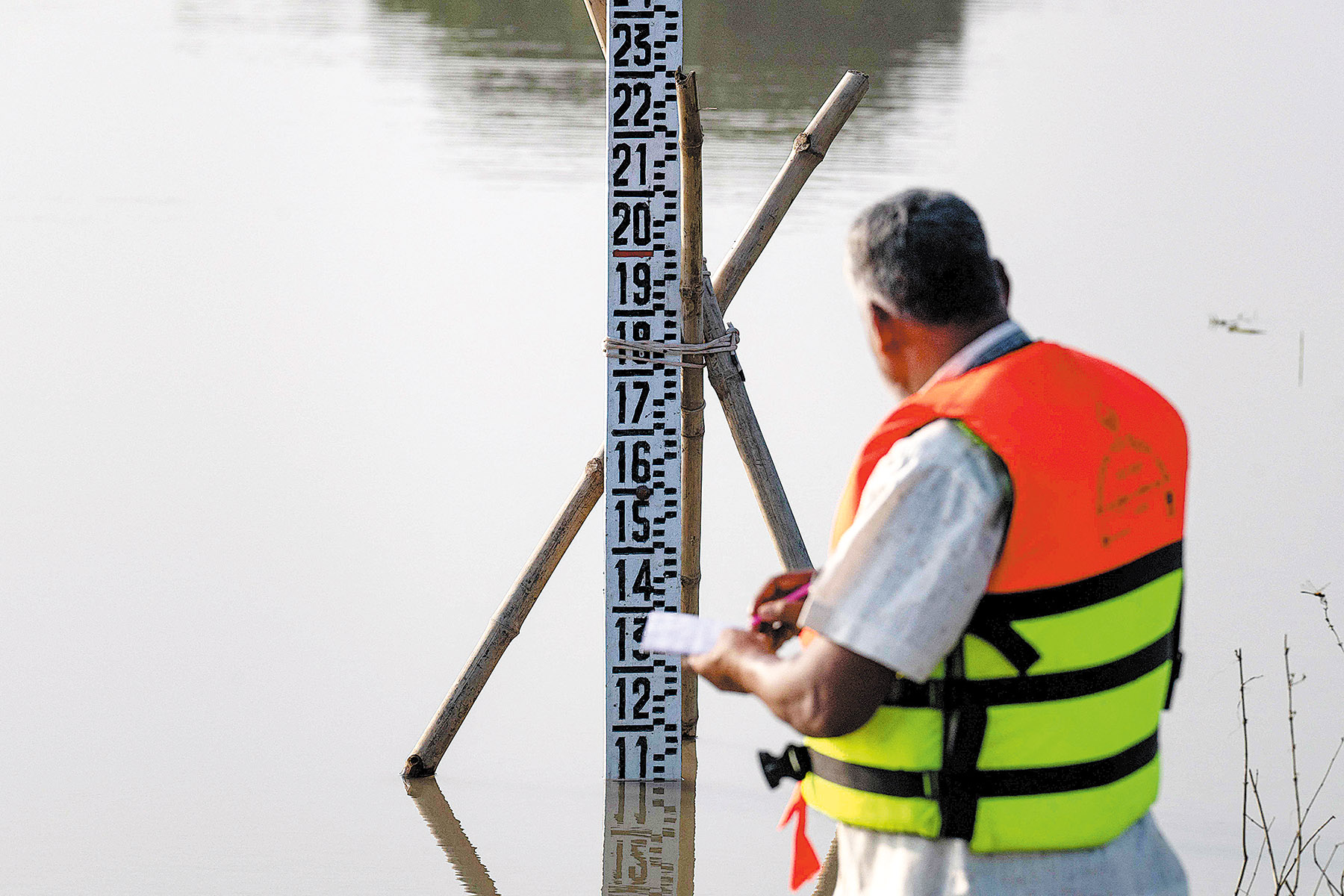
RAJSHAHI, Bangladesh — With a 30-year Ganges water-sharing treaty with India expiring in December, Bangladesh fears failure to strike a new deal could deepen water shortages, threatening tens of millions of livelihoods.
In Bangladesh's parched Barind region, 72-year-old Bikash Soren remembers when the Ganges River flowing in from neighboring India carried large boats past his village year-round.
"For almost three months a year, you hardly see the river flowing," the Protestant priest said.
Two farmers killed themselves last season, he said, after dwindling water levels left their rice and wheat crops in tatters.
Shrinking flows in the Ganges have also slashed fish catches in the river, known in Bangladesh as the Padma.
"Where will we find fish now?" said Abu Bakar Siddique, 55, who has switched to fish farming in ponds.
"I used to catch many kinds."
The 2,525-kilometer Ganges flows through the world's most populous river basin, home to 655 million people including more than 50 million in Bangladesh, according to the World Bank.
The 1996 treaty, which expires on Dec 12, governs dry-season water sharing at India's Farakka Barrage, 20 kilometers upstream of Bangladesh.
But Bangladesh needs a new deal based on "mutual benefit and respect", Rashed Al Mahmud Titumir, a prime ministerial adviser who heads a technical committee on water-sharing, told AFP.
Water arguments over 54 cross-border rivers between India and Bangladesh stretch back decades, and the Ganges is among the most important.
New Delhi's foreign ministry said that "discussions regarding river-related matters" are a matter for the Joint River Commission, or JRC, which held its last technical talks back in May.
The last officially confirmed ministerial-level JRC meeting was in 2022 — after a 12-year gap.
And a proposed water-sharing deal for the cross-border Teesta River has been stalled since 2011.
Relations between New Delhi and Dhaka have soured since Bangladesh's former leader Sheikh Hasina fled to India, where she remains, following the 2024 nationwide political chaos.
Arguments date back to 1975, when India opened the 2.2-kilometer long Farakka Barrage. Bangladesh accused India of diverting most of the water.
The United Nations intervened in the dispute and a deal was agreed in 1977.
Severe consequences
But water-sharing arrangements lapsed a decade later, bringing severe consequences, said Sheikh Rokon of Dhaka-based environmental group Riverine People.
"The Ganges suffered during the years without a treaty, and at least three rivers almost dried up," Rokon said.
One was the Gorai, which carries freshwater into the Sundarbans, the world's largest mangrove forest and a World Heritage site, helping limit saltwater intrusion as sea levels rise.
Bangladesh's Ganges-Kobadak Irrigation Project, designed to water 955 square kilometers of farmland, the country's largest, "became inoperative because of water scarcity", Rokon said.
In May, Dhaka approved the Padma Barrage, a project intended to ease shortages and include a 113-megawatt hydropower plant.
The 1996 treaty has no automatic extension clause.
"If we fail to reach a deal, I fear the situation will be worse than what we experienced during the years without a treaty," Rokon said.
"Demand for freshwater on both sides has increased significantly."
Even with the treaty in place, the Ganges-Kobadak project has shrunk to 550 square kilometers, according to Bangladeshi state news agency BSS.
"If the river does not carry enough water, the consequences could be disastrous," said Chowdhury Sarwar Jahan, a geology professor at Bangladesh's Rajshahi University.
Bangladesh's agriculture-dependent economy is already reeling from the impact of climate change, which compounds shifting river flows, alternating dry-season shortages and intense monsoon floods washing away farmland and villages.
In Chapainawabganj District, the river has widened by 3 kilometers in recent years — nearly doubling its size — according to Bangladesh Water Development Board.
Rehana Khatun, 50, described the "howling sound" as floods destroyed her home in Fielder Bazar village.
"The river turned wild and started swallowing everything along the bank," said Khatun, who now lives in a bamboo shelter.
"And the trauma stays with children long after the waters recede."
