

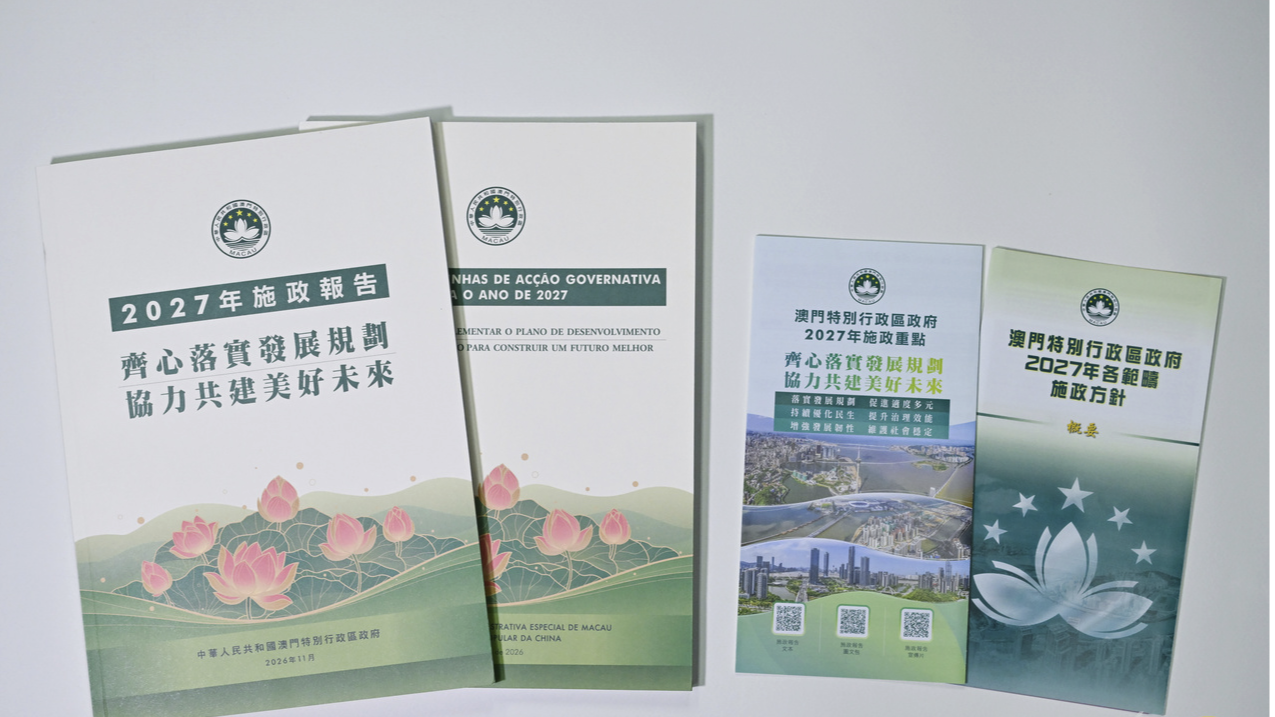
Macao will accelerate the construction next year of a university campus and an aviation cargo facility, and start a high-speed railway project in the Guangdong-Macao In-Depth Cooperation Zone in Hengqin, Chief Executive Sam Hou-fai announced on Monday in his Policy Address.
The city will also refine a child-raising subsidy program, introducing a tiered system for eligible families with children under 3.
Delivering the third Policy Address of his term at the Legislative Assembly, Sam said the coming year is “critical” to advancing high-quality development and carrying out the city’s third local five-year plan (2026-30).
The chief executive said the special administrative region government’s main goals for 2027 are to bolster the city’s development resilience while safeguarding social stability; support steady growth with economic diversification; improve livelihoods; and better integrate into and serve the nation’s overall development.
Sam said he wants to strengthen coordination between higher and lower administrative levels and pledged greater efforts to promote all the work in the 106-square-kilometer Hengqin cooperation zone. Located on an island west of Taipa, the zone links Macao with the Chinese mainland and has emerged as a key platform for the SAR’s diversification efforts.
Macao authorities will fast-track major infrastructure construction in the zone, including the topping out of the University of Macau’s Hengqin campus, a cargo-handling facility for Macau International Airport, and the Hengqin section of the Guangzhou-Zhuhai high-speed railway, he said.
To better support families with newborns, the SAR government will increase the birth allowance from 6,500 ($804) to 8,000 patacas, with both eligible parents able to apply simultaneously. Next year, subsidies for permanent-resident toddlers under 3 will continue under a new tiered structure: 18,000 patacas a year for the first child, 27,000 patacas for the second and 36,000 patacas for the third.
The city’s long-standing wealth-sharing program will also continue, with 10,000 patacas for each eligible permanent resident and 6,000 patacas for eligible nonpermanent residents. The Policy Address also sustains subsidies for older adults, underprovided families, students and teachers, as well as tax reductions for employees and enterprises.
Sam pledged to accelerate the “1+4” economic diversification strategy: to strengthen Macao as a world center of tourism and leisure; expand traditional Chinese medicine and health industries; nurture specialized finance and promote locally suited high-tech sectors; improve the quality of conventions, exhibitions and trade activities; sustain growth in culture and sports; and help traditional industries upgrade.
He also promised to foster a more favorable business environment and position Macao as a global talent hub, with an emphasis on training Chinese-Portuguese bilingual professionals and specialists in culture and medicine.
Sam acknowledged that Macao will continue to grapple with deep-seated problems in 2027, including limited economic diversification, a recovery that needs strengthening, and persistently high spending commitments.
“All this requires us to remain highly vigilant against risks and potential crises and strengthen the Macao SAR’s ability to withstand internal and external risks and achieve more sustainable development,” he said.
Speaking to reporters shortly after his address, Sam said the Policy Address set to advance 116 of the blueprint’s 118 key projects, 286 of its 310 priority tasks, and 109 of its 112 reform initiatives in 2027.
Beyond speeding up infrastructure development in Macao, he said priority would also be given to regulatory alignment between the SAR and Hengqin, with the Macao-Hengqin International Education (University) Town and the air cargo facility identified as pioneer projects during this term.
On incentives for childbirth and childrearing, Sam said he hopes future discussions would explore whether nurseries and private clinics could work more closely together to better support families raising children.
“We hope the whole community will work together to create an environment that encourages childbirth and supports parents in raising their children,” he said.
Contact the writers at wanqing@chinadailyhk.com
