

China's energy sector investment is maintaining a steady pace while accelerating its structural transition toward high-quality and green development, as the country's installed solar power capacity historically overtakes coal to become its largest single power source, government officials said on Friday.
During the first three quarters of the year, investment in the country's key energy projects remained generally stable with a clear trend toward new and green technologies, Xing Yiteng, deputy director of the development planning department at the National Energy Administration, said during a news conference in Beijing.
Investments in new-type power grids, energy storage, and electric vehicle charging and swapping infrastructure surged by 15.3 percent year-on-year. Furthermore, investment in the hydrogen sector maintained high-speed growth, doubling the figure at the same period last year, Xing said.
He also highlighted the robust participation of private enterprises, which contributed over 145 billion yuan ($21.8 billion) to the energy sector from January to September.
The green transition of China's power supply structure is achieving historic milestones. As of the end of September, the nation's cumulative installed capacity of renewable energy had reached 2.52 billion kilowatts, accounting for nearly 61 percent of the country's total, said Gui Xiaoyang, deputy director of the NEA's new and renewable energy department.
Notably, solar power capacity has historically surpassed coal power to become the largest power source in the country, Gui said.
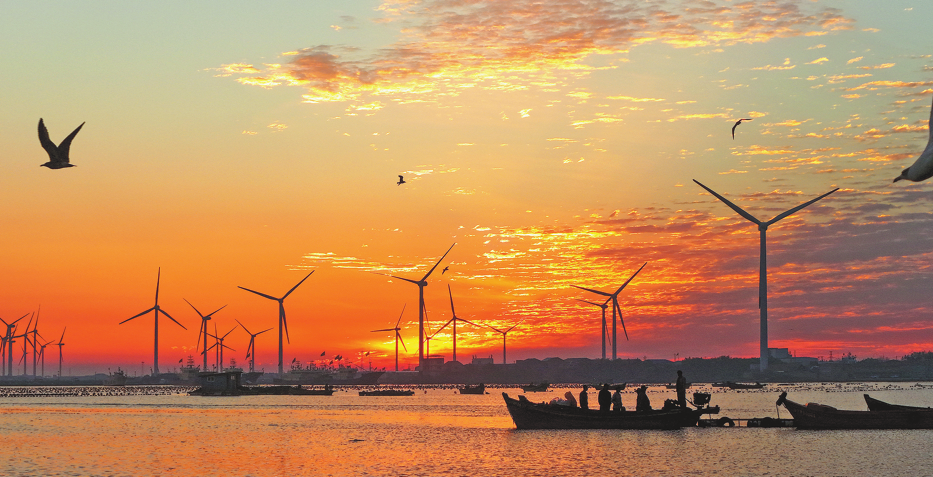
Wind and solar power combined now exceed 2.01 billion kW, representing nearly half of the national total.
Looking ahead, the green momentum is expected to persist.
During the first three quarters, national electricity consumption reached 8.07 trillion kilowatt-hours, an increase of 3.9 percent year-on-year, ensuring the safe and stable operation of a balancing power system, said the China Electricity Council.
Total electricity consumption for 2026 is projected to reach approximately 10.8 trillion kWh, up 4 to 4.5 percent year-on-year. Jiang Debin, deputy director of the CEC's statistics and data center, estimated that China will add over 350 million kW of new generating capacity in 2026.
By the end of 2026, the country's total installed capacity is expected to reach 4.3 billion kW, with nonfossil fuel sources accounting for 63 percent. Wind and solar power will make up half of the total capacity, while the share of coal will decline to about 31 percent, Jiang noted.
The rapid development of artificial intelligence is also creating new paradigms for electricity demand. Tan Hongjiang, deputy director of the NEA's power department, projected that AI-driven computing power will drive substantial electricity consumption in the coming years.
During the 15th Five-Year Plan period (2026-30), electricity used for computing is expected to grow by over 100 billion kWh annually, reaching 800 billion kWh by 2030, or roughly 6 percent of total societal power consumption, Tan said.
To address this, the NEA will promote the synergy between computing networks and new power systems. The administration aims to advance direct green power supply models for computing facilities, guiding local governments and enterprises to implement tailored pilot projects.
Contact the writer at zhengxin@chinadaily.com.cn
