

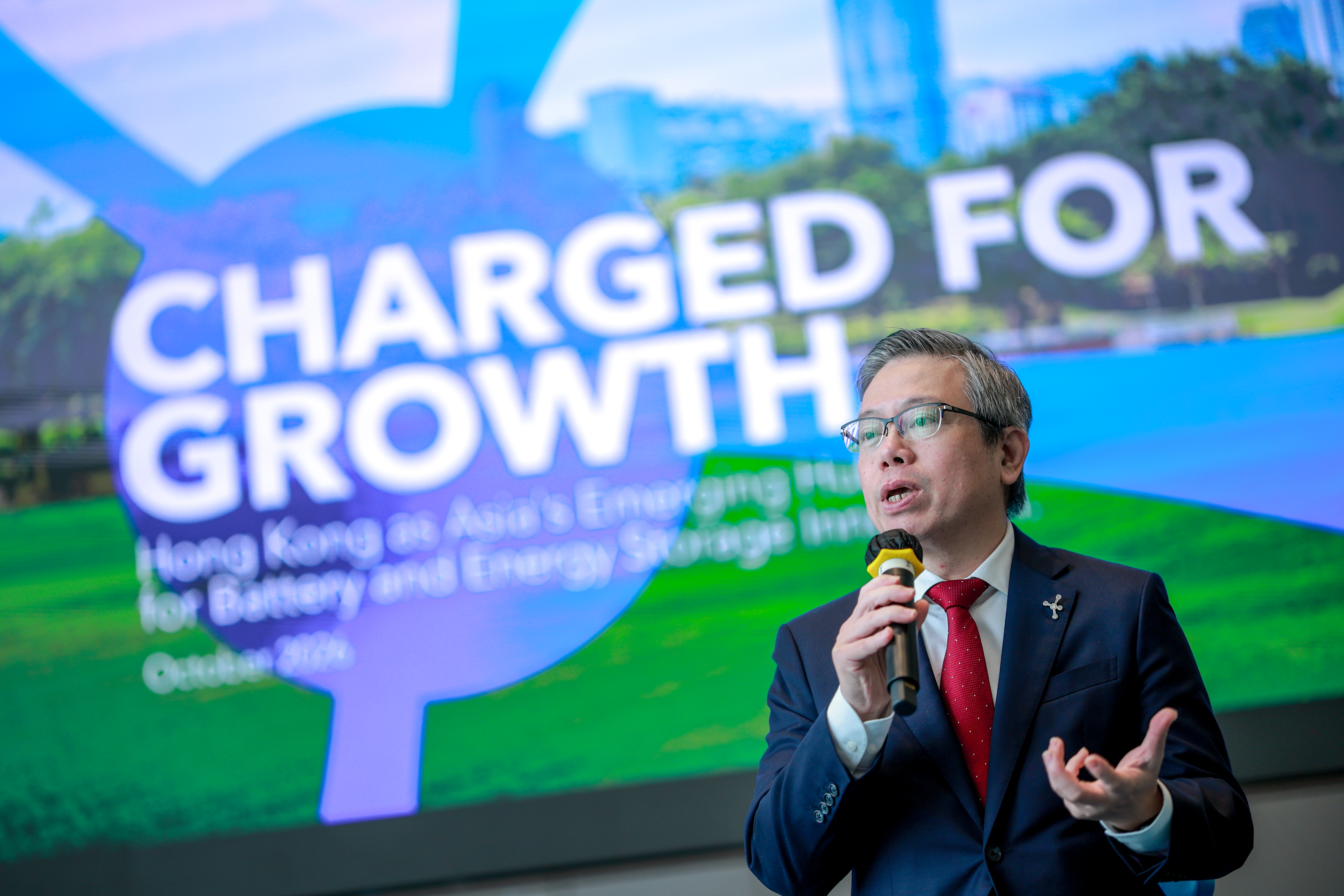
Fueled by extreme weather events and the soaring energy demands from the rise of artificial intelligence, the global shift toward renewable energy has reached a critical juncture, unlocking vast market potential for battery and energy storage (BES) technology. Industry research reflects the growing trend: Annual global energy storage deployments reached a new record in 2025, surging 23 percent year-on-year with green energy as the primary driver.
At the forefront of the trend, Hong Kong Science and Technology Parks Corp (HKSTP) is positioning green technology as a core strategic pillar, building a comprehensive ecosystem where innovative ideas translate into real-world applications.
Hong Kong’s comprehensive four-stage BES value chain
This momentum is highlighted in HKSTP’s newly published Strategic Analysis Report on BES, which underscores Hong Kong’s unique edge as the leading market in Asia integrating all four stages of the BES value chain: Frontier R&D, Scenario Application, Capital Access, and Sustainable Recycling.
The paper notes that driven by HKSTP’s infrastructure and Hong Kong’s five global top 100 universities, the city is equipped with research capability in next-generation battery and new materials, turning academic excellence into commercial output. Hong Kong is also embedded with multiple BES application scenarios to facilitate integration of green energy technology — from grid-scale energy storage to green mobility and electric vehicle (EV) charging facilities.
Hong Kong’s premier financing ecosystem presents a compelling advantage by seamlessly bridging the gap between deep-tech ventures and global capital markets. Meanwhile, official data projects end-of-life EV battery volumes in Hong Kong to reach nearly 6,700 tonnes in 2030, so we urgently need to strike a critical balance between the rapid expansion of bioenergy systems and long-term ecological protection.
Homegrown tech completes the loop
A prominent innovator within HKSTP’s ecosystem that perfectly displays the power of Hong Kong’s four-stage value chain — especially in closing the circular economy loop through battery recycling — is Green, Renewable, Sustainable Technology (GRST), a homegrown company transforming the global lithium-ion battery industry.
Conventional lithium-ion batteries rely on per- and polyfluoroalkyl substances (PFAS) as binders in electrodes. These nondegradable “forever chemicals” pose severe environmental and health risks while complicating battery recycling. With the worldwide transition to electric vehicles, sustainable battery management has become of paramount importance. Following years of dedicated research and development anchored within HKSTP’s ecosystem, GRST engineered a patented, non-PFAS, water-soluble binding technology that serves as a seamless “drop-in” solution — matching conventional battery specifications and cost without major modifications.
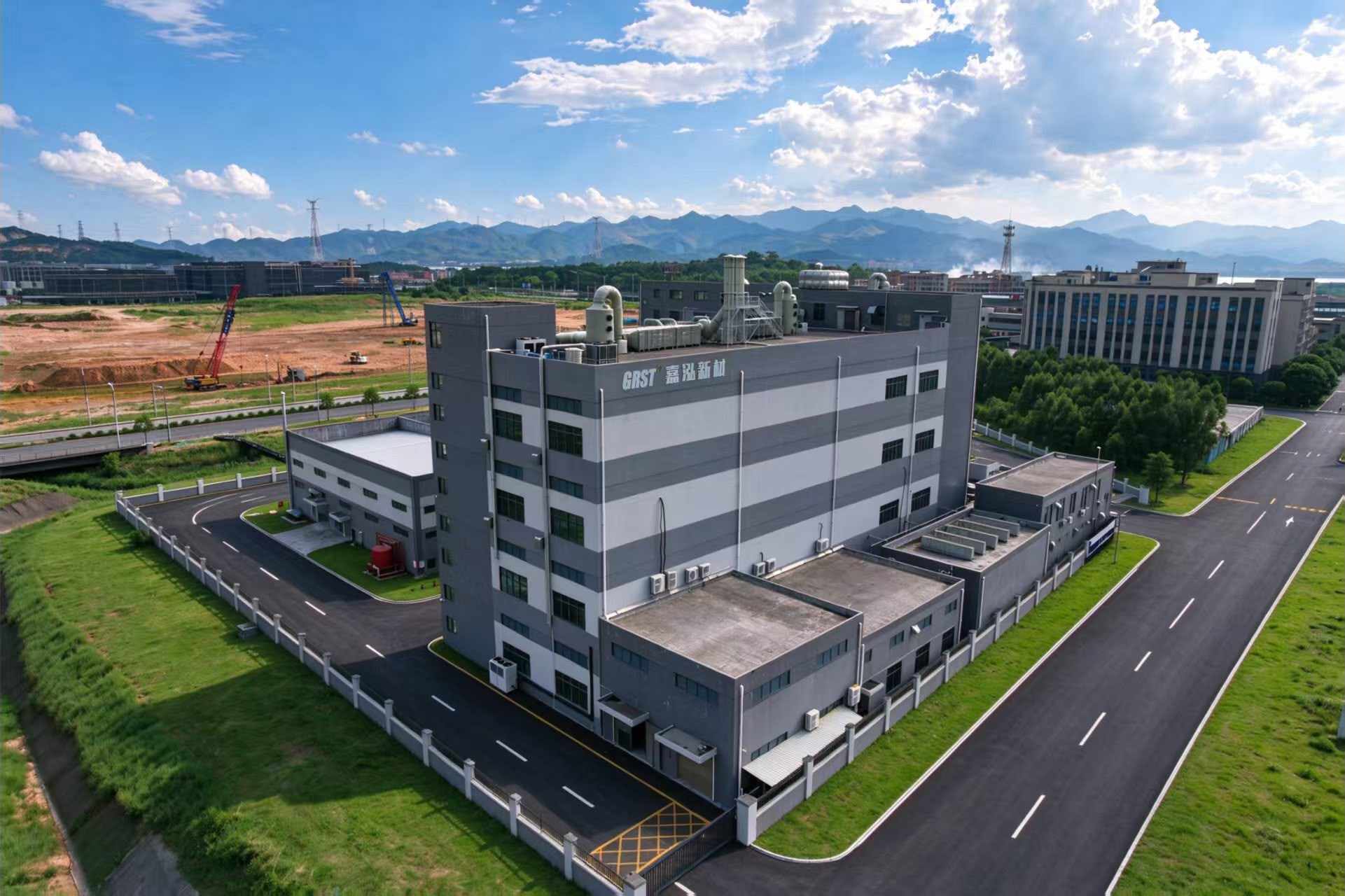
GRST recently established a chemical plant for battery binder in Jiangmen, Guangdong province, harnessing the manufacturing strength in the region.
Bill Ho, GRST’s co-founder and CEO, notes that Hong Kong played an indispensable role as the company’s research team launched the research and development (R&D) undertaking in the city. Extending its network within the Guangdong-Hong Kong-Macao Greater Bay Area, GRST recently established a chemical plant for battery binder in Jiangmen, Guangdong province, harnessing the manufacturing strength in the region, Ho revealed. Beyond these R&D breakthroughs, he attributes the company’s growth to Hong Kong’s robust innovation and technology framework and HKSTP’s comprehensive support — spanning rental aid, financial backing, intellectual property protection, and marketing.
Crucially, by simplifying electrode separation without toxic chemicals, GRST’s technology directly addresses the recycling phase of the BES value chain. GRST leverages its proprietary solutions to minimize environmental impact, striking a crucial balance between rapid BES expansion and long-term ecological protection.
Asian ingenuity meets global market requirements
Beyond nurturing homegrown startups, HKSTP serves as a strategic springboard for global industry leaders expanding internationally. Within its ecosystem stands another pioneering enterprise, Gotion, a leading provider of new energy batteries and green solutions. Gotion Hong Kong serves as the group’s Asia-Pacific marketing center and operations management center.
“Through our presence at Hong Kong Science Park, we are shaping a dynamic ecosystem for next-generation battery technologies, where R&D excellence meets real-world market access,” says the vice-general manager of Gotion High-Tech (HK) Ltd.
Gotion boasts its closed-loop value chain, spanning frontier R&D, technology commercialization, industrial implementation, and market operations. Through industry-university-research collaboration, Gotion advances new energy technology and scenario-based industrial validation with the Hong Kong Applied Science and Technology Research Institute and the Nano and Advanced Materials Institute. HKSTP has also assisted Gotion to identify local clean energy demands and application scenarios.
With ambitions for global expansion, Gotion has addressed trade requirements and established four regional bases across the Chinese mainland, the Asia Pacific, the Americas, and Europe-Africa, with plans to deploy 10 overseas facilities. “This unique positioning allows us to bridge Asian ingenuity with global industrial scale to drive clean energy adoption and advance smart mobility worldwide,” the representative adds.
Building Asia’s green energy engine
More than a cradle of emerging innovators, HKSTP’s ecosystem acts as a magnet for the world’s top 10 BES enterprises, among which are CATL, BYD and Gotion, with their bases at HKSTP to promote technology innovation.
To further unlock the city’s greentech potential, HKSTP marked another milestone by launching GreenTech Hub in Kowloon Tong InnoCentre, offering stage-specific resources to accelerate startups from initial concept to full commercialization.
The success of this ecosystem model is clearly demonstrated by the series of world-first breakthroughs developed by Park companies to address critical global challenges. Luquos Energy’s commercial sulfur-based flow battery for safe, long-duration storage Halo Energy’s partnership with XPENG to roll out 1MW ultrafast flash charging — proving Hong Kong’s strength as an ideal testbed for clean-tech innovation.
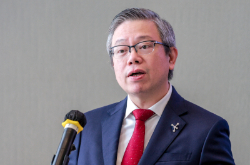
“Through HKSTP’s GreenTech Hub, we are bridging the critical gap between frontier research and real-world deployment,” said Terry Wong, CEO of HKSTP.
Reinforcing this mission, HKSTP is targeting 40 percent growth to expand its ecosystem to over 350 green enterprises. “Hong Kong is not just participating in the global green transition. We are anchoring it by turning lab breakthroughs into bankable, scalable, and market-ready solutions for the world,” Wong concluded.
Innovation and Technology Special
