

JAKARTA – Once a familiar sight on Jakarta’s streets, becak (pedicab) has largely disappeared from the urban transportation landscape. Yet nearly a century after its arrival in the capital, the human-powered vehicle is getting a new lease on life elsewhere in the country, this time with an electric motor.
Becak began operating in Jakarta in 1936 and quickly became a major mode of public transport. By 1970, around 150,000 pedicabs were estimated to be operating in the capital, along with around 300,000 drivers working in two shifts, according to historical records cited by Antara.
This once ubiquitous three-wheelers were increasingly blamed for the city’s congestion and criticized as outdated for their reliance on human power. In 1970, governor Ali Sadikin banned the production of new becak and their entry to Jakarta.
The following year, the city restricted them from major roads, then a 1972 regulation classified becak alongside oplet, a type of public minivan, as forms of transport unsuitable for the capital.
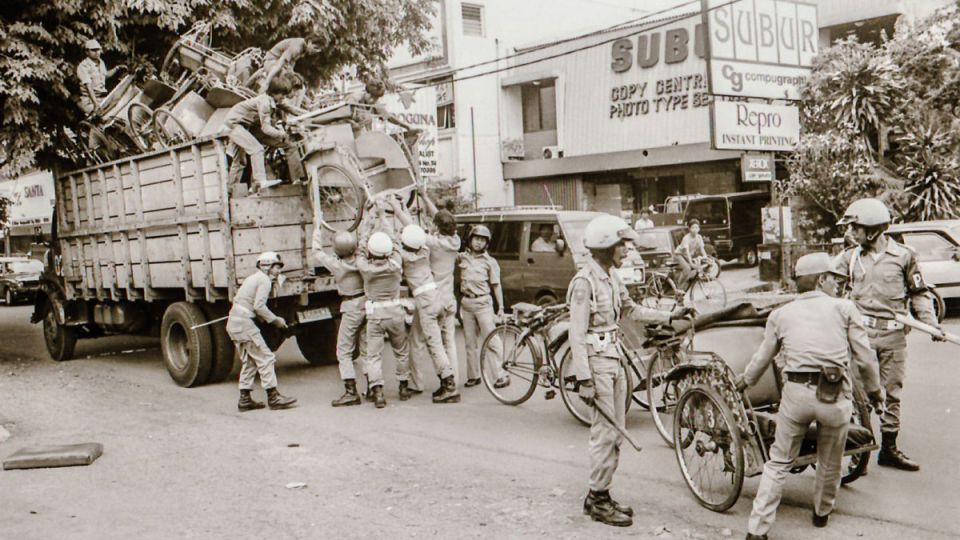
The crackdown continued under successive administrations. The City Council passed a total ban in 1988 and in April 1990, the Jakarta administration moved to remove becak altogether. On Oct 6, 1987, during a raid on Jl. Wolter Monginsidi in South Jakarta, officers seized and loaded pedicabs onto trucks as traffic whizzed by, seemingly oblivious to their removal.
During the 1997-1998 Asian financial crisis, governor Sutiyoso briefly relaxed the ban to help people affected by the economic downturn. Becak quickly returned to the city streets, but the reprieve lasted less than a week.
The issue resurfaced two decades later under governor Anies Baswedan, who proposed the revival of becak in 2018 as localized neighborhood transport, with special routes keeping them off major roads.
ALSO READ: Report: SE Asia economies set for 4.8% growth annually through 2035
The administration collected data on drivers, established waiting areas and mapped routes in several neighborhoods while exploring motorized and solar-powered versions. But the City Council rejected a regulatory change that would have allowed becak to operate in Jakarta again.
Today, the capital’s residents rely heavily on online transportation alongside mass transit services such as the Commuter Line, the Jakarta MRT and the Greater Jakarta LRT, as well as Transjakarta buses and public minivans. It is a far cry from the Jakarta of decades past, when becak were visible across the city, from narrow alleys to major thoroughfares.
Elsewhere, becak has been adapted rather than pushed aside. In Yogyakarta, the provincial administration has sought to phase out bentor (motorized pedicabs) and prepare 1,000 electric pedicabs as an alternative.
The transition gained a national push in 2025, when President Prabowo Subianto launched a program to replace conventional becak with electric versions, dubbed e-becak, particularly for elderly drivers. By November, the nonprofit Gerakan Solidaritas Nasional (National Solidarity Movement) announced it had distributed 2,303 electric pedicabs.
The program has continued this year with the distribution of e-becak in regencies across Java, including Tulungagung, Banyuwangi and Lamongan in East Java and Tasikmalaya and Bekasi in West Java. In September, 190 elderly becak drivers in Bekasi had received the vehicles.
For Jakarta, however, the becak remains largely a memory of a bygone time, when the iconic vehicle once crowded the streets before the city’s public transport veered down a different path.
