

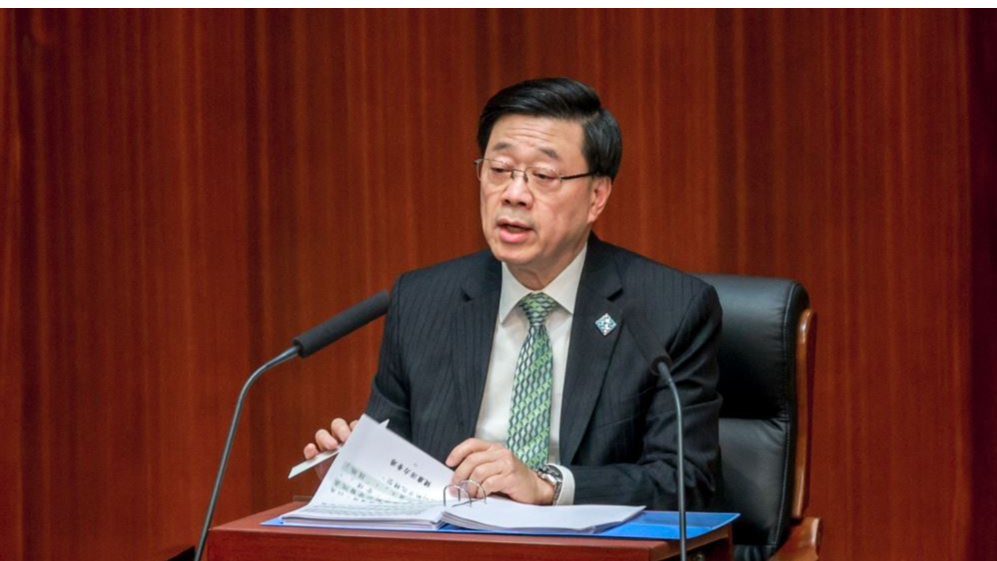
Chief Executive John Lee Ka-chiu is on Straight Talk this week to talk about the Hong Kong Special Administrative Region’s first five-year plan and his fifth Policy Address, both of which were just delivered last week.
Lee outlines the importance of having the right strategies in the five-year plan to go along with our country's Five-Year Plan, which is a planning process that focuses on the right process for the people to achieve the best outcome, rather than a planned economy that focuses on a target number, and the importance of implementation under the Policy Address.
Check out the full transcript of TVB’s Straight Talk host Eugene Chan Kin-keung’s interview with Chief Executive John Lee:
Chan: Good evening, and welcome to Straight Talk. I'm Eugene Chan, and we are joined by Chief Executive John Lee to discuss a historic blueprint for Hong Kong's future – the 2026 Policy Address along with our city's inaugural five-year plan. We will hear from CE on his strategic vision for a bright new era, how he plans to drive reform and boost development, as well as unleash opportunities for and enhance the livelihood of Hong Kong people. It is an honor to have you back, CE. Thank you for coming today.
Lee: Thank you, Eugene. Thank you for giving me the opportunity to talk to the English-speaking audience.
Chan: Right. CE, I have to congratulate you again. This is Hong Kong's first five-year plan, and your fifth Policy Address, and you have massive undertakings; true to your result-oriented approach, they are indeed comprehensive and have a lot of details. You have described the five-year plan as providing the long-term strategic direction, and the Policy Address focuses on implementation. Can you help our viewers to further understand how the five-year plan and the Policy Address are linked?
Lee: Well, I make a very conscious decision to release the two documents together, exactly for the purpose of letting people know how the two work together. Because if I separate the publication of these two documents, particularly the first five-year plan for Hong Kong is very new for everybody, so people will have a lot of questions in mind. And, "Well, I've seen it now, and then what?" The what is answered by the first Policy Address …
Chan: I see.
Lee: ... which was released at the time when the five-year plan was first rolled out, despite the fact that it is my fifth Policy Address. But here's a difference from previous Policy Addresses, because its meaning is very significant. It is the first government report on how the five-year plan will be implemented, so people will know after the first year, there will be a second year, which will equally implement the directions and the policies of the five-year plan in this way. So, very vividly, they know how they work together. That is the reason. And more importantly, what the five-year plan is aiming to do. I think that is important.
Chan: Right.
Lee: It's aiming to let people know about what will happen as a blueprint and where the directions are heading, but more importantly, to tell people about the opportunities, to tell people what good things in five years the plan will bring to them. So, it talks about how we will develop our economy with the goal of ensuring that we'll enhance our livelihood. I have said repeatedly, the purpose of any government is to raise the living standard of the people.
Chan: Right.
Lee: Raising the livelihood standard is a continuous process, which I always describe as there's never the best, only the better. But how do we do it? We need resources to improve people's livelihoods. That's why we need to work on developing the economy. But to develop the economy, you need methods, and you need some strategic directions. So, the five-year plan tells everybody ... In summary, it says that we will capitalize on the strength of “one country, two systems”, which means that we can integrate and capitalize on the country's development, which I think is amongst the global opportunities the strongest, most certain and everybody agrees with.
So, capitalizing on our country's development is one area we can really develop ourselves even more strongly. The other area is to ensure that our international connection is further enhanced.
Chan: Right.
Lee: So, it is to really capitalize on the “one country, two systems” principle, which gives Hong Kong ... there's a very special advantage of being fully integrated with our country's development and at the same time, fully connected to the international world.
Chan: Right.
Lee: So, in simple terms, we have the best of both worlds.
Chan: Right. CE, thank you for setting out very clearly how we link together. But what will be your highlights that you think you would share with our viewers? Because you have spent three hours talking about a lot of details. What are the main points that we must remember?
Lee: I know the challenges that everybody's facing, because it's new, and also the number of words in the five-year plan is almost 60,000. So, indeed, we have produced two highlights for members of the public. One for the five-year plan, right? And one for the Policy Address. So, these two documents actually give the highlights, as you have asked me to do.
Chan: Right.
Lee: This five-year plan tells you about the principles we will uphold while we draw up this five-year plan. These principles are all the main principles under “one country, two systems.” In other words, whatever we do with and without this five-year plan, our way of living, our freedom, our political framework, such as capitalism, the common law system, our own currency, free flow of people, capital, data, goods – they are all there. And the international-ness of Hong Kong is also there, and Hong Kong, being a special administrative region, will be able to capitalize, enjoy all the favorable policies of our country with all there. So, that is, you can say, a good layout of the key points.
But what is also important is what we achieve at the end of the day after five years. It says here, first of all, livelihood will be further enhanced, which, I have explained, is a continuous process. And of course, these include eight areas, as described in the five-year plan. But in my Policy Address, I've added something other than eight areas, which is city management.
Chan: Right.
Lee: Because, I think, such as water pipes, electricity supply, and also how we handle all these threats of extreme weather – this is part of livelihood. And I have really expanded the whole coverage on livelihood in my Policy Address, and it's also the longest and the biggest chapter.
Chan: Right. CE, when you talk about the five-year plan, I'm sure people will understand why we need a plan, because without a plan, nothing will happen. But we only just had the national 15th Five-Year Plan in March this year. Why do we need a plan for Hong Kong, and why now?
Lee: Well, first of all, since we all agree opportunities that will be generated by our country's development is every city, every country is looking at seriously. Because we have this super-sized market of China. This consumer market is big. Our country's technological advancement, everybody recognized. Our country's diversified industry is something I think we need to learn about. And also, the fast pace of development around us in all of China is something I think we should really try to appreciate, experience. It's a competitive world. So, when this vast amount of opportunities that are presented in the country's 15th Five-Year Plan was announced in March, then of course I need to capitalize it as soon as possible.
And we want to actively align with it so that we enjoy these opportunities ASAP. We shouldn't wait. And also, the world is changing fast, so we must know how to reform to ensure that we can, well, take on the challenges of the fast changes around us, such as there may be conflicts all of a sudden, another trade war, tariff war, and, well, we experienced COVID. All these things can happen all of a sudden. So, we need to reform to strengthen ourselves. That's why I don't wait.
But why really should all of us don't wait? Because everybody is going fast now. With technology developing so fast, particularly AI, we are all watching AI very seriously. While we benefit a lot from AI's development, we're also watching the extraordinary fast pace of its development. So, we have to be fast as well. That is why now.
Chan: Good.
Lee: Waste no more time so as to enjoy all the possible opportunities, capitalize them so as to benefit our people.
Chan: All right. Thank you, CE. Let's take a short break now. We'll be back with more Straight Talk.
Chan: Welcome back, viewers. Hong Kong chief executive, John Lee, is with us, sharing with us some of the highlights from both our city's first five-year plan and his fifth Policy Address. So, CE, thank you very much in the first half laying out the groundwork, the principle behind and how they are linked, and why is it necessary right now as we want to waste no more time, we want a better livelihood for Hong Kong people. Let's move on to another area I'm sure many people want to know, is that although we know that the plan emphasizes alignment with the national 15th Five-Year Plan while promising to preserve Hong Kong's international character, how can you address concerns from international investors, saying that this is no longer with the Hong Kong … the pride of traditional, entrepreneurship, dynamism, compared to what we call a planned economy?
Lee: Well, people, if they watch the development of the five-year plan process in the mainland, they know they have changed the Chinese wording to, from Jihua to Guihua, which means, I think the best possible English translation I can use is, rather than a planned output, it is a planning process …
Chan: Okay.
Lee: … that I think the five-year plan is talking about. In China's development of the Five-Year Plan, they have done about 10 planned output plans … 10 exercises of 10 output plans. And then from the 11th exercise, it is changed from a planned output to a planning process. That is the best, I think, English translation I can use. But the Chinese word has a very clear, different meaning.
Chan: Right.
Lee: What does it mean? I'll give you some example, right? A planned economy probably asks you to produce, say a million bottles. That is a planned output process. But the planning process now, our country's Five-Year Plan is talking about, is telling you to produce sufficient number for your population. So, it is up to you, the market, and other enterprises, to design whether you design only one kind of bottle, or you can design the big size, small size, a luxury brand bottle …
Chan: I see.
Lee: ... or just a very basic type of bottle. So, it is this kind of planning process, and this is kind of a five-year plan we're talking about. So, it is a planning process which is important. In simple terms, is it draws a blueprint, and you can make use of the best way to achieve …
Chan: I see.
Lee: ... the blueprint. It's like producing a film. You can have a theme for the film, but you can write your script; you can write your own story. You choose your actors. But at the end of the day, I want this theme to talk about, say, Chinese culture. I want your film to talk about, say, well, how we end up with the result of say one dynasty. So, it's up to you. You pick. You can do it your way. And it's an organic process as well because we talk about market forces. So, the five-year plan, whether it is a mainland city's five-year plan or Hong Kong's five-year plan, it is an organic process in which you can make adjustment. And that is exactly the big difference from a planned economy. And there is a strong emphasis of market being a very productive force, being a very lively and vivid force for good. So, the market and the government are working together to ensure the best interest is achieved. And I think it works very well for Hong Kong because we have said that capitalism will be maintained, but at the same time, capitalism has its defect sometimes because capitalism talks about trying to gain the maximum return on investment. So, some underprivileged people …
Chan: True
Lee: ... may fall out of their radar screen. So, it is up to the government ensure that, okay, minority interests will be taken care of. I have given the example previously. If you talk about laying some fiber for communication, if I'm a company, of course, I lay the fiber to the most populous area, not to a remote village. So, that is capitalism. But then the government will have to do something and ensure that while those underprivileged should be taken care of, well, this is just one simple example. Another example, which is important, is how we distribute resources.
Chan: Right.
Lee: Well, we have tax; we have collected fees from different operations, but it's your money. It's people's money. It's not the government's money. The government actually works for the people to take care of this money, and we re-distribute them in the interest of the overall community.
Chan: Right.
Lee: So, public interest takes precedence, and that is what an effective government is all about. An effective government combining with an efficient market means we have the best outcome to serve the overall interest, not just individual enterprises' interests, which is important. We give them a good environment to operate so that they can maximize return. But at the same time, not at the expense of some people's need also basic requirements.
Chan: Right. See, I think what ... Since listening to you, it makes things much clearer, and I like very much the comment you made in the first part saying that we have the best part of both worlds. So, with this certainty, that means the international community should be even more, have more confidence to invest in Hong Kong because they know that we have a planning process that will be amended or bettered due to the situation.
Lee: Your comment just echoes the feedback I have received from a lot of international investors. They are very glad to see the five-year plan published because it gives a very clear blueprint of what Hong Kong will become, where we are heading, and where the opportunities are, so they can do their calculations. For investors, they are most concerned about certainty, because with certainty, they know how to ensure that their investment gets a return. One other thing they are very concerned about is opportunities, and now this five-year plan tells them that Hong Kong is the place where they can have three areas of opportunities that converge in one single city.
Chan: Right.
Lee: That's Hong Kong's opportunities. Our country's opportunities and international opportunities.
Chan: Right.
Lee: And Hong Kong is the only place in the world under “one country, two systems”, we can have all these opportunities and advantages converging in this 1,100 square kilometers.
Chan: Right. CE, now, with your plan with the Northern Metropolis, with the talent scheme, and everything's going to work in a few years' time. But I think one area that I will ask you on behalf of a lot of viewers is a lot of young people, when they're having done going to good universities and studied abroad, coming back to Hong Kong, they're having some difficulties in getting a good start, like the times that we had before. What will the government do, and what does this blueprint tell them? Because with advanced AI, as you mentioned, we are facing new challenges. What would you tell the viewers what shall we do to prepare for this?
Lee: Well, I'm doing both near-term, short-term and long-term strategies to help them. Well, near-term, right, I have already said that in the Policy Address, we’ll roll out a very new, this is also a very new plan of 30,000 new jobs and apprenticeships for 30,000 people. And that is something I will thank sincerely both my colleagues and also people in the commercial side, because the associations, the commercial association leaders, when we discussed, and also employers’ representatives when we discussed, I have heard this comment during one of my district forums where young people really feel a little bit apprehensive about finding jobs, particularly they are relatively inexperienced.
So, I went back and talked to my colleagues and, and I talked to those who have always been trying to do something for society, and very quickly everybody comes to agree, and agree with my proposal of creating a new scheme for jobs and also for apprenticeships. And so we have put together 30,000, about 10,000 is offered by the people in the commercial sector, and they are offering a minimum six months …
Chan: Right
Lee: ... and probably longer, new jobs. And they will be helping particularly those without work experience or very little working experience. And then also, on the construction side, we have also another 10,000 jobs with allowance, those so both for job and training of with at least HK$5,000 a month. And for the first sector which I talked about, is provided by the commercial sector, we provide about HK$6,000 for each job. And then we have an apprenticeship, which gives the maximum for that period, something to probably HK$11,000. So, altogether, we are trying to help people who are new to entering the market. But more importantly, I think in the long run or even midterm, is to create more industries.
Chan: Exactly, yeah.
Lee: Because jobs are created by enterprises. If you have more enterprises, more industries, there will be more jobs. And we have been working on this, and you can see that OASES, which an office set up to invite strategic, important companies to come to Hong Kong, they invited over 120 and they create a lot of jobs, good quality jobs. And so in the mid- and long-term, industry diversification and industry development are important, and they will create a lot of jobs, and good jobs as well, high-quality jobs, better-paid jobs. Northern Metropolis give us this opportunity. Northern Metropolis, when it was first proposed, it was principally a land and housing project. We have elevated it from a land and housing project to a project that will also involve education.
Chan: Right.
Lee: That's why we have university towns. We have also elevated to enhance industries and technology. What it means is that with Northern Metropolis redeveloped, and we are developing it fast, then we have more industries, which means more jobs. We have better technologies, which means better quality jobs. And we have better education. We have this university town. And all these will mean we have more talent coming.
Chan: Okay.
Lee: And more talents means our people will be expanding their network in the long run. They have even broader vision. So, they develop themselves even stronger.
Chan: Right. CE, that wraps up our interview today, and thank you so much for giving us a clearer picture of your vision for Hong Kong's future. As we have heard, this dual strategy outlines ambitious targets spanning innovation, demographic growth, and economic reform. And as our city advances from stability to prosperity, this blueprint is set to make the next five years a definitive turning point for Hong Kong. Thank you for watching Straight Talk. I'm Eugene Chan, and good night.
