

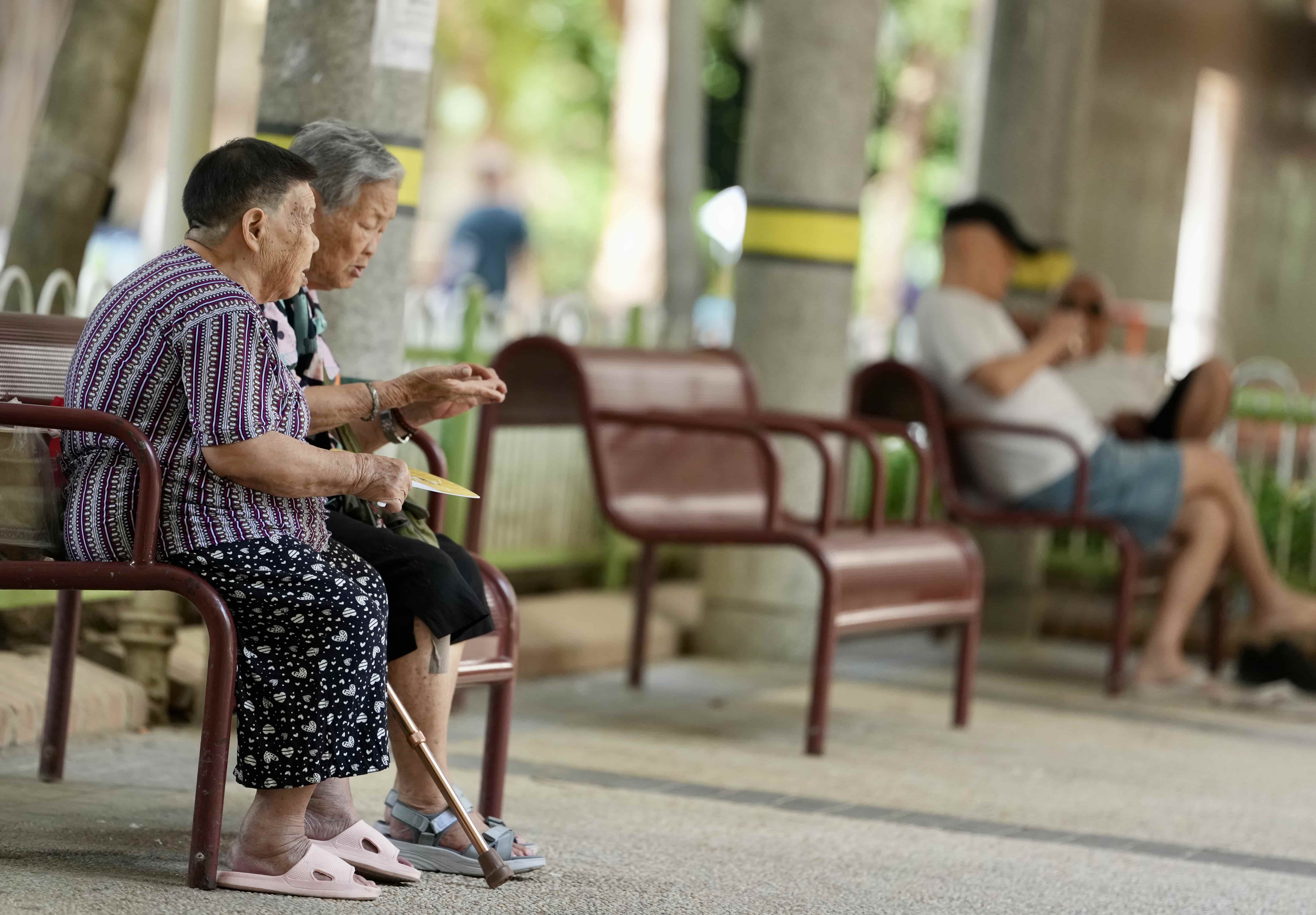
The Hong Kong Special Administrative Region government on Friday released a report on addressing the city’s aging population, proposing 73 measures across 11 areas, covering medical services, residential care, age-friendly technology, and cross-boundary eldercare.
Many of the principles and initiatives outlined in the report are already included in the city’s inaugural five-year plan and the latest Policy Address, delivered by Chief Executive John Lee Ka-chiu on Wednesday.
At a news conference on Friday, officials said that the new measures and policies aim to better prepare the city for its aging population.
Deputy Chief Secretary for Administration Warner Cheuk Wing-hing said Hong Kong’s population that is aged 65 and above is expected to reach 2.74 million by 2046. That would be more than one-third of the total.
The report was compiled by the Working Group on Ageing Society Strategies, established under the 2025 Policy Address and led by Cheuk.
RELATED ARTICLES
- HK's 5-year plan, policy address aim to improve housing, help grassroots
- Policy Address boosts I&T, education, supports livelihoods, fertility
- HK’s five-year plan should ‘scale up’ grassroots facilities
Describing the city’s aging problem as “persistent” and “rapid”, Cheuk said the report recommends further enhancing the services of the Elderly Health Centres across all districts. The centers’ services will be integrated into the district health network, with the number of service points expected to exceed 100 by 2028.
The centers will offer comprehensive services, while improving referral mechanisms, Cheuk added.
The 2026 Policy Address pledged to double the centers’ service capacity for elderly health assessments and cut the maximum waiting time by two-thirds.
Cheuk also announced the addition of about 3,500 subsidized longterm care places for the elderly, provided by the Social Welfare Department, by the end of 2027.
Under the city’s first five-year plan, authorities aim to raise the total number of service places by 8,000, to around 77,500 by the end of 2030.
Secretary for Labour and Welfare Chris Sun Yuk-han introduced other supporting measures, including the “Wellness-on-Wheels” project, which will deploy mobile vehicles to provide home repairs, body checks, and habilitation training for elderly persons and their caregivers living in aged buildings.
The “Community Dining Hall” project will provide affordable and nutritious meals for residents in need, including older adults living alone and elderly couples, with the first pilot program to be launched in the Southern District, Sun said.
New measures include 2,000 additional vouchers for buying community care, 1,000 for residential-care services, and three new residential-care homes providing about 400 places.
To diversify options available to society, authorities will allow the entry of foreign caregivers with extensive eldercare experience, and extend government subsidies to more care homes based in the Chinese mainland cities of the Guangdong-Hong Kong-Macao Greater Bay Area.
Secretary for Health Lo Chungmau outlined healthcare reform measures to help Hong Kong cope with its aging population.
These include providing about 220,000 additional Hospital Authority Family Medicine Outpatient service quotas each year from next year, including around 10,000 evening outpatient quotas, to meet local demand.
He also said authorities aim to cut the waiting time for certain specialties by 10 percent in 2027-28 in the first phase.
Contact the writer at amberwu@chinadailyhk.com
