

Vast industrial base, dense supply chains boosting robot performance

Microduck, a robot duck that waddles, carries objects with its beak and skates on tiny wheels, has become an unlikely global AI hit. Priced at disarmingly $399, the gadget drew orders of as many as 10,000 units within days of its launch, with sales topping $2.6 million in the first 24 hours.
Interestingly, it was developed by French robotics developer Pollen Robotics, part of New York-based AI platform Hugging Face, but it runs on a chip from China's Rockchip, and is manufactured in China by Shenzhen, Guangdong province-based firm Seeed Studio, according to media reports.
Behind the toy-like duck is a much bigger technological shift. The global AI race is moving from models that generate words and images into embodied AI — robots that can perceive, reason and act in the physical world — and China is betting that its vast manufacturing base, dense supply chains and rapidly expanding robot fleet can give it an edge.
READ MORE: Robot on the line
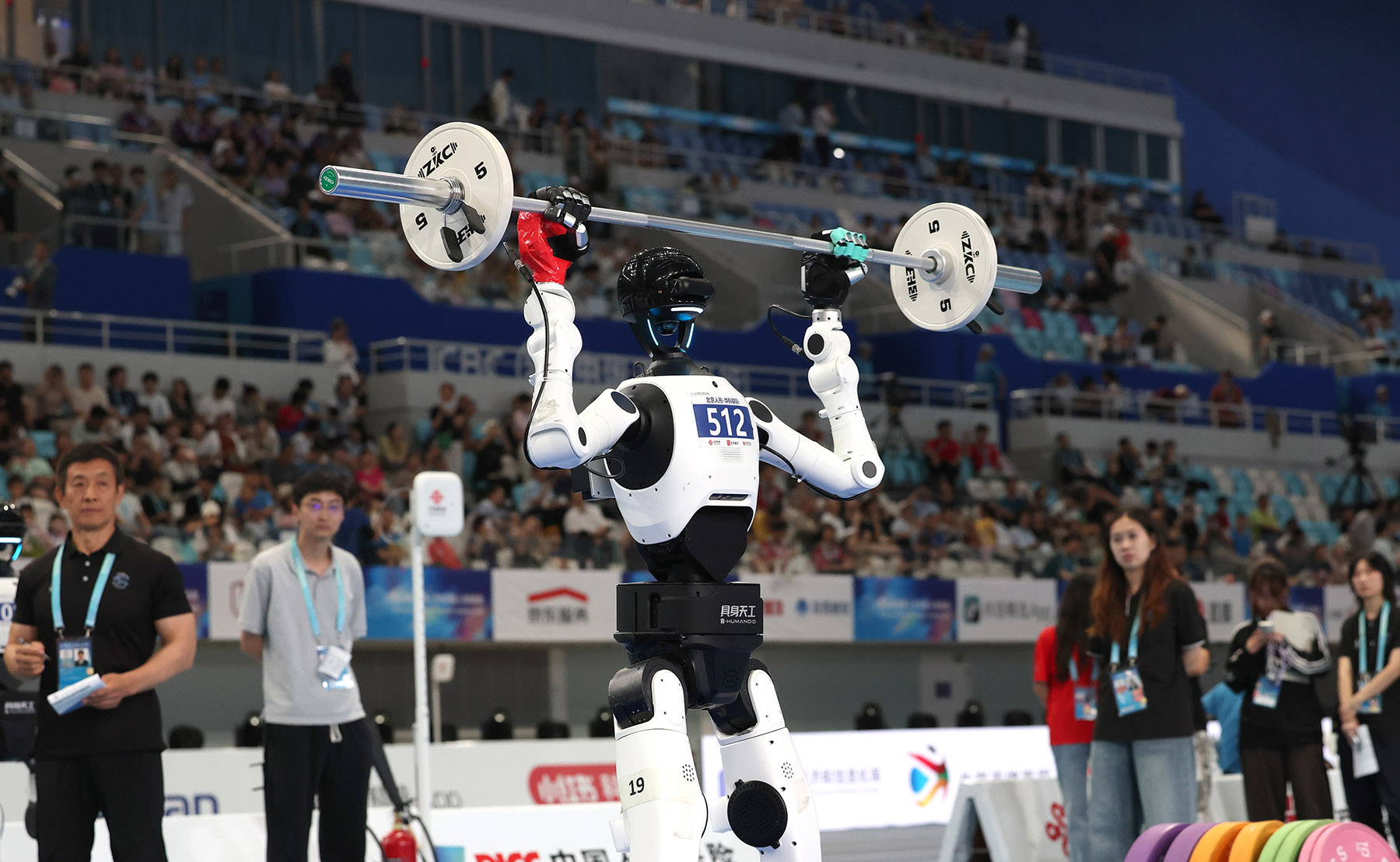
This transition was on vivid display across Beijing in August. At the 2026 World Robot Conference, 373 companies packed exhibition halls with more than 3,000 products, including 311 debuts. Days later, more than 2,000 robots descended on the World Humanoid Robot Games, where they sprinted, fought, danced and tackled tasks drawn from factories, homes and service industries.
Taken together, the events captured a Chinese robotics industry trying to make a crucial transition: from machines that look impressive on stage to machines that can earn their keep on factory floors.
For much of the generative-AI boom, the competitive scoreboard was relatively straightforward: advanced semiconductors, computing clusters, foundation models, data and developers.
Robots complicate that equation. A humanoid may need a sophisticated AI model, but it also needs motors, reducers, bearings, cameras, tactile sensors, batteries, power electronics, precision-machined joints and hands capable of manipulating objects.
All of those components must work together reliably, repeatedly and cheaply.
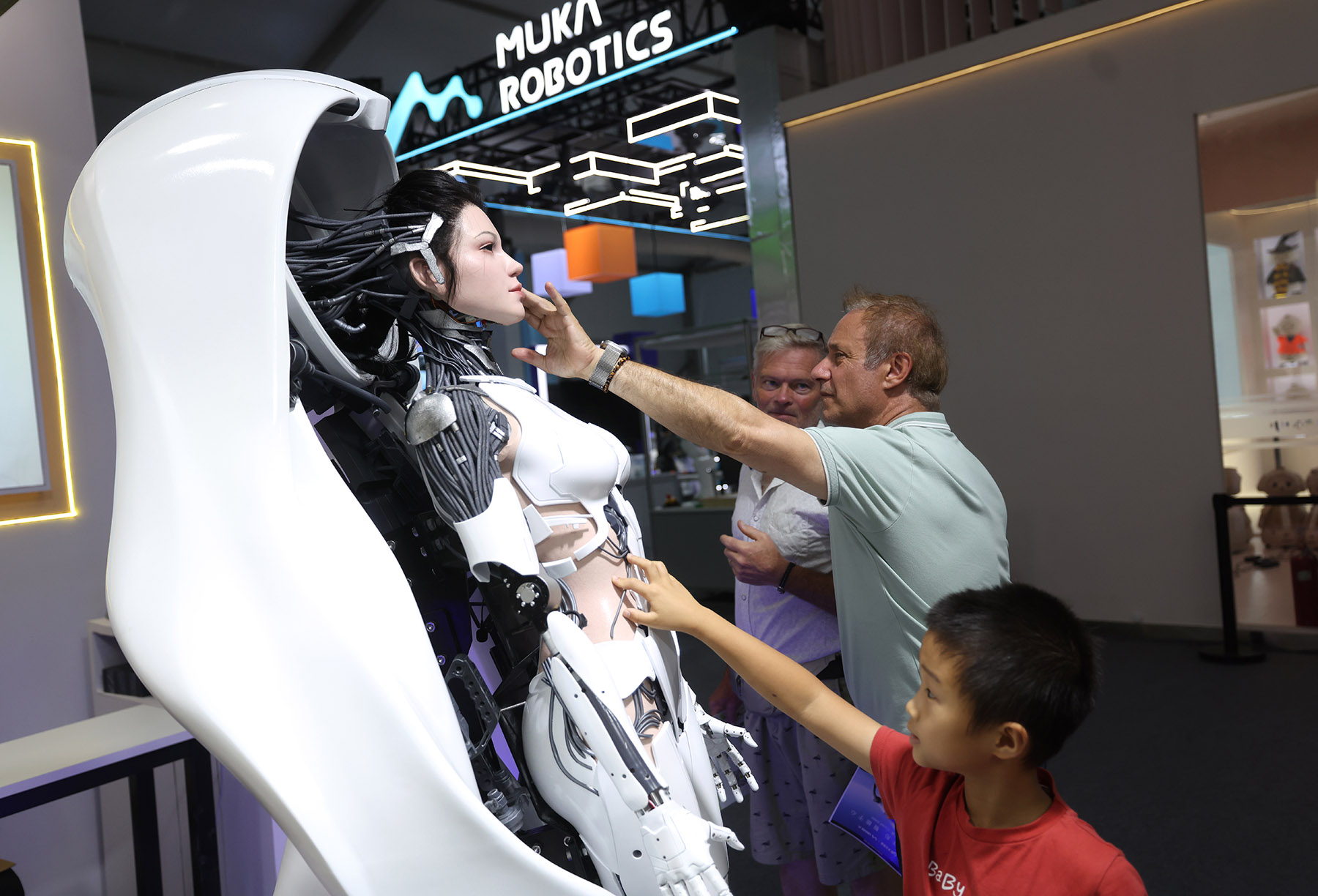
China already operates the world's largest industrial robot market and has spent decades building electronics, electric-vehicle and automation supply chains that can increasingly be redirected toward embodied AI. Components refined for smartphones and cars — cameras, batteries, sensors, motors and power electronics — are now turning up inside robots.
Xi Ning, chair professor of robotics and automation at the University of Hong Kong, said at the World Robot Conference that China's gap with the United States in basic robotics theories and methods had shifted from one of "quality" toward one more of "quantity", while parts of China's supply chain had already moved ahead.
Physical-world AI is also fundamentally harder than language AI, Xi said, because robots must understand not just logical relationships, but space, time and interaction.
Microduck offers a miniature example of how that ecosystem works. It weighs less than 800 grams but packs 15 motors, a camera, miniature lidar, two inertial measurement units, microphones and a movable beak. Its software allows developers to train behaviors in simulation before transferring them to the physical machine.
It is a remarkable amount of robotics for $399. China's advantage, however, goes beyond low-cost components. It increasingly lies in engineering density — the ability to redesign a motor, source another sensor, modify a circuit board and put a revised machine back into production quickly.
And some Chinese companies are beginning to test whether that manufacturing strength can translate into something more important: robots doing economically useful work.
At a tablet factory operated by electronics manufacturer Longcheer Technology in Nanchang, Jiangxi province, eight robots from Shanghai-based Agibot spent six days in June operating around the clock alongside an existing mass-production line.
The company's G2 robots loaded and unloaded tablets, transferred devices between testing stations and sorted products after inspection. Agibot said positioning accuracy was controlled within one millimeter and the machines were able to distinguish qualified from defective products during the trial.
The deployment offers a glimpse of how China hopes to turn factories into both markets and laboratories for embodied AI.
Agibot said its 15,000th robot rolled off its production line in June, after the company took roughly a year to move from its first 1,000 units to 5,000, and only three months to double that to 10,000.
Yao Maoqing, Agibot's senior vice-president, has called 2026 and 2027 critical years for large-scale robot deployment in factories, saying the company plans to expand into consumer electronics, semiconductor packaging and testing, automobiles, logistics and warehousing.
Another Chinese robot maker, Galbot, is targeting heavier work. Its Galbot S1 has entered production lines at battery giant Contemporary Amperex Technology, or CATL, performing material handling and picking in battery-module and battery-pack production.
The machine can carry a combined load of 50 kilograms with its two arms and operate for up to eight hours, according to CATL. The companies are also working together on global deployment and after-sales standards for humanoid robots.
For CATL, the world's largest electric-vehicle battery maker, the experiment represents an unusual convergence: a company that helped build China's EV supply chain is now providing both the workplace and the batteries for the next generation of robotic workers.
The industry's next milestone is no longer whether a humanoid can walk. It is whether thousands of robots can repeatedly execute mundane jobs — loading, sorting, inspecting and transporting — cheaply enough for factory managers to keep ordering them. That shift was also visible at the World Robot Conference.
Previous robotics shows were dominated by spectacular demonstrations: humanoids doing somersaults, kung fu or synchronized dances. This year's booths increasingly resembled miniature factories, pharmacies and stores, with robots sorting goods, folding clothes, cleaning floors and manipulating industrial components.
The question has changed from "Can it move?" to "Can it work?"
Wang Tianmiao, honorary director of the Robotics Institute at Beihang University, said: "Commercialization will require much more than improving a robot's AI brain. Reliability, manufacturing consistency, supply-chain standards, economics and the choice of suitable applications must advance together."
The World Humanoid Robot Games put those limitations under even harsher lighting. A total of 666 teams registered 2,056 robots for 51 events. Alongside running and martial arts were 21 scenario-based competitions designed to test capabilities closer to those required in real workplaces.
Robots fell. They collided. Some struggled with objects that humans would handle without thinking.
A sprint exposes balance, actuation and control problems. Manipulation tests expose weaknesses in perception, force control and dexterity. A robot's ability to recover from a mistake may ultimately matter more commercially than its best-case performance.
ChatGPT could learn from trillions of words already sitting on the internet. There is no equivalent internet-scale repository showing robots how hard to squeeze every object, how to recover every dropped tool or how to open every drawer.
ALSO READ: Robotics boom fueling nation's tech ambitions
Ken Goldberg, a robotics professor at the University of California, Berkeley, has identified the shortage of robot-training data as one of the industry's central constraints.
China's huge manufacturing economy could therefore become more than a market for robots. It could become a data engine.
Ubtech said its humanoids have already accumulated more than 100 million pieces of data from real industrial manufacturing scenarios. Agibot has built dedicated data-collection facilities and has said that accumulating high-quality real-world behavior data is critical to improving robot performance.
It creates a potential physical-AI flywheel: more factories enable more robot deployment; more robots generate more data; more data improves models; better models make more robots economically useful.
Wang Peng, a researcher of Beijing Academy of Social Sciences, said: "Rather than a simple world of US brains and Chinese bodies, embodied AI is developing through deeply intertwined software, hardware and manufacturing ecosystems."
Contact the writers at chengyu@chinadaily.com.cn
