

US, Iran trade strikes on oil tankers, military bases amid Hormuz crisis
Fresh tit-for-tat strikes between the United States and Iran have escalated tensions across Gulf waters, with oil tankers and US bases coming under renewed attacks.
The US Central Command (CENTCOM) said in a statement on Sept 8 that its forces destroyed five Iranian crude oil carriers after the Islamic Revolutionary Guard Corps (IRGC) targeted a US Navy warship with ballistic missiles twice over the past two days.
“The US warship successfully evaded the attempted Iranian attacks and continued to patrol regional waters. No American personnel were harmed,” CENTCOM said.
It added that a vessel named M/T Riesco sank in the Gulf of Oman on Sept 8 after being destroyed by CENTCOM forces in response to attempted IRGC attacks on a US Navy warship.
US Secretary of State Marco Rubio warned on Sept 8 that Washington will continue targeting Iranian oil tankers in response to ongoing attacks on American naval ships, Fox News reported.
“Iran continues to try to hit US naval ships,” Rubio said. “And for every time they do that or try to do that, they’re going to lose tankers. And I think you’ll see that again today,” he added, referring to the strikes on five Iranian tankers in the region.
Jordan came under a missile attack from Iranian territory, the Jordan News Agency reported on Sept 9, citing a spokesperson for the Jordan Armed Forces.
The spokesperson said that Jordanian air defense systems engaged 20 ballistic missiles fired toward Jordanian territory, successfully intercepting and destroying 18 of them. Two missiles fell in unpopulated areas. No casualties were recorded.
The IRGC claimed it launched a retaliatory operation against the US al-Azraq base in Jordan with heavy missile strikes, using solid- and liquid-fuel ballistic missiles, Iran’s Mehr News reported.
The operation targeted the repair and maintenance hangars, preparation areas and deployment positions of F-35, F-16 and F-15 warplanes, as well as fighter jet hangars, inflicting heavy damage, IRGC said.
But a US official in Washington D.C. called the Iranian response “ineffective”, Al Jazeera reported.
“The Iranian response was ineffective against integrated air-and-missile defences … (and caused) no casualties among US forces,” the official was quoted as saying by Al Jazeera on condition of anonymity.
The IRGC Navy said it targeted two US vessels and eight tankers in the Persian Gulf in response to the strikes on five Iranian tankers, and also targeted 10 ships attempting to transit the prohibited and unsafe zone in the Strait of Hormuz.
A British maritime monitor said that attacks continued on shipping in key transit routes in the Gulf with “several merchant vessels” attacked and disabled.
In a post on X on Sept 8, Iranian President Masoud Pezeshkian said Iran “has always opposed war and has considered the preservation of the people’s interests and regional security to lie in refraining from igniting conflict”.
“However, just as it has boldly risen to defend against aggression up to this day, it will continue this resistance with full strength until the aggressors are brought to complete regret,” Pezeshkian wrote.
In a separate post on X, Iranian Foreign Minister Abbas Araghchi noted that after 47 years of sanctions, the US “went to war with Iran on behalf of Israel”.
“The fallout has been disastrous for America, including its standing worldwide. After failing to achieve its aims through sanctions or war, Washington’s ‘novel’ solution is … more sanctions. Seriously?” said Araghchi.
AbdulWahed Jalal Nori, a lecturer in the Department of Fundamental and Inter-Disciplinary Studies at the International Islamic University Malaysia, noted that “when oil tankers, shipping lanes and regional bases become bargaining chips, this is no longer simply pressure on Tehran”.
“It is a self-perpetuating cycle in which ‘deterrence’ can gradually become a substitute for diplomacy, while the real cost is ultimately transferred to regional stability and the global economy,” he told China Daily.
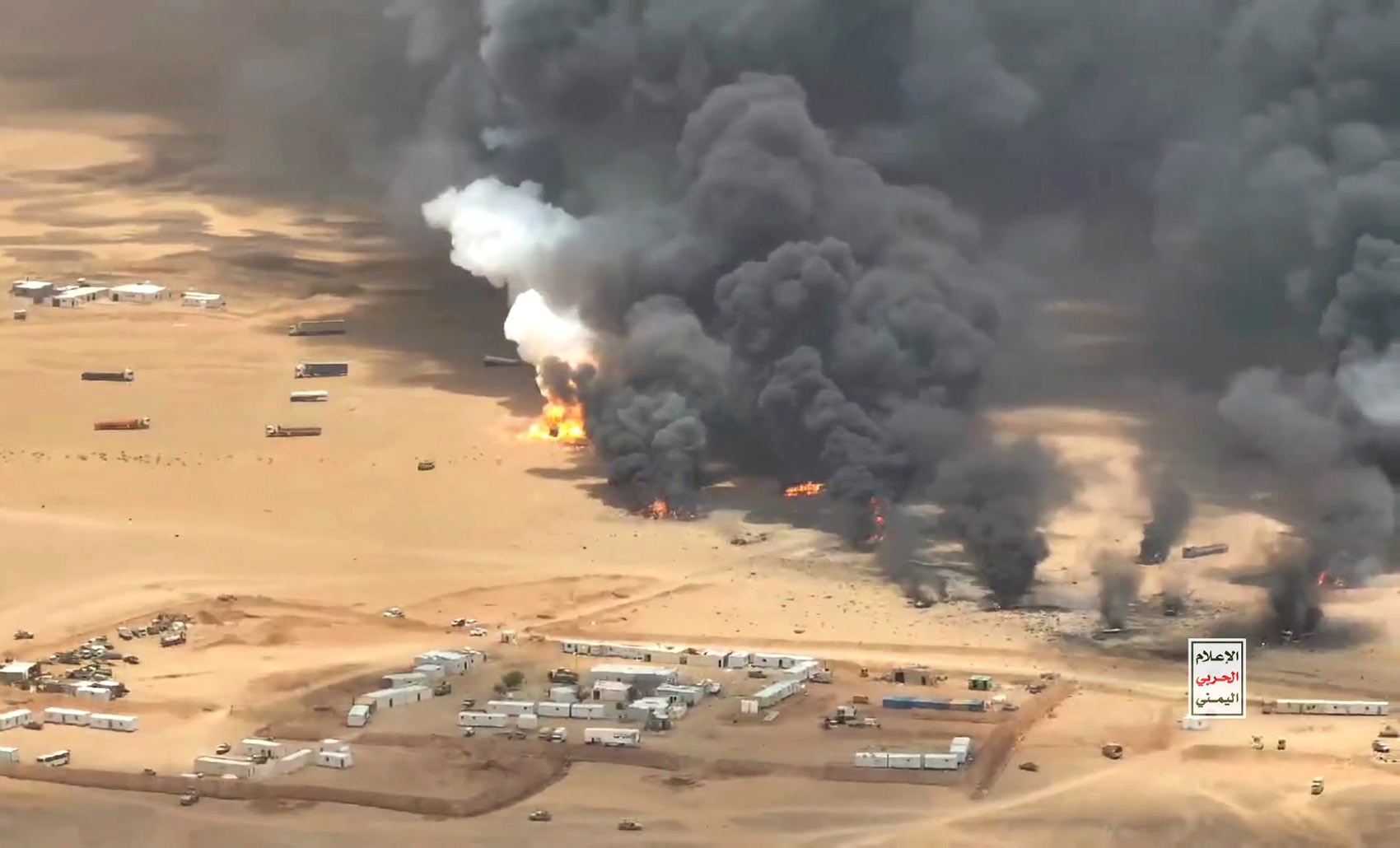
Earlier, the Iran-aligned Houthi militant group in Yemen on Sept 8 claimed responsibility for large-scale missile and drone strikes on military and energy facilities across southern Saudi Arabia. They said the attacks were in response to recent Saudi military operations in Yemen.
Saudi authorities said earlier on Sept 8 that the Houthi attacks hit civilian and economic sites, injuring 73 people. Fires broke out at several energy facilities and utilities, forcing a temporary suspension of operations, according to the Saudi energy ministry.
The Houthi-run al-Masirah TV reported a series of Saudi strikes on Sept 8. “The Saudi aggression launches a series of raids on Al-Waziyah district” in Taiz Province, where fighting has raged for days, al-Masirah said.
Contact the writers at jan@chinadailyapac.com
