

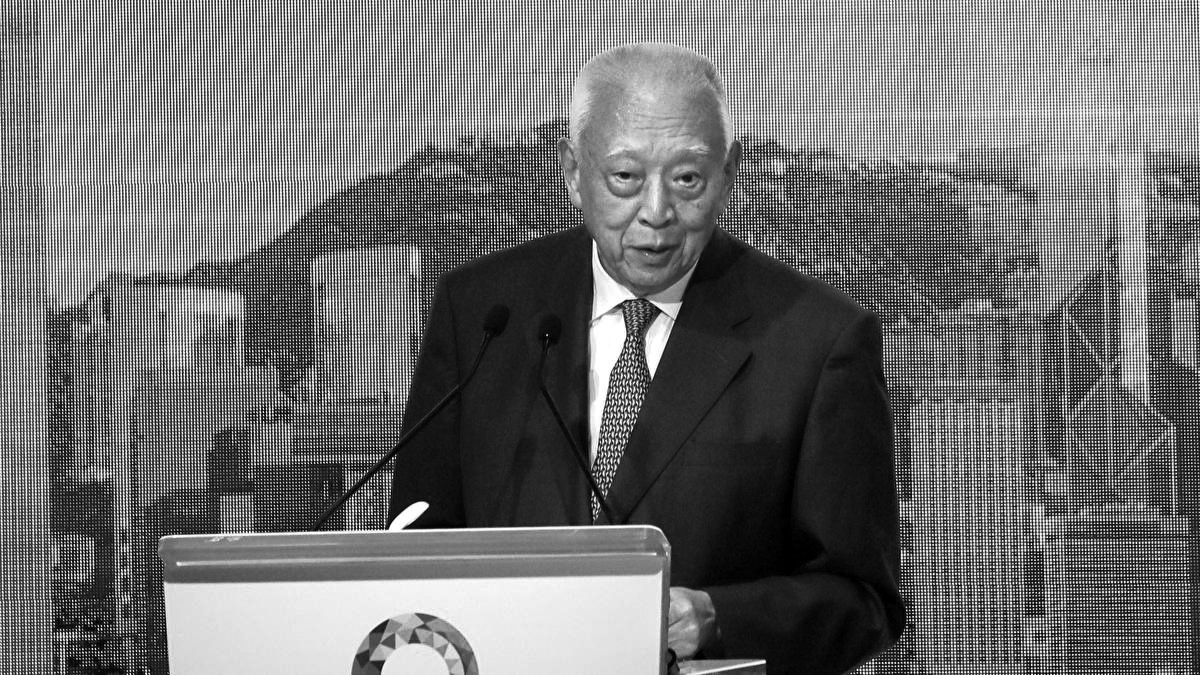
Hong Kong business leaders, financial officials and industry representatives paid tribute on Wednesday to Tung Chee-hwa, highlighting his significant contributions in safeguarding financial stability, promoting economic development, and fostering economic and trade ties between Hong Kong and the Chinese mainland.
Tung, the Hong Kong Special Administrative Region’s first chief executive, died on Tuesday at the age of 89. He served in the position from July 1997 to March 2005.
Expressing his deepest condolences, the SAR’s Financial Secretary Paul Chan Mo-po particularly praised Tung’s leadership during the Asian financial crisis that began in 1997. In a social media post, he said Tung had led the government and financial regulators in safeguarding Hong Kong’s financial stability and security.
At a critical stage in Hong Kong’s economic transition, Tung had insisted on long-term planning, shouldered responsibility, pursued new sources of growth and sought to address complex, longstanding socioeconomic problems, the financial secretary said.
Carlson Tong, chairman of Hong Kong Exchanges and Clearing Ltd, noted that during Tung’s tenure, the Hong Kong capital market implemented a number of significant reforms, including the completion of the merger and corporatization of the stock exchange and clearing house, which laid a crucial foundation for the development of the HKEX and further enhanced the competitiveness and international standing of Hong Kong’s financial sector.
Kelvin Wong, chairman of the Securities and Futures Commission, credited Tung with guiding Hong Kong through the 1997 financial turmoil during his more than seven years in office, and with helping establish the Mainland and Hong Kong Closer Economic Partnership Arrangement, or CEPA.
Wong said CEPA, together with national policies supporting mainland State-owned commercial banks list in Hong Kong, had significantly increased the stock market’s total market capitalization, liquidity and internationalization. This had strengthened Hong Kong’s position as the preferred offshore fundraising platform for mainland enterprises and as a regional market hub, he said.
Cheung Kong (Holdings) Ltd, Henderson Land Development and Sun Hung Kai Properties highlighted Tung’s significant contributions to the country and Hong Kong, noting that he played an indispensable role in the implementation of “one country, two systems” in the HKSAR.
Local business associations, such as the Chinese General Chamber of Commerce and the Chinese Manufacturers' Association of Hong Kong, also joined in paying tribute. They said Tung’s initiatives to promote CEPA and the Individual Visit Scheme, which allows mainland residents to freely visit Hong Kong and Macao, have opened up the vast mainland market to Hong Kong and propelled the city’s economy to new heights.
Hong Kong Trade Development Council Chairman Frederick Ma Si-hang, who served as secretary for financial services and the treasury under Tung, said he would not have joined the government without Tung’s invitation.
Ma described Tung as his “benefactor” for bringing him into government, and as a farsighted leader who loved the country and Hong Kong.
Mofiz Chan, chairman of the Hong Kong Securities and Futures Professionals Association, recalled Tung’s support for smaller brokerages when Hong Kong was preparing to abolish the “minimum commission system” between 2001 and 2002.
In order to strengthen the global competitiveness of Hong Kong’s financial sector and align with major international securities markets, the city had proposed abolishing the “minimum commission system” for securities traders, plunging many industry professionals into a survival crisis.
After the association’s preparatory committee submitted a letter to Tung to convey the industry’s concerns, the government decided to postpone the policy for one year — which allowed industry workers who were facing the threat of layoffs to take a breath, Chan said in a statement issued by the association.
With the one-year policy delay, the association was able to rally the industry’s forces and establish itself in 2002, growing from an initial membership of just over 100 to its current size of more than 3,000 active members, Chan said. He remembered Tung as a leader willing to balance financial sector changes with the rights and interests of frontline professionals.
Yao Xi contributed to this story.
Contact the writer at bingcun@chinadailyhk.com
