

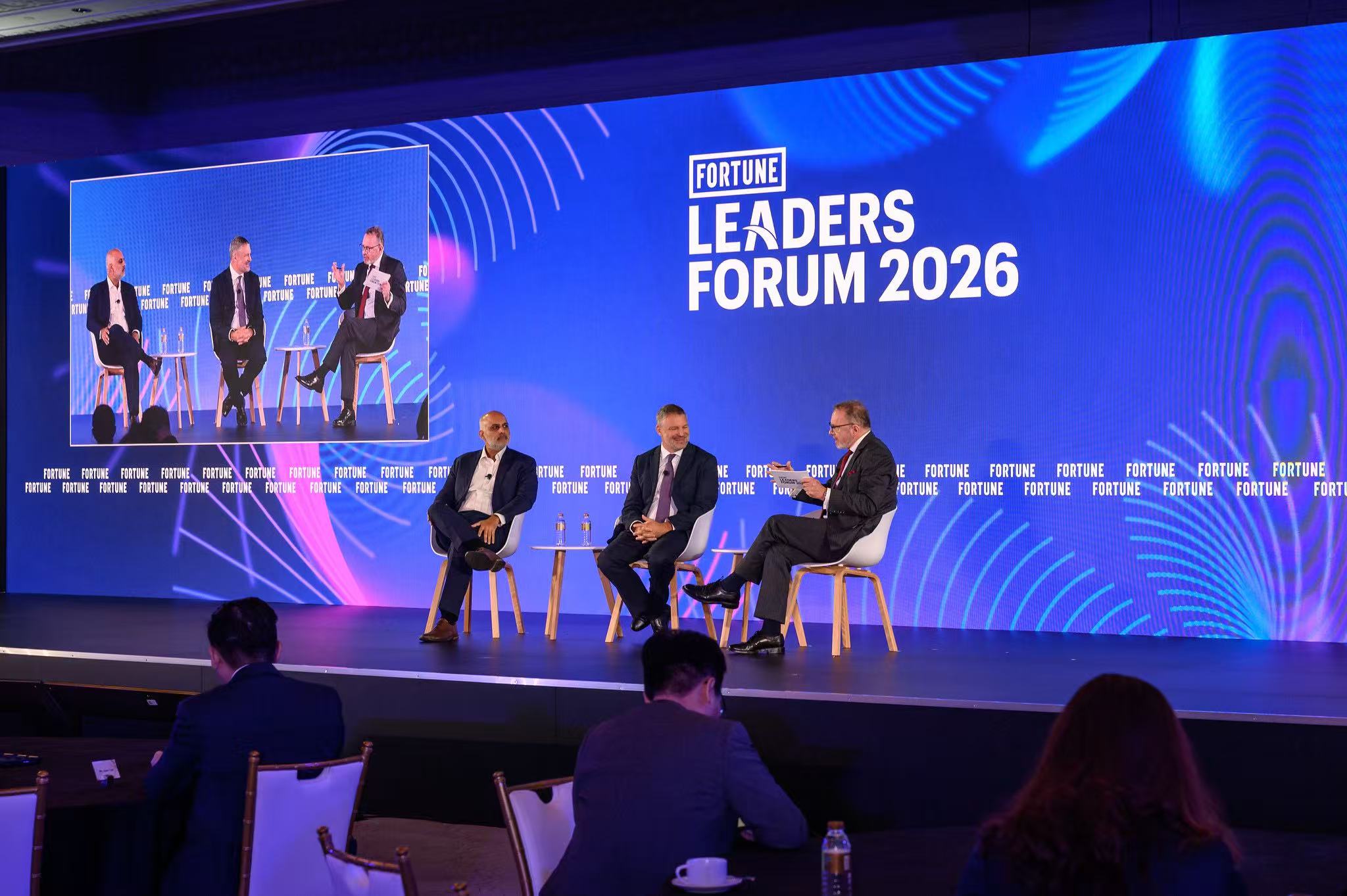
Business leaders worldwide are urged to adapt their business models to today’s more complex and contested reality, experts told a forum in the Macao Special Administrative Region on Sept 8.
“The greatest danger in an era of turbulence is not the turbulence itself; it is to act with yesterday’s logic,” said Ziad Haider, partner and global director of geopolitics at consulting firm McKinsey & Company, at the inaugural Fortune Leaders Forum 2026.
Organized by Fortune magazine, the forum was held under the theme “Leadership in the Age of Convergence and Complexity”, with around 250 global business leaders, investors, and decision-makers sharing their insights on economic trends, innovation, and leadership.
Macao hospitality company SJM Resorts was the host partner of the one-day forum, held at the Grand Lisboa Palace Resort.
ALSO READ: Macao’s blueprint sets a clear course for its next chapter
In a panel titled “The global economy: Signals for the year ahead”, Haider said geopolitics is not happening in a vacuum but colliding with other major transitions in areas ranging from energy and software to enterprise and capital, making the business environment today significantly more complex.
Noting the world is entering a stage of higher bond yields, a weaker US dollar, and higher commodity and energy prices, Louis-Vincent Gave, founding partner and CEO of Hong Kong-based financial services company Gavekal, said this presents big hurdles for any business.
“All of a sudden, any investment you want to make is more challenging,” he said.
While countries have historically been willing to save in US dollars amid the United States’ naval power securing trade routes, Gave said warfare and challenges in the Middle East in recent years have undermined confidence, leading to the current trend of countries diversifying away from dollars and directly stockpiling commodities.
This also comes at a time when China, which prioritizes social stability over maximizing profit, is providing more resilience and “anti-fragility” during shocks, Gave added.
Despite the challenges, Haider of McKinsey said many opportunities remain, and businesses must navigate new multidimensional choke points in geography, supply chains, technology, and finance, including rerouting shipping, replacing suppliers, and finding product substitutes.
Speakers at the forum also shared their views on topics such as artificial intelligence, energy transition, and China’s Guangdong-Hong Kong-Macao Greater Bay Area (GBA).
READ MORE: Macao’s ‘1+4’ strategy is reshaping its future
In a panel discussion on “Accelerating the energy transition”, Daniel Liu, vice-president of Shanghai-based JinkoSolar, one of the world's largest solar module manufacturers, said China is leading the world in new energy transformation, with almost all new incremental power demand being covered by new energy sources last year.
Noting the gap between China and Southeast Asian countries in new energy development, Liu said that integrating new energy with fossil energy, as well as storage, to meet demand across the islands in Southeast Asia could be a key topic for Asia’s energy transition.
In a panel discussion on “The GBA decade: Opportunity, innovation, and global impact”, Che Weng-keong, president of the Commerce and Investment Promotion Institute of the Macao SAR, said the GBA is undeniably a powerhouse of innovation, but whether it can truly become an international city cluster with bigger global influence will require more effort.
For Macao, Che said the city can play a role in this by, for instance, positioning itself as a world-class hub for conferences and exchanges and connecting the Portuguese-speaking world.
“China, as the number two leading economy in the world, is perfectly placed to be … an engine for the growth here in Asia,” Henry Brockman, managing director of corporate advisory and investment firm Trate Capital in Macao, told China Daily.
Brockman, who was among the delegates, said it is also time for Macao to further play the role as an important gateway between the world and the Chinese mainland.
Contact the writer at kelly@chinadailyapac.com
