

Driven by curiosity and persistence, a 19-year-old fossil hunter turns discoveries at construction sites into a path toward paleontology research.
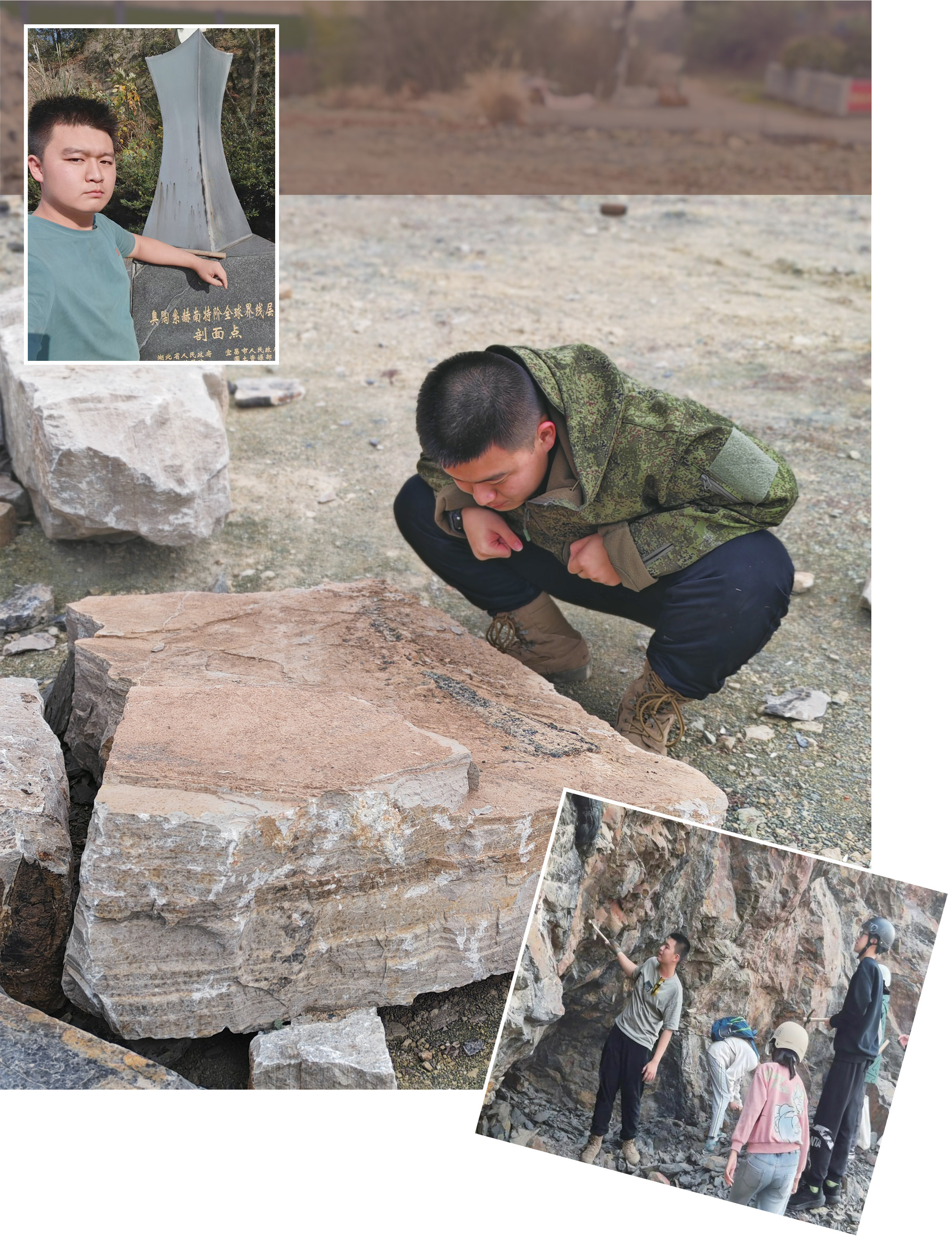
At a construction site in Guangzhou, Guangdong province, dust hung in the air as excavators roared. Ni Zijie, 19, crouched beside a pile of freshly unearthed rubble, tapping at a rock with a geological hammer.
Several passing workers stopped to watch him. "What are you looking for?" one asked.
"Something from tens of millions of years ago," Ni replied.
For Ni, scenes like this have become part of everyday life. A student at Hubei Land Resources Vocational College in Wuhan, where he studies land resources survey and management, he has spent years searching construction sites, road cuts and riverbanks for traces of prehistoric life.
His finds include dinosaur footprint fossils, a crocodilian egg fossil, Paleogene insect fossils, a roughly 60-million-year-old Bauhinia fossil, and what was identified as the first Cretaceous amber found in South China.
He has also published four papers in SCI-indexed journals — a remarkable record for a student still pursuing vocational college studies.
Ni was born in Guangzhou in 2006. His interest in fossils began in sixth grade, when he watched a documentary about ancient climates.
"It was about how scientists reconstructed past environments by studying stomata preserved on ginkgo fossils," he said. "I found it fascinating."
With no professional equipment or teacher to guide him, Ni began teaching himself. He bought simple tools and searched online for academic papers. After reading that ginkgo fossils had been found in Guangzhou's Huadu district, he went there alone to look for them.
He soon developed a preference for construction sites.
"They are the best places to look for fossils because excavation exposes layers of rock that would otherwise remain buried," Ni said.
From middle school onward, he often cycled to construction sites around Guangzhou. As his searches took him farther from home, his father became a steadfast supporter, driving hundreds of kilometers with him to explore new sites.
Ni's fossil-hunting trips have now taken him to 122 cities and towns across China. His collection grew to more than 7,000 specimens weighing over 7 metric tons.
Among them, one Bauhinia fossil became especially important.
While searching in Sanshui, Foshan, Guangdong province, Ni came across an unusually large leaf fossil.
"I had never seen a leaf fossil that big before. It was almost half the size of my palm," he recalled.
Less than 100 meters away, modern bauhinia trees were growing. Suspecting that the specimen might be significant, Ni contacted researchers at Sun Yat-sen University who were studying the flora of Sanshui.
Subsequent research identified the specimen as the earliest known fossil record of Bauhinia in the broad sense, highlighting South China's importance in the genus' phytogeographic history. The findings were later published in a research paper co-authored by Ni.
For Ni, the discovery also demonstrated the difference between finding a fossil and turning it into scientific research.
"The paper was completed under the guidance and with the strong support of many of my teachers," he said. "I could never have carried out all this research by myself."
Ni's transition from self-taught enthusiast to someone working alongside professional researchers took a major step forward in 2021, when he attended a national gathering of fossil enthusiasts and showed his specimens to experts for the first time.
"There were academicians and professors at the meeting, and they were very interested in what I had brought," he said. "They asked me a lot of questions, and we exchanged contact information. After that, whenever I ran into a problem, I would ask them for advice."
Several professors later invited him to participate in their research projects.
Years spent searching in the field have also given Ni a practical sense of where fossils might be hidden.
"I know the temperament of rocks," he said. "I know which layers are likely to contain fossils and how to split the rock so the fossil can be exposed more completely."
But Ni is also aware that field instinct alone is not enough for the academic path he hopes to pursue.
One challenge is English. When he began writing his first academic paper, he struggled to put together even a few sentences.
"There really is a considerable gap between the English level of many vocational college students and what is required for postgraduate study," he said.
He is now preparing to continue his studies in a bachelor's degree program, which he hopes will become a stepping stone toward postgraduate study.
"If I want to do paleontological research and go further in the field, postgraduate study is essential," he said.
Hubei Land Resources Vocational College has supported that goal. According to Zhong Li, a teacher at the college, the school has provided Ni with a classroom to store his specimens, connected him with geological exploration organizations for internships and approved leave for field research.
"We hope Ni can make his way in his chosen field and show other students what is possible," Zhong said.
For all the attention his discoveries have attracted, Ni describes his progress as less a product of talent and more the result of the time and effort he has devoted to his passion.
"I've simply spent the time other people use to play video games on fossils instead. A genuine passion is something that can stay with you for a lifetime," he said.
Contact the writers at guiqian@i21st.cn
