

Two sides seek to inject new impetus into regional economic development
China will work with members of the Association of Southeast Asian Nations to bring the upgraded free trade agreement into force at an early date, as the two sides seek to inject new impetus into regional and global economic growth, said government officials on Tuesday.
Speaking at a news conference in Beijing ahead of the 23rd China-ASEAN Expo, scheduled for Sept 17 to 21 in Nanning, capital of South China's Guangxi Zhuang autonomous region, Yan Dong, vice-minister of commerce, said China will step up policy support to help businesses tap opportunities created by the upgraded agreement.
"The two sides will promote coordinated implementation of the China-ASEAN Free Trade Area 3.0 Upgrade Protocol and the Regional Comprehensive Economic Partnership, or RCEP, to take bilateral economic and trade ties to a higher level," Yan said.
READ MORE: China-ASEAN trade exceeds $1t for first time in 2025
The upgrade protocol was signed in Kuala Lumpur, Malaysia, in October 2025, marking a further step in deepening economic and trade cooperation between China and ASEAN.
The upgrade marks the latest stage in the evolution of the China-ASEAN free trade area, which was initiated in 2002 and fully implemented as Version 1.0 in 2010.
A subsequent Version 2.0 protocol was signed in 2015 and came into full effect in 2019.
Supported by their complementary industrial structures, China-ASEAN trade reached $744.41 billion in the first seven months of 2026, up 24.7 percent year-on-year and accounting for 21.8 percent of China's total foreign trade, data from the Ministry of Commerce showed.
With the global economic environment becoming more complex and the risk of supply chain fragmentation rising, Wang Liping, director-general of the Commerce Ministry's department of Asian affairs, said maintaining resilient and stable industrial and supply chains has become increasingly important to global economic growth.
"China and ASEAN will deepen investment cooperation in emerging areas including the digital economy, green development and the blue economy, and strengthen links across research, manufacturing and commercial applications," said Wang.
The two sides will also improve regional connectivity and encourage wider use of artificial intelligence, big data and other digital technologies to make industrial and supply chains more resilient and efficient, he added.
Deepening business ties are already creating new opportunities for Chinese exporters.
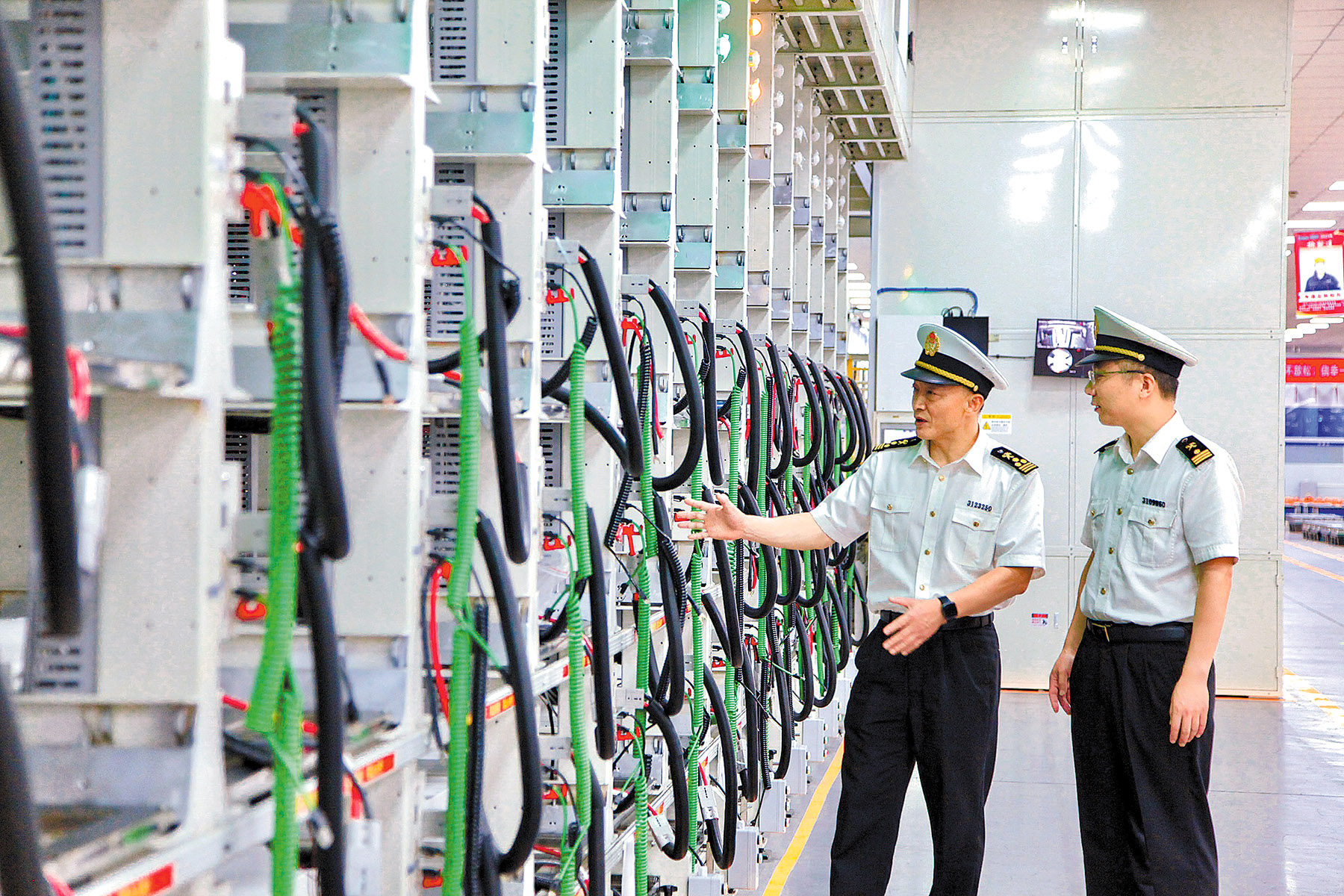
Fujian Yanan Power Group, a manufacturer of generator sets and hydrogen fuel cells based in Ningde, Fujian province, saw its exports to ASEAN markets exceed 20 million yuan ($2.98 million) between January and August, up more than 6 percent year-on-year, according to Fuzhou Customs.
"Strong demand for diesel and gas generator sets, fueled by growing infrastructure investment and rising power demand across the region, has supported our export growth to Southeast Asia," said Zhou Wenhao, the company's assistant president.
ALSO READ: China, ASEAN partners in prosperity
At Dongguan Port in Guangdong province, container-sized modular housing units were being loaded onto vessels bound for ASEAN markets including Indonesia and Vietnam in late August.
"Complete with electrical and plumbing systems and interior finishes at the factory, the units can be assembled directly upon arrival at their destinations," said Wang Bo, foreign trade director at Shanghai Azonal Trade Co, adding that ASEAN markets are seeing sustained demand for modular buildings, including those used for data centers.
In the first seven months of this year, Shatian Customs, a branch of Huangpu Customs in Guangdong province, supervised 23 shipments of modular housing exports worth 548 million yuan, up 730 percent year-on-year, with most of the shipments destined for Southeast Asian countries.
Contact the writers at zhongnan@chinadaily.com.cn
