


JPMorgan Chase & Co and Morgan Stanley are among banks shareholders are suing over their roles on multibillion-dollar buyout deals after a recent corporate-law overhaul failed to protect financial advisers from potential liability.
In cases against financial advisers, shareholders have claimed, among other allegations, that banks helped steer sales of public companies to private equity firms with which they do business at prices that undervalued their shares, according to suits filed in Delaware Chancery Court. That means the banks allegedly knew they were helping directors breach their fiduciary duty, according to the suits.
A controversial revision of Delaware law last year, fueled in part by Elon Musk’s decision to leave the state and reincorporate Tesla Inc in Texas, made it harder to sue top executives and directors in insider deals. But banks didn’t get the same protection, making them a target for plaintiffs looking for new pathways to pursue such cases. That, coupled with a court setback for Goldman Sachs Group Inc earlier this year, has for some plaintiffs made bringing cases against financial advisers more attractive.
The threat of litigation gives banks “an extra impetus for carefulness,” Gail Weinstein, a corporate attorney at Fried, Frank, Harris Shriver & Jacobson, said in an interview. The result should be “more focus on disclosing conflicts to a board early on and throughout the process,” Weinstein said, adding that judges have increasingly demanded that advisers detail relationships with bidders and provide context for the fees they receive.
JPMorgan and Morgan Stanley have each faced two such suits, though both have managed to have one dropped.
JPMorgan asked a judge to toss a second case alleging it helped private equity firm Hellman & Friedman sell out of its investment in Snap One Holdings Corp to the detriment of public stockholders. The bank argued that the deal “bore all the hallmarks of a legitimate and well-executed sale process.”
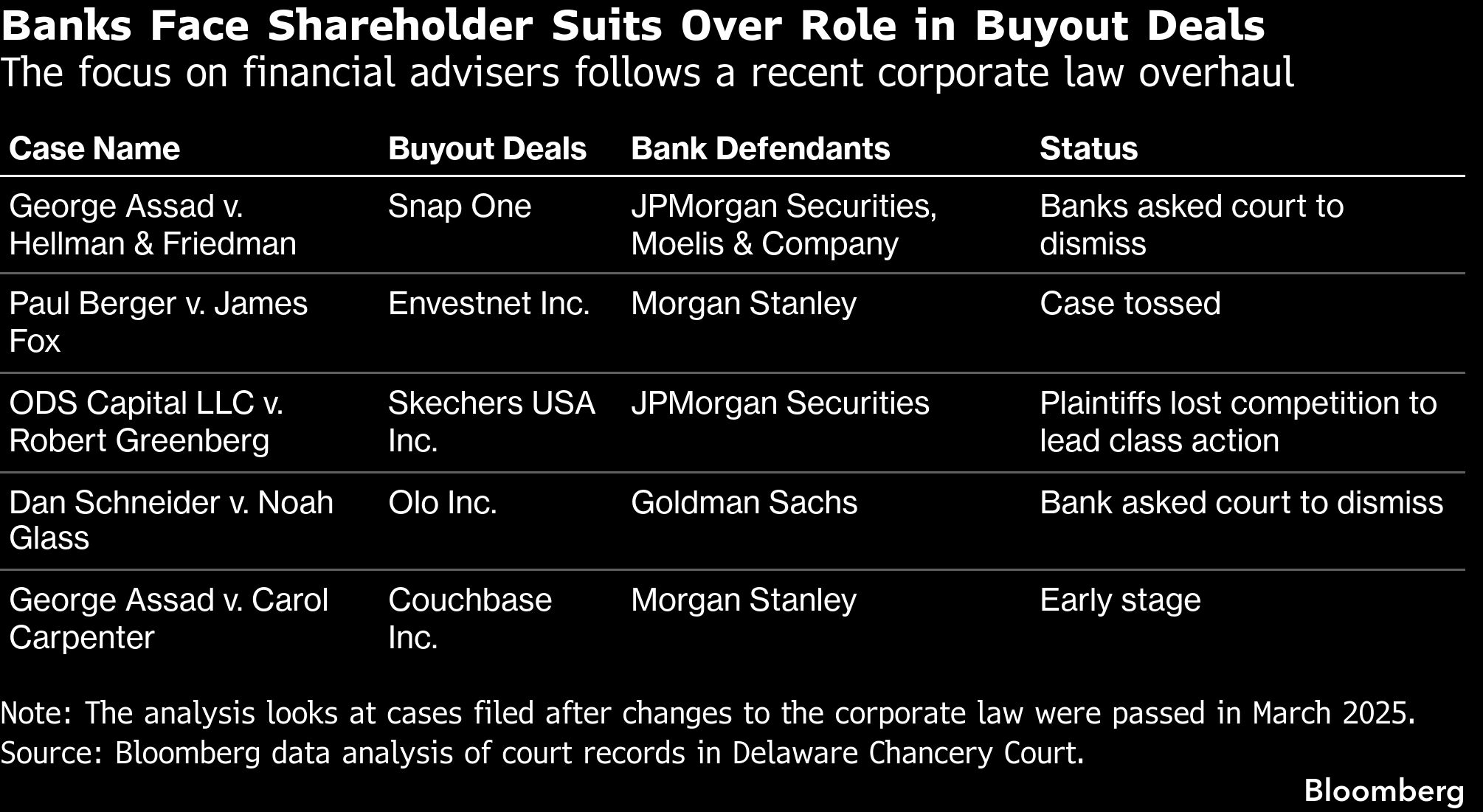
And Morgan Stanley is now facing a fresh lawsuit for its work on the $1.5 billion buyout of database software provider Couchbase Inc. by Austin-based private equity firm Haveli Investments.
The banks have denied any wrongdoing in their own court filings, saying that they helped companies run a fair process, weren’t conflicted and properly disclosed any business ties.
The largest US banks have extensive relationships with private equity firms, which makes the potential for conflicts inevitable. Those institutions can lend to buyout shops, help them raise money and advise their portfolio companies on deals. That can make them ripe targets for suits that claim they helped facilitate a sale of a public company to a buyout firm with which they have a lucrative business relationship.
While these types of claims have historically been rare, banks have been defendants in at least five cases since the changes to the Delaware law passed in March 2025, according to an analysis of court records by Bloomberg News.
Law firm Block & Leviton brought four of those cases, which mostly target buyouts of public companies by private equity firms.
Spokespeople for JPMorgan and Morgan Stanley declined to comment.
Kimberly Evans, a plaintiffs’ attorney at Block & Leviton, said that the recent changes to the Delaware law “seem to be prompting more lawsuits” against banks. Even if directors are shielded by the overhaul, the theory is that claims can still proceed against banks if a breach of fiduciary duty is established, said Evans, who declined to comment on her cases.
Block & Leviton, along with Elsberg Baker & Maruri, made that argument earlier this year on behalf of two clients seeking to become lead plaintiffs in a proposed class-action lawsuit questioning the fairness of 3G Capital’s $9.4 billion buyout of Skechers USA Inc last year.
The attorneys told a judge they were the only ones to name JPMorgan as a defendant, accusing the bank of using information from advising Skechers management to help 3G Capital value the deal at a cheaper price. The judge earlier this month selected a different plaintiff to lead the class-action, meaning that JPMorgan won’t face the suit.
The claim against JPMorgan “is carved out” of the changes to the Delaware law and “is not exposed to a safe-harbor dismissal,” attorneys at Block & Leviton and Elsberg Baker argued in making their case to the judge. Other law firms competing for lead didn’t sue the bank.
It’s rare for banks to be named as defendants in cases involving allegations of breach of fiduciary duty since it’s hard to prove that financial advisers knew about any wrongdoing. Even with the heightened focus, other recent cases brought by plaintiffs’ firms, including Block & Leviton, don’t target financial advisers.
Some plaintiffs’ attorneys also say they haven’t changed their approach because of the high bar of winning those cases. Recent Delaware Supreme Court decisions have also made it tougher to bring these types of claims, though those cases were against buyers rather than banks.
But a few rulings earlier this year put financial advisers on alert. Judge Travis Laster in February refused to drop Goldman Sachs Group Inc. from a lawsuit challenging the fairness of a $4 billion take-private of EngageSmart Inc by Vista Equity Partners, which handed a $500 million dividend to General Atlantic, the company’s then-controlling shareholder. Laster questioned whether banks would have more difficulty escaping liability than buyers since they are on the inside of a sales process.
“While acknowledging that breaches of duty in sale processes are likely rare and misconduct by financial advisors equally so, the financial advisor’s central role makes it all the more conceivable that — when a breach happens — the financial advisor will have assisted in the act and understood its nature,” Laster wrote in his decision on the case.
Goldman Sachs in court papers denied the allegations, and a spokesperson for the bank declined to comment.
It’s unclear how the current cases will shake out since most are in the early stages. Morgan Stanley, however, managed to escape one of the suits after a judge in July tossed the case, which challenged the take-private of Envestnet Inc by Bain Capital — a private equity firm with which Morgan Stanley had business ties.
The judge wrote that the complaint failed to “allege that Morgan Stanley took any action without Board direction or approval or concealed information from or otherwise misled the Board,” the judge wrote, adding that “nothing about the way the process allegedly unfolded supports ‘clear and direct knowledge’ of a fiduciary breach.”
