

Once carried overseas, Jingdezhen porcelain now draws international artists to its source, creating new exchanges between cultures and creative traditions.
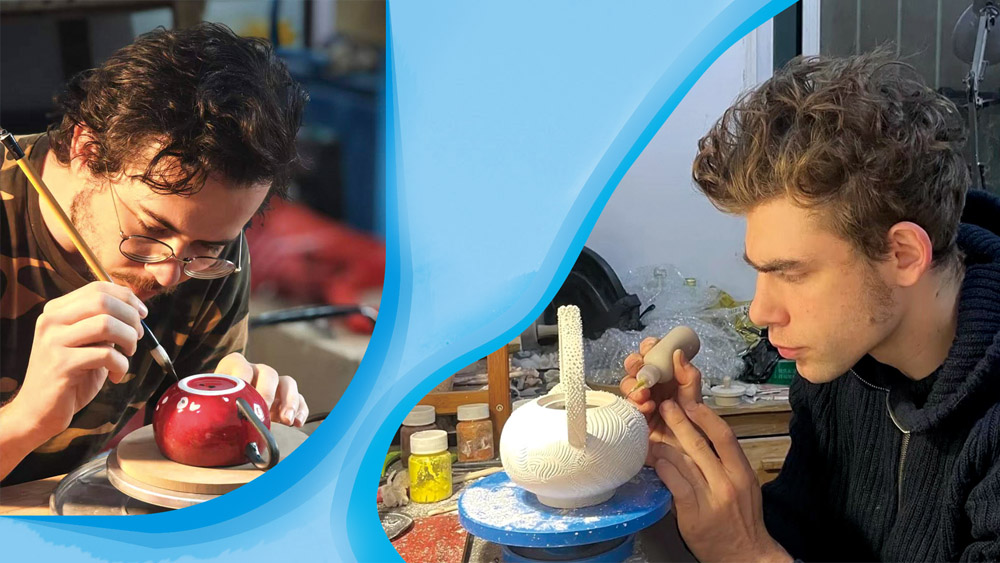
When French artist Yann Colleu first encountered porcelain in 2014 as a contemporary art student in France, he had little idea that the material would eventually become central to his life.
At the time, he worked across a range of media, from wood and oil painting to performance and music, with porcelain just one material among many.
That began to change in 2017, when he traveled to Jingdezhen, Jiangxi province, for a three-month academic exchange at Jingdezhen Ceramic University.
Colleu said his time in Jingdezhen opened his eyes to how expressive porcelain could be on its own. "I want to explore every aspect of porcelain that can emulate thought and convey emotion."
READ MORE: Jingdezhen porcelain sites added to World Heritage List
Back in France, he could not stop thinking about Jingdezhen and soon found himself longing to return. Over the following years, he traveled back and forth between the two countries. In 2024, when Colleu was 32, he and his family decided to settle in Jingdezhen.
Colleu is one of many international artists drawn to the city, some for short stays and others who eventually choose to put down roots.
Their presence has taken on added significance since the Jingdezhen Handicraft Porcelain Industry Sites were inscribed on the UNESCO World Heritage List in July.
For centuries, Jingdezhen porcelain traveled overseas along ancient maritime trade routes, carrying Chinese craftsmanship and aesthetics to distant markets. Today, artists from around the world are making the journey in the opposite direction, learning from the city's ceramic traditions while bringing artistic languages of their own.
Colleu has witnessed the city's creative scene become increasingly international and diverse.
What was once centered on technical mastery and material quality, he said, has grown to embrace contemporary art, performance, experimental music, digital modeling and 3D printing. "Some artists who left for larger cities in search of opportunities are also beginning to return."
Colleu himself went on to study qinghua, or blue-and-white porcelain, and youzhong wucai, an in-glaze polychrome decoration technique, working with local craftspeople to learn from and experiment with these traditional methods.
The longer Colleu worked with porcelain, however, the more he came to understand how much of the process lay beyond the maker's control. Moisture, drying, shrinkage and firing can all affect the final results, and even a carefully made piece can crack or deform in the kiln.
He compares the process to a human relationship.
"You cannot force a relationship and expect positive results," he said. "You have to observe, you have to listen, and you have to adapt."
That dialogue between maker and material has also fascinated Denis Naymark, a sculptor from the United States.
Naymark began working with ceramics at around the age of 8, in a studio at a university in New York where his father taught. After his father's lectures, he recalled, he would run to the studio and shape clay into faces, dragons, horses, teapots and bowls.
"The possibilities were always endless," he said.
He later studied ceramic sculpture and traveled to Jingdezhen in 2013, at age 22, to deepen his knowledge of advanced porcelain techniques and traditional Chinese ceramic materials.
Naymark said the city gave him the space to weave his fascination with nature into his work.
"Growing up near the ocean in New York, I developed an enduring interest in aquatic life," he said. "The hills and forests around Jingdezhen offered me further inspiration."
That influence can be seen in his teapot designs, which draw inspiration from seashells, coral, and other marine life. Rounded bodies, shell-like ridges, dotted textures and glossy blue, white and pink glazes give them the feel of an underwater world.
Though the compositions may appear spontaneous, every shell, form and color is carefully placed.
For Naymark, experimentation does not mean breaking with tradition. "You need both traditional techniques and modern, new ideas," he said.
Beyond aesthetics
South Korean entrepreneur Bang-Cho (pseudonym), who came to Jingdezhen in 2019, found his own path into the city's porcelain legacy through tea. To him, porcelain is particularly well suited to bringing out the character of tea.
"Jingdezhen is one of China's major production centers for everyday teaware, with kilns capable of consistently firing porcelain at temperatures above 1,300 degrees Celsius," he said. "At such temperatures, the glaze forms a smooth, glasslike surface with very low water absorption, helping preserve the tea's original aroma and flavor."
That understanding shapes his designs. For BangCho, function comes before decoration.
When designing a gaiwan, or lidded tea bowl, he considers factors such as its thickness and diameter, pouring speed and heat retention — all of which influence the experience of drinking tea.
Beyond his own designs, BangCho sees porcelain not only as an art form, but as a craft that has supported the city's economy for generations.
"There is hardly another city anywhere in the world that has sustained itself on a single ceramics industry for a thousand years," he said.
Over the years, he has also watched the city and its ceramic economy evolve.
"Years ago, young people were far less visible in the city center," he recalled. Today, he said, they fill its streets and markets, while contemporary ceramics, from coffee cups to plates and bowls with modern designs, have grown in popularity alongside traditional wares.
Livestreaming and e-commerce have further expanded the market, extending the reach of Jingdezhen ceramics beyond the city.
But BangCho sees that growth as a double-edged sword.
"If used well, livestreaming can help the industry grow, but when everyone is chasing traffic and quick profits, prices can become distorted, and craftspeople devoted to traditional techniques may be left wondering where the industry is headed," he said.
ALSO READ: Rekindling 'ivory white' porcelain
He believes preserving the knowledge behind the craft is just as important as expanding the market and has called for publicly supported training programs to provide craftspeople with the resources and opportunities needed to pass their skills on to younger generations.
Looking ahead, BangCho hopes to develop products that bring Chinese and South Korean aesthetics into dialogue while introducing ceramic works from both countries to wider audiences.
The paths taken by Colleu, Naymark and BangCho are different, but what connects them is Jingdezhen itself — a place whose centuries-old ceramic traditions continue to attract people from beyond China, not simply to observe them, but to learn from them and become part of their continuing evolution.
For Colleu, that pull has become inseparable from a feeling of home.
"Once you experience that environment, it becomes very difficult not to feel that you belong here," he said.
Contact the writers at guojiatong@i21st.cn
