

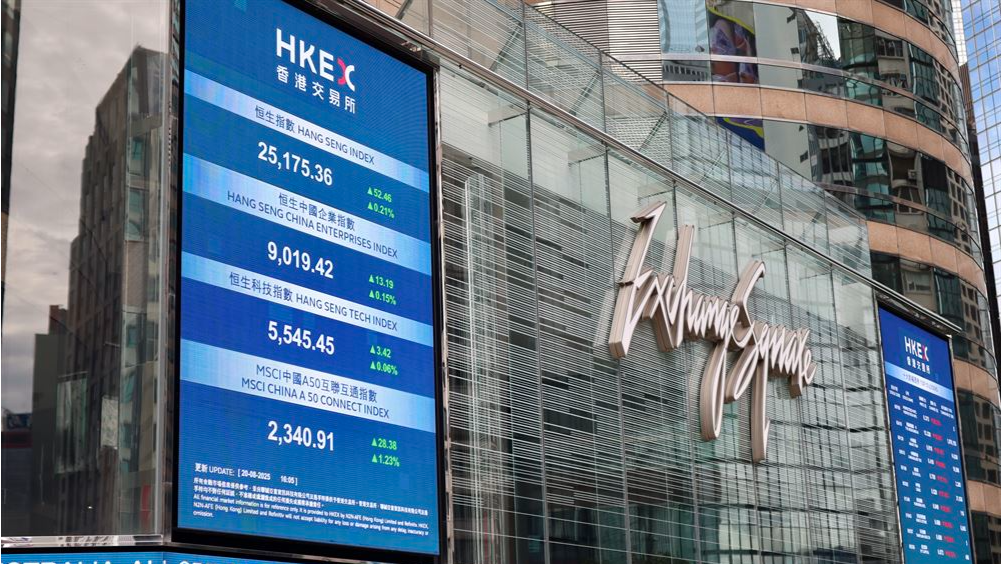
Financial analysts said that the proposed overhaul of Hong Kong’s technology share-market index would make it more representative and help attract global capital inflows into technology enterprises listed in the special administrative region.
Hang Seng Indexes Company, which is responsible for compiling the city’s stock market index, kicked off market consultations on Monday on its plan to raise the Hang Seng TECH Index’s constituent stock number from 30 to 50, and introduce a “sales growth” criterion to strengthen market representation amid changes in the global technology industry.
“The proposed reforms are well-timed, and would make the index more representative of today’s innovation economy, underscoring the capital market’s shift from the internet age to an era defined by artificial intelligence and hard technologies,” Edward Au, Deloitte China southern region managing partner, told .
He said the plan should encourage greater participation from exchange-traded fund providers, index funds and global institutional investors. “When HSTECH becomes stronger, more products will track it, and more long-term capital will naturally follow.”
ALSO READ: New national measures give HK’s financial prowess a powerful boost
Martin Liu, executive director at Mouette Securities Company, said the proposed index revamp would lead to portfolio rebalancing by global institutional investors, as fund managers investing in internet platforms would shift to stocks with higher technology content.
“The benefit of this rebalancing is that overall market liquidity would be increased, thus creating a virtuous cycle -- market valuation would be reassessed, and the market’s price-to-earnings ratio could potentially increase,” he said.
Hong Kong’s stock market benchmark index – the Hang Seng Index – had largely been trailing the major stock market indices of Japan, South Korea, Taiwan and the United States in the first half of this year. Analysts attribute the HSI’s relative underperformance to the lack of AI-related shares in the SAR’s equity market, undermining its capital-absorbing capabilities.
“The intended reform would attract more high-growth companies and diversify risks. This is positive for the index in the long run,” said Mofiz Chan, who chairs Hong Kong Securities and Futures Professionals Association.
However, he suggested the plan could have gone further regarding the inclusion of more small-capitalization technology companies.
READ MORE: Hong Kong launches trial run of gold central clearing operation
The proposed changes call the constituent stock number of the revamped HSTECH to be increased from 30 to 50. The selection of the top 40 stocks would be based on their market capitalization, while the rest would be picked on the basis of their revenue growth momentum.
The 10 additional constituent stocks based on market value would be given a weighting of 9.1 percent, and the 10 new constituent shares based on sales growth would be given a weighting of 2.4 percent, according to Hang Seng Indexes Co.
“The 20 new constituent stocks together would account for only 11.5 percent of the index weighting, so the short-term impact would be limited. The dominance of large-cap technology stocks would remain largely unchanged,” Chan said.
Whether the number of HSTECH constituent stocks would go up in the future would depend on market fundamentals and the earnings growth of the listed technology firms, and not solely on the pace of the index compilation reform, the chairman added.
READ MORE: HKEX reports HK$5.18 billion record profit in Q1
Au is more positive, saying the overhaul would allow promising technology companies with strong growth prospects to win early recognition from investors.
The results of the consultation exercise will be announced late next month, and the proposed changes will take effect in December.
Gaby Lin and Wang Zhen contributed to the story.
