

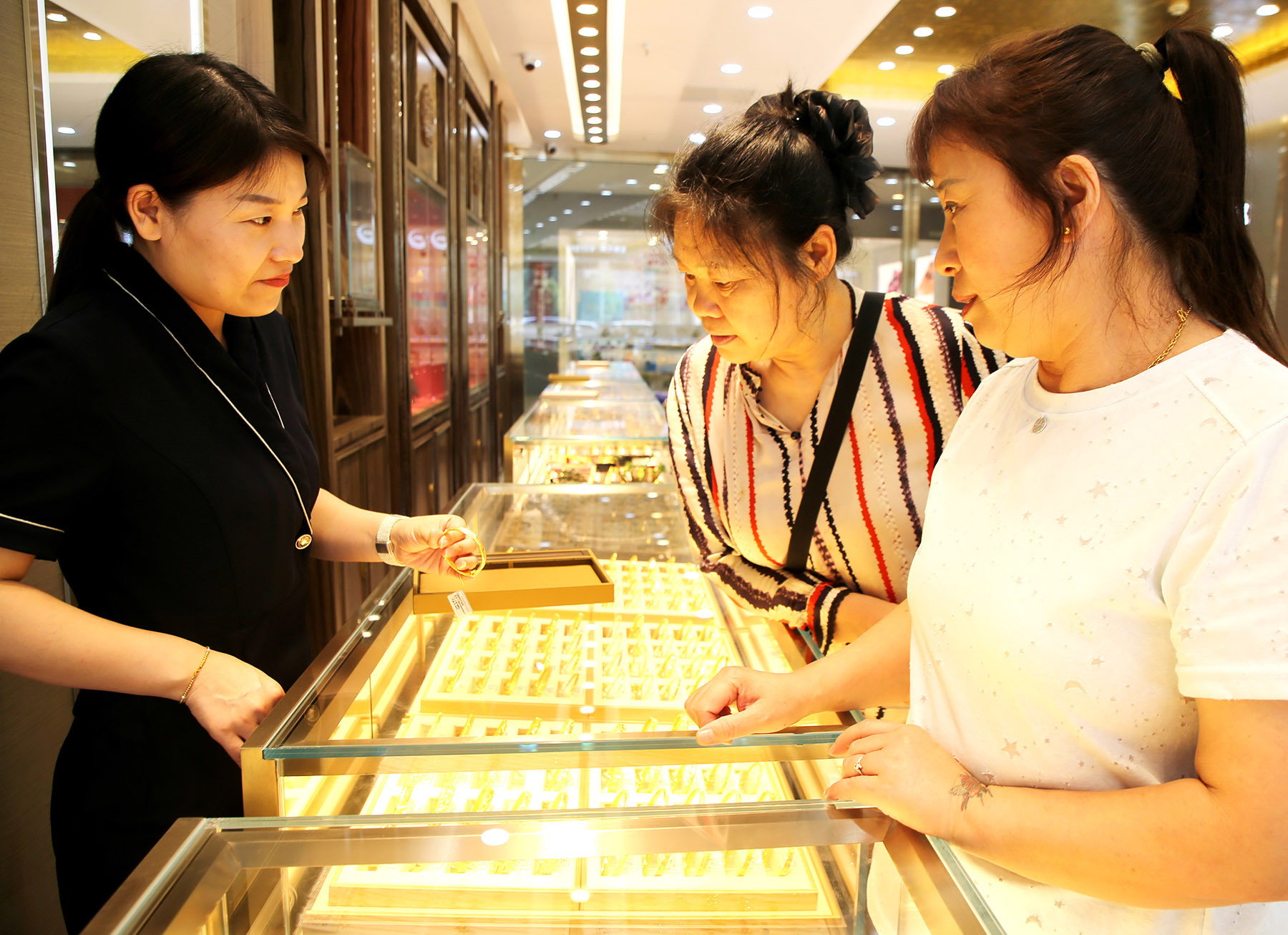
China's gold consumption saw a slight increase in the first half, reaching 511.41 metric tons, up 1.23 percent year-on-year, as strong investment demand offset sluggish jewelry sales, according to the latest industry data released by the China Gold Association.
Driven by sharp price fluctuations at historically high levels and the implementation of new domestic gold tax policies, the country's gold consumption structure continued to experience significant divergence, the association said.
Demand for gold jewelry plummeted 33.88 percent year-on-year to 132.13 tons, as consumers became hesitant to make purchases amid soaring retail prices. In stark contrast, robust investment demand pushed the consumption of gold bars and coins to 339.34 tons, surging 28.42 percent.
READ MORE: China reports slight increase in gold consumption
Periodic price pullbacks have consistently stimulated sales of gold bars through domestic banking channels, cementing them as a popular safe-haven asset for investors seeking to hedge against market risks, it said.
Meanwhile, persistently high gold prices have pushed up production costs for industrial enterprises, leading to a 2.9 percent decline in industrial and other gold uses, which stood at 39.94 tons for the first six months.
On the supply side, China's gold output from domestic raw materials dropped 14.62 percent year-on-year to 152.91 tons.
The CGA attributed this decline to comprehensive safety inspections, rectifications and special environmental governance campaigns conducted in key gold-producing provinces. These strict regulatory actions led to temporary production halts at certain mines as they underwent mandatory self-inspections to ensure high-quality, sustainable development in the sector.
Gold produced from imported raw materials, however, increased by 4.62 percent, adding 3.40 tons to reach 77.08 tons. Combined, the country produced 229.99 tons of gold from both domestic and imported raw materials, representing a 9.01 percent decrease compared to the same period last year.
Despite domestic supply constraints, China's major gold enterprises maintained stable operations and orderly capacity expansion at their overseas mines.
State-owned giants including China National Gold Group and Shandong Gold Group reported steady production growth abroad.
In the first half, overseas mine production by these large groups reached 48.10 tons, a robust 21.43 percent year-on-year increase, it said.
Industry experts believe that overseas expansion of Chinese mining companies has evolved from an optional growth strategy into a structural necessity in recent years.
As the world's largest gold consumer, China's rising offshore output demonstrates that proactive mergers and acquisitions are serving as a vital buffer, said Zhao Xiangbin, chief strategist at Beijing Gold and Forex Fortune Investment Management.
ALSO READ: Gold miners hike overseas capacity in Q1
"Chinese enterprises are securing high-quality assets at attractive valuations while deploying advanced extraction technologies," he said.
Zhao added that by securing upstream physical assets globally, domestic mining giants are anchoring the country's physical reserves and steadily expanding China's long-term influence over global precious metal markets.
At the institutional level, China's central bank continued its strategy of optimizing and diversifying its official foreign exchange reserves, adding 40.12 tons of gold in the first half.
This marked the 20th consecutive month of accumulation spanning from November 2024 to June 2026, pushing the nation's total gold reserves to a massive 2,346.45 tons and firmly securing its position as the fifth-largest holder globally.
Contact the writers at zhengxin@chinadaily.com.cn
