

The first thing people notice is the silence. Not an ordinary silence, but the kind that lives underground, thick and old, broken only by the drip of water and the distant murmur of a hidden river.
Jean Bottazzi has spent his life crawling into the dark guts of the Earth, from Europe to Asia, but Shuanghe Cave in Guizhou province does something no other cave has done. It swallows him whole and leaves him utterly lost — in the best possible way.
"Most caves I have explored around the world have relatively simple structures," the French caver said, his voice echoing slightly in the chamber. "This one feels like a huge maze."
He flicks on his headlamp. The beam cuts through the blackness and lands on a wall of stone that twists and branches like a frozen forest.
Somewhere in the distance, water rushes. Somewhere deeper, passages he has not yet mapped disappear into the mountain. At 439.7 kilometers and counting, Shuanghe is Asia's longest cave complex, and it still hasn't revealed all its secrets.
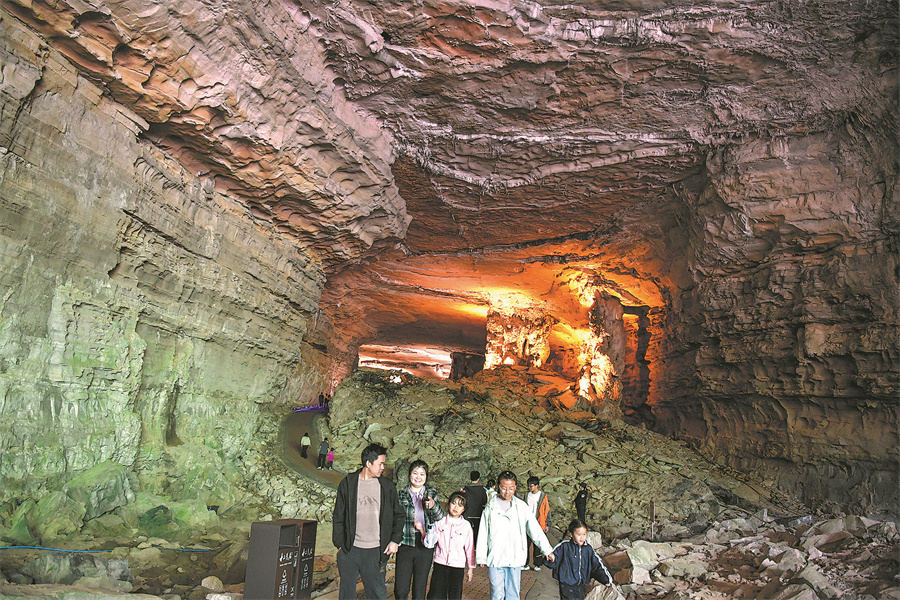
Outside, the world is burning. A brutal heat wave has clamped down across much of China, pushing temperatures past 35 C. But the moment you step through the cave mouth in Suiyang county of Zunyi, Guizhou, the summer heat vanishes.
Inside the cave, the air drops to a steady 19 C. The noise of cars and city life dissolves. You hear only your own breath and the low, constant whisper of underground streams.
Zhou Xin, 22, first encountered the cave via a screen. Late one night, scrolling through Xiaohongshu, or RedNote, he saw a first-person video of someone dangling from a steel cable inside a cavern, suspended above water so green it looked unreal. He booked a ticket the next morning.
Now there, he leaned back against the rock wall, arms outstretched, exactly like the figure in that video. Below him, the heart-shaped green pool glimmered under the thin beam of his headlamp. Steel cables hum softly overhead. "I came all this way just for this photo," he said.
ALSO READ: Guizhou is an adventurer's paradise
He is on Shuanghe's wildest attraction — an underground protected climbing route that is bolted into the cave walls.
Helmets buckled and harnesses tight, climbers edge along steel lines, squeeze sideways through slots barely wider than their shoulders, wade knee-deep through icy underground streams, and finally scale a sheer 30-meter cliff face in the dark.
Not everyone arrives feeling brave.
Yan Ziqian, a 12-year-old from Chengdu, Sichuan province, trembled when he stood at the entrance. "It was completely black inside," he said. "I couldn't see anything." Then his lamp caught the glimmer of an underground river, and the fear melted into wonder. "It felt like I had stumbled into a secret world."
By the end, he was grinning, already calling himself a seasoned spelunker.
Guide Huang Huazhou sees this transformation every day.
"Kids come in nervous," she said, "but they leave feeling like heroes."
The team has designed two routes — a gentler 2-km stretch for ages 10 and up, and a more challenging 2.5-km route with steep drops that demand real muscle.
Not everyone wants to dangle from a cliff. Some prefer to drift.
Out on the water, paddleboarders glide across a surface so still it mirrors the mountains. They move toward the cave's mouth in near silence, paddles dipping and rising, the only sound the soft splash of water against rock.
The river is fed by the cave's own underground waterways, and even in August, the water is shockingly cold.
"It feels completely separate from the world," said visitor Xu Kexin, floating on her back, staring up at cliffs wrapped in green. "You forget what season it is. You forget the city even exists."
Bottazzi, who now lives nearby so he can keep exploring, is blunt about what's at stake.
"Exploring and developing Shuanghe is important for regional development and the advancement of knowledge," he said. "But we must do it wisely and with greater respect for this heritage."
