

Lithium battery innovator honored for making China an intl powerhouse
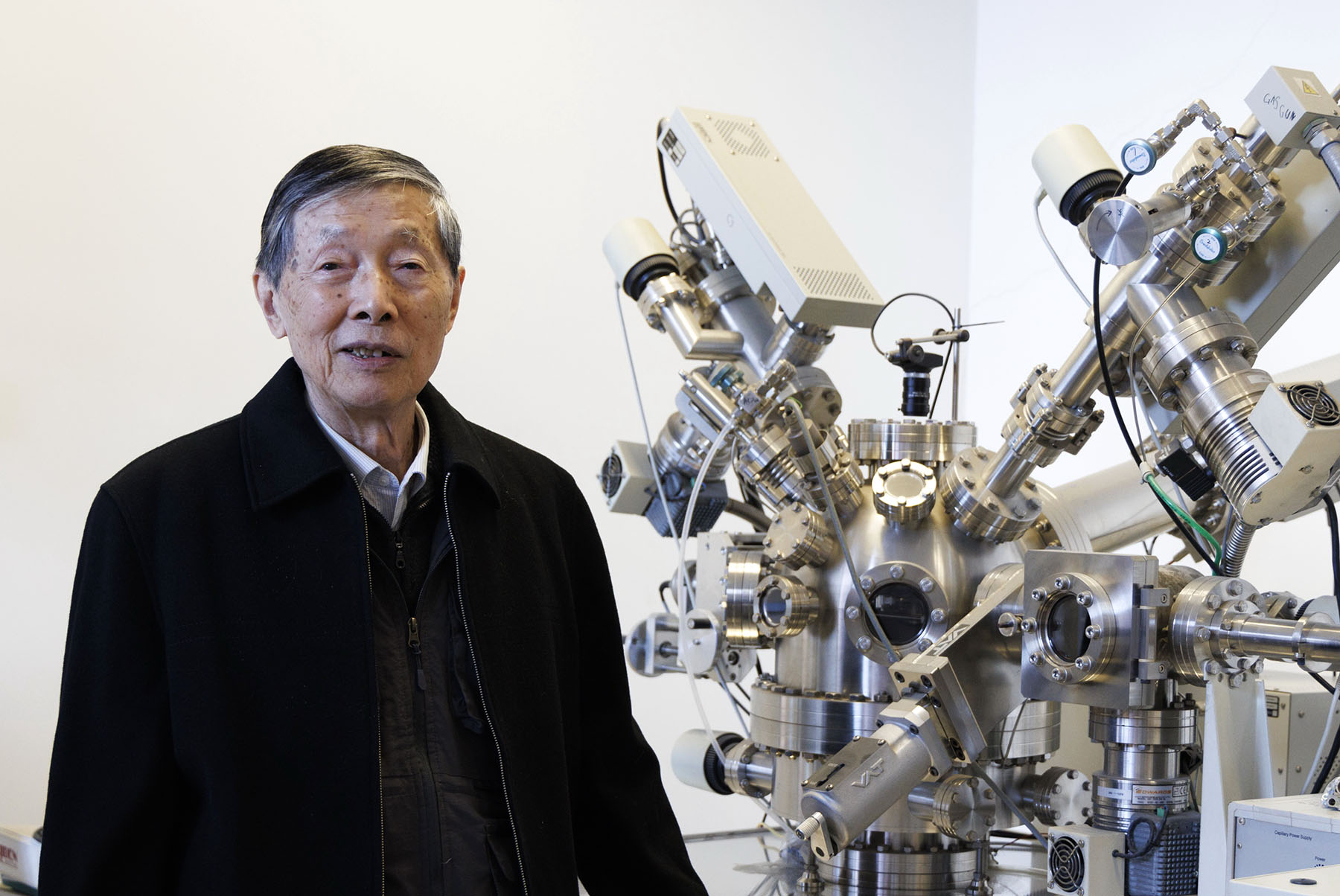
Chen Liquan was 36 years old when he arrived as a visiting scholar to the Max Planck Institute for Solid State Research in Stuttgart, in what was then West Germany, in 1976. During an open day, his attention was captured by a button-sized lithium nitride cell with high energy density displayed beside a bulky traditional lead-acid battery.
Something clicked with Chen when a German colleague expressed the belief that such materials might one day be used to make batteries capable of powering cars. That night, after receiving swift approval from the Chinese Academy of Sciences, Chen decided to change his research direction — from crystal growth to the then-obscure field of solid-state ionics, which focuses on materials such as lithium nitride.
Few could have predicted that the decision would help lay the foundation for China's rise to dominate the global lithium battery industry, which today accounts for around 80 percent of worldwide output.
READ MORE: Pioneering scientists honored with China's top national sci-tech award
Now 86, Chen, an academician of the Chinese Academy of Engineering and a researcher at the Institute of Physics of the Chinese Academy of Sciences, received China's top sci-tech award in Beijing on Wednesday.
The path to the podium began in a mountain village in Nanchong, Sichuan province, where Chen studied by the dim light of a kerosene lamp fashioned from a discarded ink bottle. His family did not have electricity until he entered senior high school, and he did not ride in a motor vehicle until leaving for university in 1959.
His childhood experiences sparked a lifelong passion for electricity, one that stayed with him as he returned from West Germany in 1978 to pioneer solid-state ionics research in China.
In 1981, with support from the Chinese Academy of Sciences, he led the establishment of China's first solid-state ionics laboratory, housed in a converted chicken shed — the only space available at the time.
The conditions were primitive. An old utility pole still stood in the middle of the room, with rainwater running down onto the floor. Because lithium sulfide — a key raw material for synthesizing lithium nitride — was unavailable domestically, Chen produced it himself by melting metallic lithium. Using rudimentary equipment, he assembled a makeshift closed system, feeding sulfur powder through a glass tube to maintain a rough vacuum.
It was a hazardous process. "One time, flames shot out of the tube the moment the sulfur touched the lithium," he recalled with a laugh. "I pulled back immediately. Luckily, I wasn't burned."
Despite the difficult conditions, the team published more than 30 papers within three years. In 1988, Chen's group developed China's first all-solid-state lithium metal battery.
The landscape shifted dramatically in 1991, when Japan's Sony commercialized the liquid-electrolyte lithium-ion battery just as global research into all-solid-state batteries had reached a bottleneck. Recognizing that all-solid-state technology remained far from commercial readiness, Chen made a decisive strategic shift. He temporarily put aside the research he had pioneered and turned his focus to liquid-electrolyte lithium-ion batteries.
"China is rich in coal but short on natural gas and oil. Given this energy structure, using lithium batteries to drive the new energy vehicle industry and reduce reliance on imported oil is an inevitable trend," Chen said, underscoring the importance of commercializing lithium battery technology.
"Our research has always been guided by the country's strategic needs. We must not only achieve zero-to-one breakthroughs in basic science but also carry them through to industrialization — turning good papers into good products that truly power the country," he said.
By 1995, Chen's team had developed China's first liquid-electrolyte lithium-ion cell. Three years later, it completed the country's first pilot production line, capable of producing 200,000 cylindrical cells annually using mostly self-developed equipment, domestically sourced raw materials and independently developed technologies.
The journey, however, was not without danger. While building the pilot production line, the coating machine was too large to fit into the elevator and had to be hoisted manually up the stairwell.
Huang Xuejie, a researcher at the Institute of Physics, recalled that the steel cable supporting the half-metric-ton machine suddenly snapped between the second and third floors.
"It immediately began sliding back down. The three of us closest to it — including Chen, who was already in his fifties — instinctively threw ourselves against the machine," Huang said. "It tilted and slammed into the wall and the handrail, but it held. We saved the equipment."
"Chen is always the first to charge ahead. That's why we followed him," Huang added.
For Chen, lithium batteries have never been confined to the laboratory. They represent an application-oriented technology supported by a complete industrial chain and demanding strong engineering capabilities.
Following Chen's advice, Amperex Technology Limited was founded in 1999 to develop commercial lithium-ion batteries.
Its power battery business, led by Chen's student Zeng Yuqun, was later spun off as the Contemporary Amperex Technology, now the world's largest supplier of power batteries, accounting for more than one-third of global shipments.
According to his students, Chen's greatest strength is his strategic vision. "When everyone else was still celebrating the success of liquid-electrolyte lithium-ion batteries, Chen had already turned his attention to safer solid-state systems with longer cycle life and higher energy density," said Li Hong, Chen's student and now also a researcher at the institute.
"He never abandoned the solid-state route. He simply waited for the technology to catch up," Li said.
That patience paid off in 2016, when Chen and Li proposed the concept of in situ solidification, allowing the electrolyte to transform from liquid to solid inside the battery cell. The approach creates continuous, intimate contact with the electrodes and addresses the long-standing solid-solid interface problem.
Even now, Chen is looking 30 years ahead. He envisions an "Electrified China", where not only cars but also ships, trains, aircraft and rural power grids are powered by domestically produced batteries.
Looking at his students, Chen said: "I know I won't be able to finish it (my work) in my lifetime. So it falls to the younger generation to carry it forward."
Guo Yuhe contributed to this story.
Contact the writers at limenghan@chinadaily.com.cn
