

Energy security, growing power demand seen as impediments to transition goals
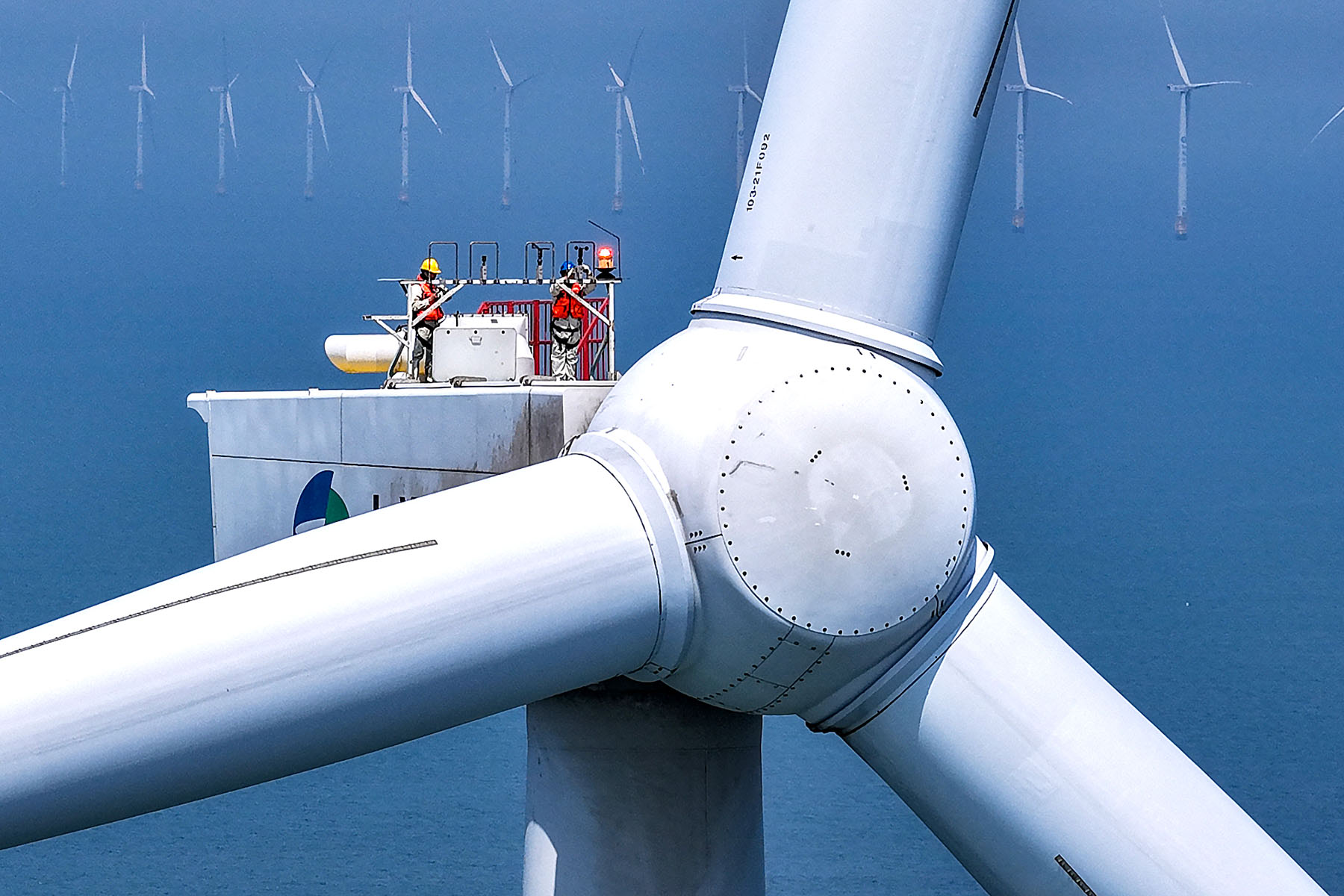
Energy experts have dismissed a recent report from a foreign research institute on China's carbon emissions, noting that its optimistic climate projections for the nation may not fully align with current realities.
Although China has made remarkable progress in addressing climate change and advancing its "dual carbon" initiatives, experts noted that the report might not adequately consider challenges such as China's existing grid limitations, rising power demand, and the government's emphasis on energy security.
The report, unveiled by BloombergNEF in May, projects that China's emissions will fall 17 percent from their 2023 peak by 2030, outpacing China's commitment under the landmark 2015 Paris Agreement.
READ MORE: Premier calls for new energy security strategy
Yet, China has never officially announced that its emissions have peaked. The country pledged in 2020 that it would strive to reach peak carbon dioxide emissions before 2030 and carbon neutrality before 2060.
The report said China is rapidly electrifying, with electricity already the dominant final energy carrier by 2023 and coal's share of power generation falling from about 54 percent in 2025 to an estimated 19 percent in 2035 and 7 percent by 2050.
Wang Weiquan, deputy secretary-general of the renewable energy committee at the China Energy Research Society, described the report as "overly optimistic" and "even radical".
Coal-fired power plants still contribute over 50 percent of China's electricity generation, he noted. If the share is to decrease to 19 percent by 2035, as mentioned in the report, the country has to bring it down by three percentage points a year.
"That's too optimistic," Wang said.
He argued that the report underestimated the weight that the Chinese government places on energy security, which underpins economic stability and people's livelihoods.
"The government has to take a holistic approach," he said.
Wang also pointed to several hurdles that stand in the way of China's energy transition.
China's electricity demand is rising by 500-600 billion kilowatt hours annually, reaching over 10 trillion kWh in 2025 and an estimated 13 trillion kWh by 2030, he said. Wind and solar together currently generate 2.2 trillion kWh.
Including hydro and nuclear, nonfossil sources account for roughly 40 percent, he added.
In addition, the growth of wind and solar power generation may slow down as both have to compete in the power market, where volatile prices create uncertain returns, he said.
"That uncertainty has made even the big State-owned power companies scale back their investment pace," Wang said.
In February 2025, Chinese authorities reformed the approach to pricing wind and solar power, transitioning from fixed tariffs to a market-based system.
For new renewable energy projects with an operation commencement date of June 1, 2025 or later, electricity prices will be established via market-based competitive bidding, according to the new policy.
Prior to this, the country's feed-in tariff mechanism required grid operators to purchase renewable electricity at government-set prices, a guaranteed above-market rate funded through a small surcharge on electricity bills.
Wang said challenges in integrating renewable energy into the grid, along with a shortage of suitable land for new projects, are also hindering the country from rapidly expanding renewable energy development.
"To sustain rapid increase in renewable energy generation is far from easy, given all these real-world constraints," he continued.
Lin Boqiang, dean of Xiamen University's China Institute for Studies in Energy Policy, said the biggest challenge for China to peak carbon emissions and go carbon neutral lies in the construction of a new electricity system dominated by solar and wind power.
"The country's current energy infrastructure remains inadequate, as its power grid lacks the capacity to fully accommodate new energy sources," he said, highlighting that China has yet to develop sufficient capability to address the intermittency of solar and wind power.
Currently, the growth in contribution from wind and solar sources to the grid simply cannot keep up with the rise in power demand, Lin added. As a result, coal-fired power remains the only option to bridge the gap, which explains its continued expansion — albeit at a very slow pace.
"Nuclear power is constrained by safety concerns, preventing large-scale development. As for hydropower, the issue is resource availability — there simply aren't enough suitable sites," he said.
Lin urged enhanced efforts to boost power storage capacity, emphasizing its dual role: addressing the intermittency of renewable sources and, equally important, halting the continued expansion of coal-fired power.
He Kebin, dean of the Institute for Carbon Neutrality at Tsinghua University, said the process of peaking carbon emissions and achieving carbon neutrality will also bring new challenges to air pollution control in China.
He, also an academician of the Chinese Academy of Engineering, stressed that building a new electricity system cannot be done all at once, especially in the face of the explosive growth in power demand driven by climate-induced extreme weather events and the robust growth of artificial intelligence.
Building a new electricity system could take decades, he said. To ensure grid balance throughout this transition, new coal-fired power capacity will still be required, while some existing coal-fired plants will be repurposed to provide reliability support for the grid.
Under these circumstances, many coal-fired power plants will no longer operate according to their designed operating hours, he said. Instead, they will have to start and stop frequently and run at low loads, which will compromise the performance of ultra-low emission technologies and consequently affect the emission of air pollutants.
Yao Xuan, vice-general manager of CHN Energy Longyuan Environmental Protection Co, shared He's views.
ALSO READ: China to establish national fund for low-carbon transition, green economy
Addressing the 24th China International Environmental Protection Exhibition and Conference on June 2, Yao said, to achieve deep peak shaving, many coal-fired power units in developed regions like Zhejiang and Jiangsu provinces are now running at 20 percent load over long durations during the daytime.
"This was something unimaginable," he said.
As one of the country's major electricity generators, China Energy Investment Corporation (CHN Energy) saw its power units average 16 start-stop cycles per unit in 2025, compared with only five half a decade ago, he said.
The frequent start-stop cycles and low-load operating conditions make it challenging to effectively control nitrogen oxide emissions, prevent ammonia slip, and avoid excessive particulate emissions, Yao said.
Contact the writers at houliqiang@chinadaily.com.cn
