

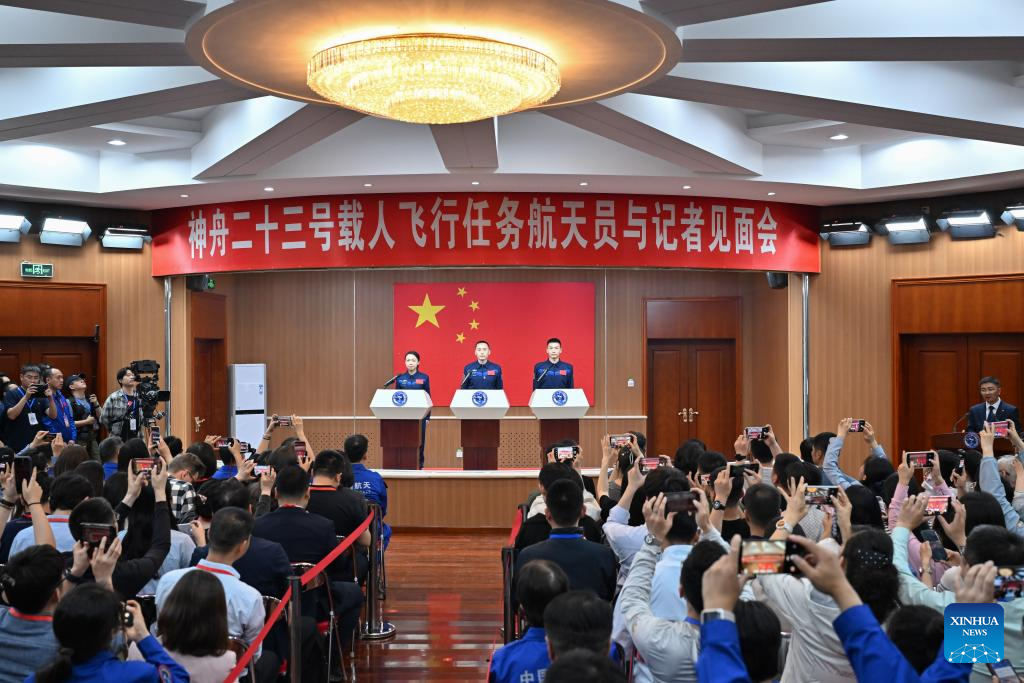
Hong Kong scientists and researchers are celebrating as Lai Ka-ying, a superintendent and technical specialist with the Hong Kong Police Force, becomes the first astronaut from Hong Kong.
Lai Ka-ying, an alumna of the University of Hong Kong (HKU), has been selected as a crew member of the Shenzhou XXIII manned mission.
Her selection marks what the HKU described in a statement as “a new chapter of deep participation by Hong Kong's scientific community in the national space programs.”
“On behalf of the University, I extend my most heartfelt congratulations to our alumna, Dr Lai Ka-ying, on being the first Hong Kong payload specialist to join the national Shenzhou mission,” said Zhang Xiang, president and vice-chancellor of HKU. “Her achievement is a moment of immense pride for the entire HKU community and the city, and a testament to the world-class calibre of our talent.”
Dual achievement
Lai’s selection represents a milestone for Hong Kong’s growing integration into the nation’s space program.
Speaking at a press conference at the Jiuquan Satellite Launch Center in northwest China, Zhang Jingbo, spokesperson for the China Manned Space Agency, also highlighted the Hong Kong University of Science and Technology (HKUST)’s Multi Spectral Imaging Carbon Observatory (MUSICO).
Described as the world’s first lightweight, high-resolution, high-precision synergistic carbon dioxide and methane point-source detector, MUSICO has arrived at the Tiangong space station after being launched aboard the Tianzhou 10 cargo spacecraft earlier this month.
Su Hui, Project Lead and Chair Professor in the Department of Civil and Environmental Engineering at HKUST, said she felt profound pride at the dual achievement.
“As a scientist in Hong Kong, I am immensely proud that our locally trained payload specialist will soon be stationed aboard the Tiangong Space Station. She will operate the MUSICO developed by HKUST — an honor that fills me with great excitement,” Su said.
Su also expressed hope that the moment would “inspire more young people in Hong Kong to pursue STEM education and bravely join the ranks of space exploration.”
Recognition of HK science talent
The City University of Hong Kong (CityU) also extended warm congratulations, pointing to its own contributions to space science, including a cartilage repair material project that was carried aboard Shenzhou XVI for testing on the space station.
Dennis Lo Yuk-ming, president of the Hong Kong Academy of Sciences (ASHK), described Lai’s selection as a historic moment in the opening year of the national 15th Five-Year Plan, saying it “demonstrates the nation's high recognition of the strength of Hong Kong's scientific and technological talent.”
Anderson Shum, president of the Hong Kong Young Academy of Sciences (YASHK), said Lai’s successful selection “fully proves the solid foundation of Hong Kong's science education and the ability of scientists to play important roles in national-level major projects.”
He expressed his hopes that more young Hong Kong scholars will join national space efforts and other top-tier research projects, drawing on Hong Kong’s unique advantage of “backing the motherland while connecting with the world.”
