

Experts welcome Cambodia's actions while also noting risks of displacement
Editor's note: In this weekly feature China Daily gives voice to Asia and its people. The stories presented come mainly from the Asia News Network (ANN), of which China Daily is among its 20 leading titles.
As Cambodia pushes forward with its effective crackdown on scam centers, a new problem has emerged.
On April 24, Cambodia declared that the authorities had cracked down on more than 250 online scam locations and closed 91 casinos between July 2025 and mid-April this year.
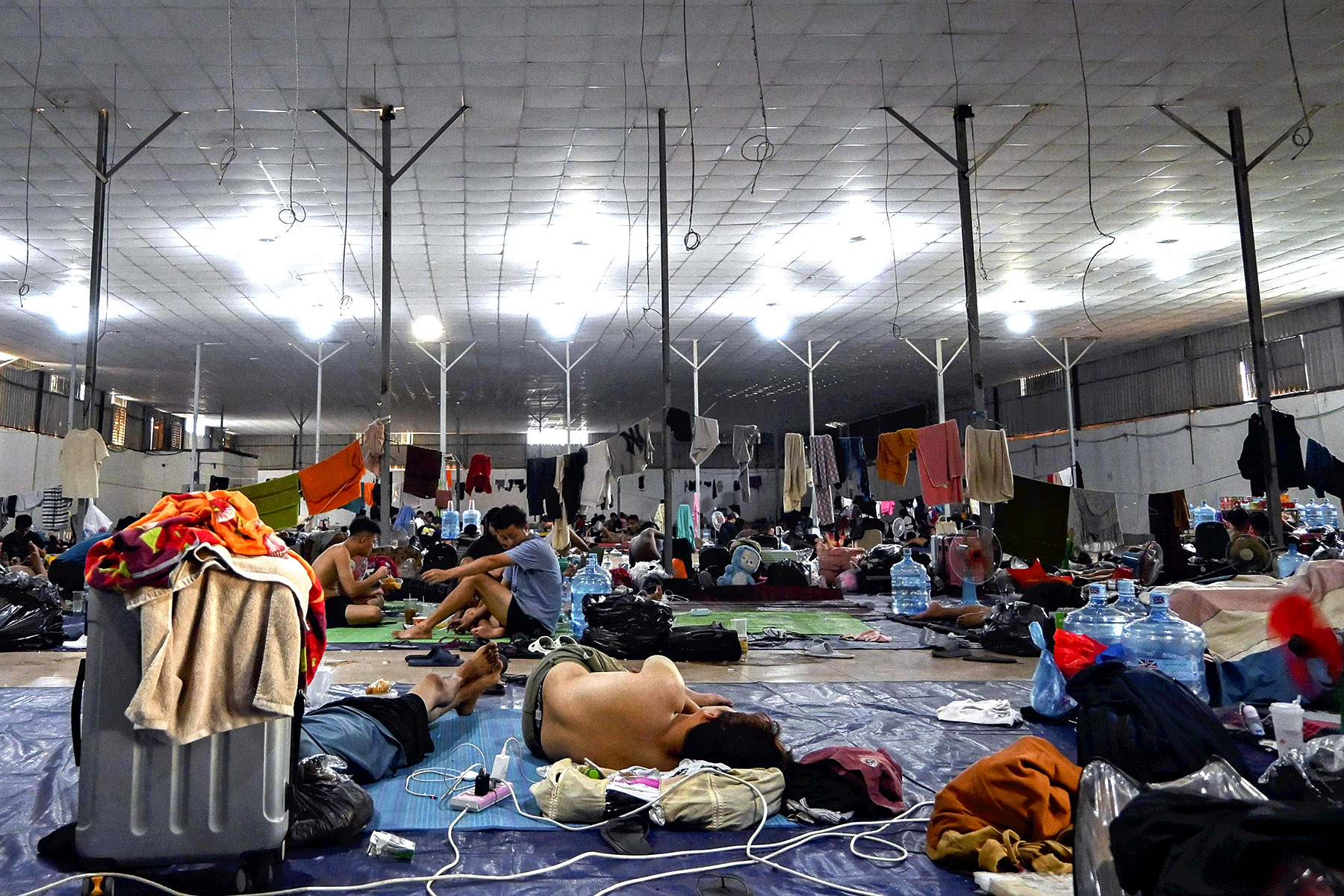
However, the shutdown of these centers has left thousands of foreigners without jobs or shelter, and they are unable to return to their home countries without passport or money.
Analysts warn these people could end up being recruited back into new scam centers, become a source of social disorder, or even trigger a humanitarian crisis.
READ MORE: Looming danger
In the last two months, hardly a week has gone by without reports about Cambodian authorities cracking down on scam operations. In early March, Prime Minister Hun Manet vowed to shut all scam centers in the country by the end of April to restore tourist and investor confidence.
Besides the capital Phnom Penh, other scam hot spots include border areas with Thailand, such as O'Smach town and Poipet city in northwestern Cambodia, as well as border cities with Vietnam, including Bavet and Kampot in the south.
On a weekday in April, about 70 men were seen milling around a park opposite the Indonesian embassy in Phnom Penh. At night, many slept on straw mats on pavement outside shops that had shuttered for the day.
Marco Lem, 28, said he had been sleeping on the street outside the Indonesian embassy for the last two months while seeking help to obtain a passport and return to Jakarta. The father of two claimed he was lured to work in a casino but was subsequently led to Sihanoukville and forced to scam people.
Sihanoukville, a coastal port city in southwestern Cambodia, is known as a global hot spot for gambling, cybercrime and reported cases of human trafficking tied to such activities.
"I don't know whether I will be arrested when I return to Indonesia. But I've seen friends who went back and were not arrested," Marco said.
Another Indonesian, David Butar, 23, has also been left on the street to fend for himself. The father of a two-year-old daughter said he was tricked into working in a scam compound in Bavet, Svay Rieng Province bordering Vietnam.
On the street for two months now, he is waiting for the Indonesian embassy's help to return home. He said he needs official documents to be repatriated, as he had overstayed in Cambodia while being holed up in the scam compound.
The Straits Times was unable to independently verify both men's claims of being tricked into scam compounds. The Indonesian embassy has yet to reply to queries on the matter.
The crackdown has raised concerns that large numbers of scam workers — both voluntary and forced — could be left stranded.
It is difficult to estimate the number of workers involved in scam operations in Cambodia, as the centers operate like a revolving door, with workers recruited regularly and moved to different locations in the country.
While some joined willingly for the pay, others were deceived with job offers, and many ended up trapped after their passports were seized by operators.
In the update on April 24, the government said that 241,888 individuals had left the country voluntarily between mid-January and April 19.
But many former scam center workers remain in Cambodia, with some housed by nongovernmental organizations or in temporary holding facilities like the one near the old Phnom Penh airport.
"If thousands of displaced workers are left homeless or scattered without a clear plan for repatriation or protection, the country risks a secondary security crisis," said independent Phnom Penh-based analyst Vanly Seng, referring to the possibility that these workers may turn to crime out of desperation.
Reports have also surfaced online of some former female scam workers claiming they were raped after being left to fend for themselves on the streets.
"It's quickly turned into a humanitarian disaster, with both the local authorities and international organizations struggling to keep up," said John Wojcik, a senior threat researcher with cybersecurity firm Infoblox.
Beyond borders
The scourge of scams is not just a Cambodian issue.
The Global Anti Scam Alliance estimates that across the globe, $442 billion was lost to scammers in 2025. A UN report in 2026 said the scam industry in the Mekong region alone is worth over $43.8 billion a year.
Cambodia's intensive crackdown on scam compounds has not gone unnoticed by neighboring Thailand.
Thailand's Foreign Affairs Ministry said there may be a risk of the scam centers moving to neighboring countries as Cambodia intensifies its operations.
The ministry said Bangkok has strengthened its controls and surveillance, with security agencies on high alert.
Despite strained relations after their border clashes in 2025, Thailand said it remains committed to working with Cambodia to combat online scams.
The Cambodian government has identified combating online scams as a top national priority, saying the illicit activities have affected its economy and image.
Phnom Penh said it wants to dismantle entire criminal networks and sever all the scam syndicates' financial sources in Cambodia to ensure a lasting solution.
While analysts largely welcome Cambodia's efforts, they say these are not enough to root out the problem of scams.
Seng, the analyst, said, "Raiding physical buildings is only half the battle.
"Without a sustained effort to dismantle the financial pipelines and the encrypted communication networks they use, I suspect we are seeing a displacement of the problem rather than its total eradication."
ALSO READ: Cambodian PM vows to eliminate all online scams centers by next month
As part of its enforcement efforts, the Cambodian government has filed 112 cases in court involving 1,089 individuals linked to scam operations.
But Bunna Vann, head of research and advocacy program at the Cambodian Youth Network Association, said the government has largely taken action against low-level perpetrators. Many influential figures and those with political backing behind the scam activities remain at large.
Wojcik of Infoblox said today's highly sophisticated and hypermobile syndicates operate more like transnational corporations, making them difficult to eradicate completely.
He advised countries to devise better ways to tackle the fast-evolving and sophisticated online scamming activities. One strategy is to implement national Protective Domain Name Service programs, which will make networks more secure by preventing access to malware, phishing attacks and viruses at the source.
Meanwhile, David remains hopeful even though he has been sleeping rough for weeks.
"I'm happy now because I'm free from the scam compound. I want to go back to Indonesia."
