


Editor's Note:
The Hong Kong Police Force on May 8 released a special publication titled Hong Kong Major Cases Decoded. The publication takes readers behind the scenes of seven major cases that were solved in recent years, revealing how the investigations actually unfolded. It includes interviews with the detectives who led each case. These firsthand accounts are paired with professional psychological analysis, shedding light on a side of detective work that is rarely seen by the public.
This is one of the seven cases: The Fei Ngo Shan Kidnapping Case.
How the crime unfolded
In March 2014, a nine-member criminal gang from Guizhou province hatched a plot to commit crimes in Hong Kong. The only member who held a valid travel permit, a man surnamed Zheng, entered Hong Kong first via Lo Wu Control Point. The others later sneaked across the border illegally and hid in Fei Ngo Shan (Kowloon Peak), where they surveilled potential targets.
In the early hours of April 25, 2015, they broke into a house on Fei Ngo Shan, took a female victim and her male friend hostage, and robbed them of jewelry and cash worth approximately HK$3 million ($383,000). They then kidnapped the woman, imprisoned her in a nearby cave, and demanded HK$58 million in ransom from her family. The ransom was eventually negotiated down to HK$28 million. On April 28, 2015, the victim's father personally drove to Fei Ngo Shan to deliver the money.
After receiving the ransom, the kidnappers released the victim. Two gang members who had collected the ransom embezzled HK$18 million. The remaining members split the rest of the ransom and continued to lie low in Fei Ngo Shan. Later, they made their way on foot to Mui Tsz Lam in Ma On Shan, where they stashed most of the money before fleeing back to the Chinese mainland.
Meanwhile, the police had been conducting an intensive manhunt. Zheng was captured as he attempted to cross the border at Lo Wu and confessed to the entire operation. With the cooperation of police forces from the special administrative region and the mainland, all the other gang members who had fled back to the mainland were eventually arrested.
Nearly a year later, the police forces of Hong Kong and the mainland recovered HK$ 27.89 million of the ransom and dozens of the robbed items. Only HK$ 110,000 had been spent by the gang members during their escape.

Case-solving insights
Investigators had to be extremely cautious during the hostage rescue, and the pressure was immense, according to the police.
“When I received a call from my colleague saying the hostage was safe, we all breathed a huge sigh of relief—nothing is more important than a life,” said Sergeant Tong Ho-fat, then a detective officer with the Regional Crime Unit, Kowloon East.
“We immediately started planning our next steps. We knew we had to make the most of the golden 48 hours to arrest the suspects and recover the ransom; otherwise, leads and evidence would slip away with time. From start to finish, until the moment the criminals were apprehended, none of us got much sleep.”
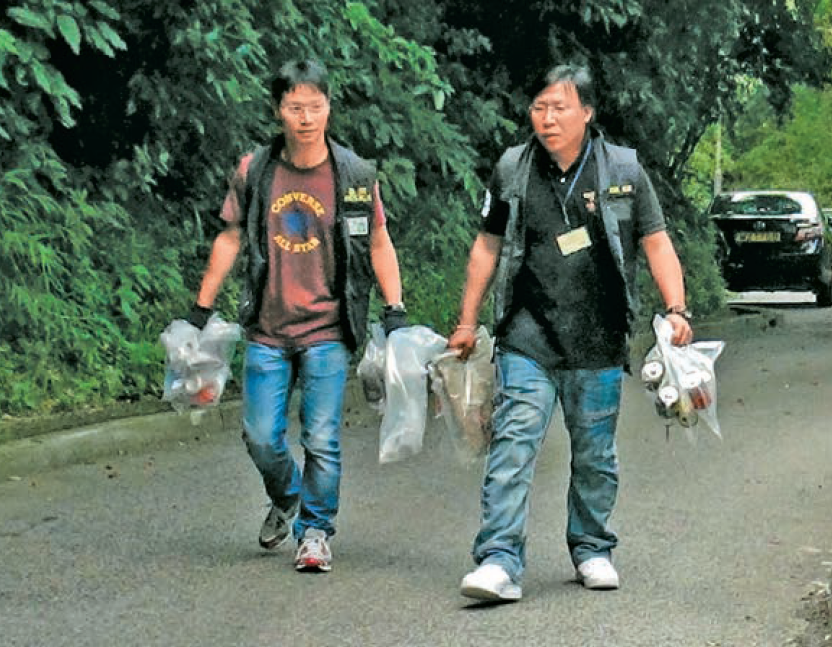
Since the suspect confessed that part of the ransom was still hidden somewhere in the mountains at an unknown location, the police team had to take shifts to search for the evidence. There were times the police stayed out in the wilderness for three days and three nights straight. In the end, it took them nearly a full year to recover the ransom, said Tang.
“Despite the scorching sun, the pouring rain, and our hands and legs covered in cuts and bruises, we never gave up—and we never would. That perseverance was a promise we made to ourselves and to justice. In the end, we recovered the ransom and successfully secured convictions against the criminals. The whole process was filled with hardships, but being able to bring the bad guys to justice with our own hands and uphold righteousness is truly an honor.”
Psychological analysis
Complex and unpredictable, kidnapping cases present investigators with a range of psychological challenges. Detectives often face numerous difficulties and setbacks during their investigations and have to make quick decisions under extreme pressure—each one potentially affecting the life or death of a hostage.
Victims of kidnapping can also react very differently. The most talked-about psychological response is Stockholm Syndrome.
In August 1973, two robbers broke into a bank in Stockholm, Sweden, and held four hostages for six days. Nils Bejerot, a psychiatrist advising the police, later observed that an emotional bond had formed between the hostages and their captors. Far from being angry at the robbers for holding them captive, the hostages actually felt grateful for the food and water they were given, sympathized with their captors, and even defended them.
Psychologists now believe that Stockholm Syndrome is not a mental disorder but rather a self-protective mechanism to survive in an unnatural situation.
Psychologists also point out that similar patterns—justifying a perpetrator's actions or forming an emotional bond with them—can appear in victims of sexual violence, domestic abuse, cult manipulation, and even online romance scams.
