

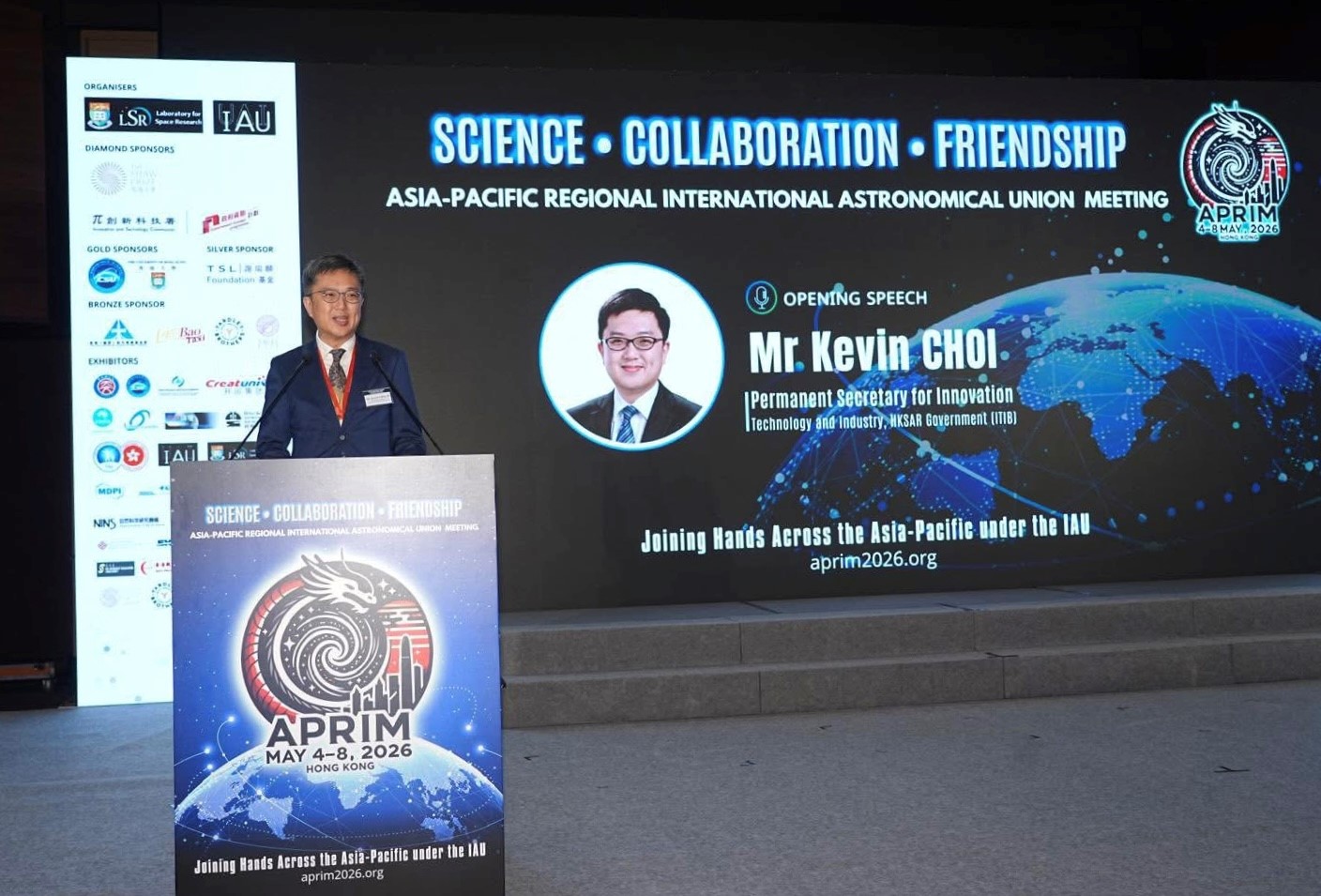
Hong Kong rolled out the welcome mat on Monday for the 2026 Asia-Pacific Regional International Astronomical Union Meeting, or APRIM.
The five-day event marks the first time the city has hosted the prestigious triennial gathering, signaling its ambition to become a launchpad for the region’s burgeoning new space economy.
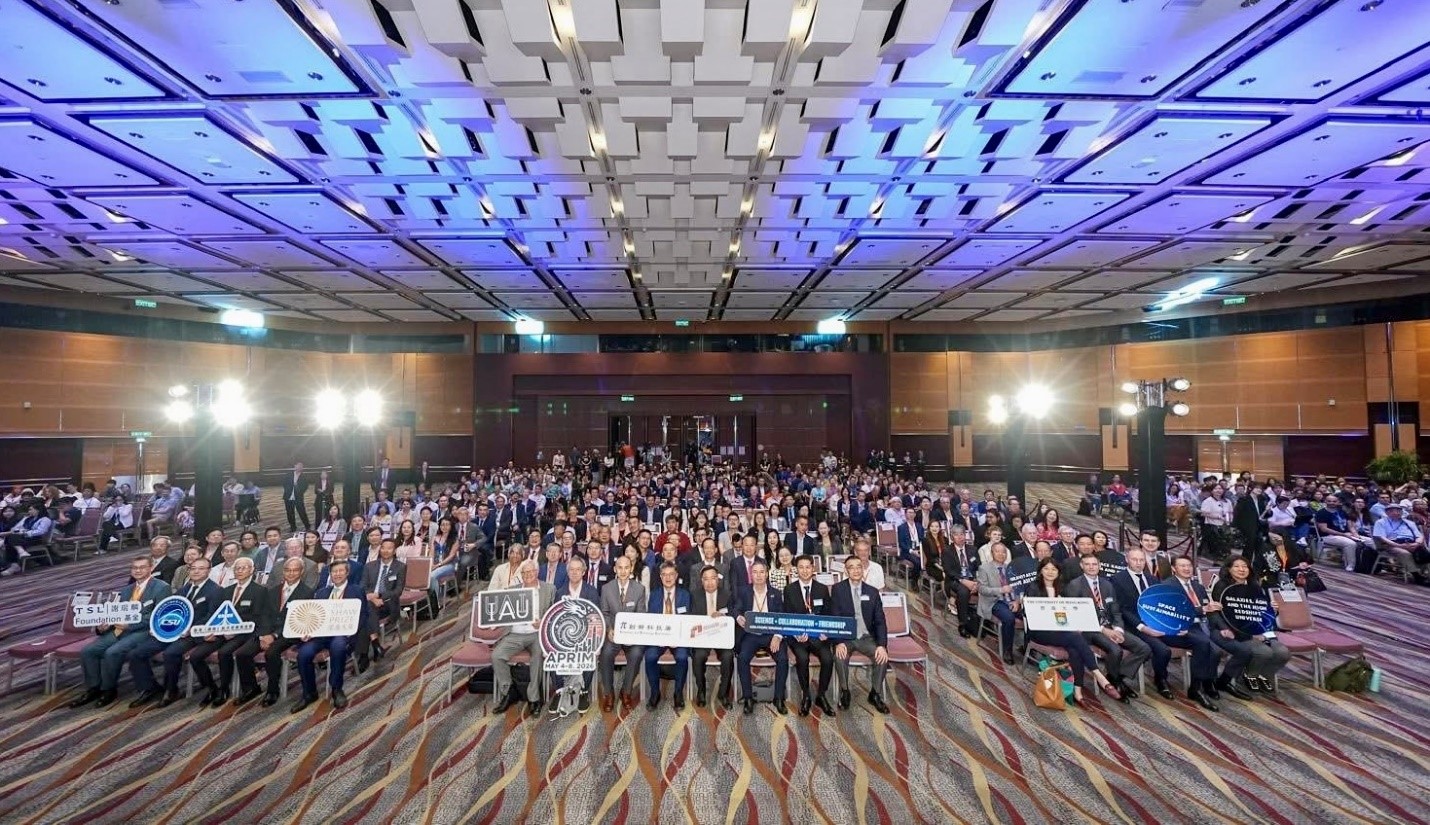
More than 600 scientists, engineers, and policymakers from 37 countries packed the conference to advance the frontiers of black holes, exoplanets, orbital debris, and the trillion-dollar burgeoning new space economy.
“Hong Kong can play big in the downstream of the new space economy,” said Executive Council member Ronny Tong Ka-wah, who has spent years pushing the city toward space commercialization.
ALSO READ: Touch base for Hong Kong’s space economy
The lineup matched the ambition. Five Nobel Prize and Shaw Prize laureates were among the delegates, turning what could have been a niche academic gathering into a full-blown science summit and a gala of the new frontier in Hong Kong’s growing stature as a convener of elite global intellectuals.
“Hong Kong has already attracted 16 aerospace companies to the city, thanks to the nation’s policy of elevating the space economy as a strategic pillar,” said Kevin Choi Kit-ming, permanent secretary for innovation, technology and industry.
He announced over HK$100 million ($12.8 million) in government funding for six flagship aerospace research-and-development projects, including a University of Hong Kong-developed short-wavelength infrared spectrometer selected as a payload for China’s Tianwen 3 Mars mission, scheduled for 2028.
Speakers from across the Asia-Pacific region converged on a defining theme: Cross-boundary cooperation was fundamental in benefiting humanity, which, in time, plays to Hong Kong’s unique niche.
As international collaboration increasingly knits space-industry players across countries into a shared vision, the city stands ready to serve as the connective tissue — bridging scientific ambition with economic opportunity, from the frontiers of deep space to the fast-emerging low-altitude economy here on Earth.
“APRIM represents far more than an academic conference,” said Quentin Parker, director of the Laboratory for Space Research at the University of Hong Kong, the event organizer.
“We can become a global hub for space sustainability,” he said, pointing to Hong Kong’s advantages in common law, fintech, international connectivity, and intellectual-property protection. He said that the new space economy is projected to reach $2 trillion by the mid-2030s.
“Science and space are beyond borders,” said Gemma Anderson of the Australia Telescope National Facility.
The Netherlands Consul General Maurits ter Kuile said his government is tracking Hong Kong’s space-economy progress and “expects to find opportunities for cooperation”.
READ MORE: Former SFC chief Anthony Neoh: HK bets on trillion-dollar space economy
A parallel two-and-a-half-day meeting on space sustainability, sponsored by the Chinese Space Enterprise Group, is running alongside the main conference — signaling Hong Kong’s ambition to anchor itself in the global conversation on orbital debris, satellite regulation, and long-term stewardship of the space environment.
Candid voices at the conference said that ambition must be matched by action.
“Although Hong Kong holds a strategic position in this regard, it is currently lagging behind the curve in space commercialization,” said Bill Condon, a consultant at local think tank Our Hong Kong Foundation and an adviser to Asia Financial.
Even on the research side, or “upstream”, of the space economy, there lies a gap in attracting talent. “We must be candid: there is much room to strengthen the collective capacity in space science — not just in Hong Kong, but across the wider Guangdong-Hong Kong-Macao Greater Bay Area,” said Luis C Ho, director and chair professor of the Kavli Institute for Astronomy and Astrophysics at Peking University.
“The city needs to sharpen its talent policy to attract the best minds in the world,” said the professor, whose research sits at the forefront of supermassive black-hole science.
Contact the writer at jessicachen@chinadailyhk.com
