

Tokyo has set a dangerous precedent in the Philippines, making it inevitable that people should remain highly vigilant about the pace of its remilitarization.
On April 6, the annual United States-Philippines joint military exercise “Salaknib” began on Luzon Island in the Philippines. This year, however, the drill carried an added resonance.
For the first time, Japan participated as a formal exercise partner, with 420 personnel of its Self-Defense Forces taking part in command coordination and live-fire exercises.
It marks the first time Japanese combat troops have set foot on Philippine soil since 1945.
READ MORE: Japan's drill role stirs unease
The stated aim was to strengthen military interoperability among like-minded countries in the “Indo-Pacific” and reinforce defense commitments.
But Japan’s participation clearly signals the institutionalization of trilateral security cooperation among the US, Japan and the Philippines.
Japan’s “first” participation in these joint military exercises is far from accidental. It is the result of the country’s sustained efforts to strengthen security ties with the Philippines in the post-Shinzo Abe era.
The Reciprocal Access Agreement between them, which came into force in September 2025, provides a legal basis for the deployment of troops on each other’s territory.
In January, the two sides signed the Acquisition and Cross-Servicing Agreement, which enables mutual provision of logistics and services, including fuel, ammunition and equipment maintenance.
Meanwhile, negotiations on a General Security of Military Information Agreement are progressing steadily. Given that both the US-Japan and US-Philippines alliances already have such arrangements in place, a Japan-Philippines agreement would facilitate trilateral intelligence sharing.
Under its Official Security Assistance framework, Japan has provided the Philippines with 3.1 billion yen ($19.5 million) in military-related aid over the past three years.
The Takaichi administration has revised the “Three Principles on Transfer of Defense Equipment”, which further eases restrictions on exporting lethal weapons.
Tokyo has reportedly already held informal consultations with Manila on the potential export of the Type 03 medium-range surface-to-air missile system.
With Australia also joining this year’s drills, the quadrilateral defense ministers’ framework among the US, Japan, Australia and the Philippines has become increasingly mature.
A new form of “minilateral” security cooperation in the “Indo-Pacific”, centered on these four countries, is taking shape.
This trend reflects both the US’ broader efforts to counterbalance China and the growing desire among its allies, including Japan and the Philippines, to enhance their own defense capabilities amid uncertainties about the US’ security commitments.
This evolving multilateral alignment overlaps with the Philippines’ role as this year’s chair of the Association of Southeast Asian Nations.
The Ferdinand Marcos Jr administration has prioritized advancing negotiations on a Code of Conduct in the South China Sea, seeking to leverage its chairmanship to reinforce the legitimacy of its actions in the region while gaining strategic leverage through defense cooperation with the US and Japan.
For Japan, supporting the Philippines could expand its presence in the South China Sea in a multilateral format.
This approach not only aims to extend Japan’s influence within the ASEAN framework through Manila, but also to promote strategic linkages among the East China Sea, the Taiwan Strait and the South China Sea.
Such moves risk introducing new variables into efforts to manage regional disputes.
During World War II, Japanese forces committed numerous atrocities across the region, including the Sook Ching massacre targeting ethnic Chinese in Malaya, the forced labor of Indonesian workers, and the Bataan Death March and Manila massacre in the Philippines.
These painful experiences remain a shared source of sensitivity toward Japan’s military role. As a result, Japan’s military expansion continues to generate unease and criticism in Southeast Asia.
ALSO READ: Japan's proposed constitutional amendment a step backwards toward its militaristic past
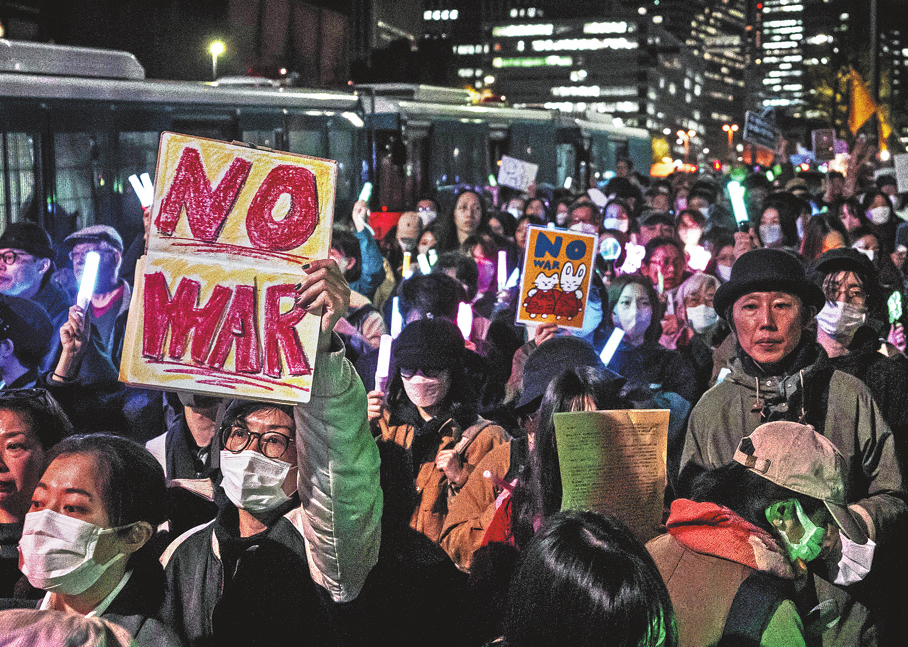
In Japan too, on the eve of the “Salaknib” exercise, over 6,000 people took to the streets in Tokyo to protest against what they see as dangerous policies, including the continued relaxation of arms export restrictions and ongoing military expansion.
The pacifist principles enshrined in Article 9 of Japan’s Constitution have long formed the foundation of the country’s postwar political consensus, yet recent moves by the Takaichi administration are eroding this consensus.
Japan is increasingly invoking the need to “uphold a rules-based order” and “respond to security threats” as justification for pushing beyond the constraints of its postwar pacifist framework, and legitimizing these steps through multilateral cooperation with the US and regional partners.
If Japan is truly committed to regional peace, it should confront its wartime history and quit military expansion, rather than repeatedly testing the boundaries of the postwar international order.
Wang Guangtao is an associate professor at the Center for Japanese Studies in Fudan University; Hua Haonan is a researcher at the Graduate School of Media and Governance in Keio University. The views do not necessarily reflect those of China Daily.
