

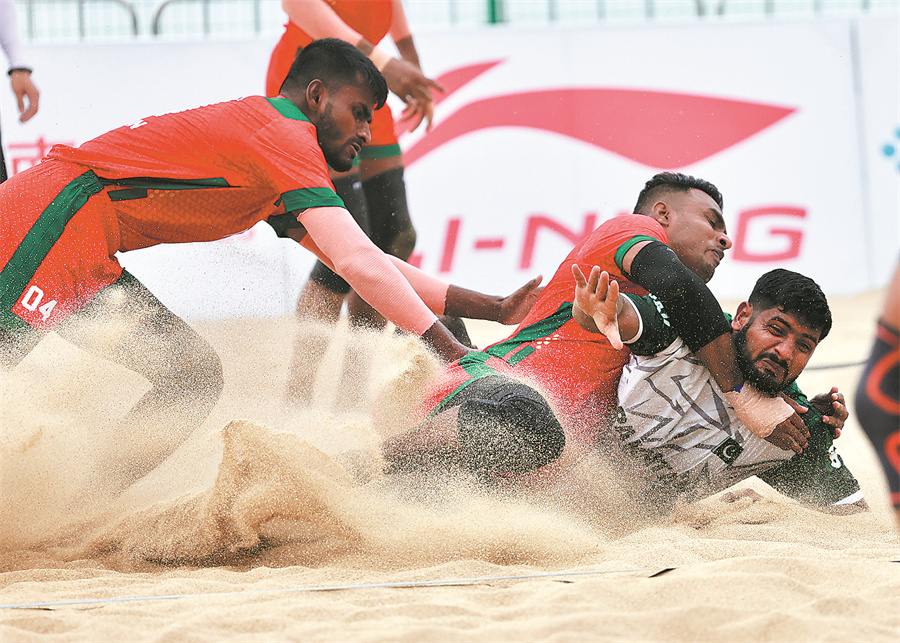
Lightning raids in kabaddi, hot shots in handball and delicate ball-control in soccer — the 6th Asian Beach Games in Sanya have it all, and much more, with a unique sports program that's captivating the world.
With the coastal city's sun-drenched shores providing a breathtaking backdrop, the 2026 Asian Beach Games, which opened in Sanya, Hainan province, on Wednesday, have shed new light on some of the more exotic iterations of popular continental sports.
From the hustle and tussle of kabaddi, to the acrobatic flair of handball, the Games' unique conditions — hosting these sports on warm and soft sand, where unstable footing requires more strength and balance, or in the ocean in the case of water polo, where surging waves prove hard to tame — have added an extra layer of intrigue to these already entertaining activities.
Almost half of the total 14 sports, consisting of 62 medal events, being contested in Sanya are not currently on the Olympic program, yet have drawn immediate and enthusiastic interest from a local crowd that has found these niche events fittingly fascinating in the context of their coastal city.
"It looks just like the chase-and-catch game of tag, and, at some points, resembles wrestling on the beach, which is pretty fun," Wang Xinying, a travel agent in Sanya, said of her first experience watching live beach kabaddi on Thursday.
"Playing on the sand, barefoot, makes it a natural fit among a variety of beach activities in Sanya. I'd like to watch more of it."
Played on soft, shifting sand rather than a hard, confined indoor court, beach kabaddi strips away the rigid indoor constraints and infuses the age-old sport, which originated in India and enjoys massive popularity in South Asia, with vibrant energy and raw physicality.
The size of the rectangular court is smaller, the matches shorter and the number of players on each team fewer, with the beach version being four-a-side compared to the traditional seven-a-side game played indoors, resulting in a faster and more unpredictable switch between raid and trap.
The uneven sandy surface challenges players' balance, agility and explosive movement, as attackers have to adapt to their unsure footing when raiding the opponent's zone, while defenders rely on low, sturdy stances and quick reflexes to tackle.
Less reliant on tactics and rigid formations, which are critical with the indoor version, beach kabaddi instead rewards instinct, encouraging sudden raids and countermoves in a faster-paced, yet safer way.
"In India, everyone knows this sport and everyone plays it. Today, kabaddi has gained worldwide fame, and the beach Games will only make it more popular," India's head coach Rakesh Kumar said after leading the men's team to a 66-23 rout of Chinese Taipei in its opening Group B match on Thursday.
Similar to beach kabaddi in being contested on a smaller court, beach handball adds more unique flair to the sport compared to its indoor counterpart. With dribbling not allowed, players attack by passing and shooting in a rapid-fire fashion, sequences usually capped with acrobatic shots, mostly spin moves, which are awarded with two points, one extra than a regular shot.
"To be honest, they are totally different," Qatari player Amir Denguir said of the comparison between the beach and indoor versions of the game. "Beach handball is more fun. You play on the beach and enjoy it, while indoor handball is more serious and comes with more pressure."
The fun of competing at the beach Games is multiplied when the action takes to the ocean.
In addition to the challenge brought by their opponents, water polo athletes in Sanya also have to contend with the rhythm of ocean waves, competing in open-air pools set on inshore floating decks.
The more experienced competitors have learned to read wave patterns, timing their sprints, while adjusting shooting motions between swells to make the best of the brief moments of stability offered by mother nature.
"The waves became strong at one point; a huge swell threw me off balance and blocked my sight so that I could not see my teammates," women's player Chan Pakyin of Hong Kong, China, said of the challenging nature of the open-water polo.
"It can be fun, as well, because, sometimes, you get to take advantage of the waves to sprint faster — and I even saw some small fish swimming close by during the match," she said following her team's 3-1 loss to Kazakhstan on Thursday.
Making its highly anticipated beach Games debut in Sanya, teqball has emerged as one of the event's most eye-catching new attractions.
Originating from Hungary, this dynamic hybrid blends the technical ball-handling of soccer with the fast-paced intensity of table tennis, played on a curved, specially designed table.
Athletes use their feet, head, chest and knees — no hands or arms — to volley a soccer ball over the net in up to three touches per turn. Competing on open sand, players must also adapt to coastal breeze and soft ground, adding an extra layer of challenge that, again, sets beach teqball apart from its indoor version.
Set against Sanya's stunning coastal backdrop, the beachfront teqball venues at the Yuhai Club drew a large crowd to the practice sessions even before the official competition began, underlining its growing public appeal.
The impressive turnout has built confidence among the participating teams that they are helping lift the sport's popularity to new heights.
"This sport is developing rapidly and becoming more popular every year," said Ramzi El-Achkar, an official for Team Lebanon. "There is a major tournament every three to four months. We can see that it keeps improving, and it will have an even brighter future."
