

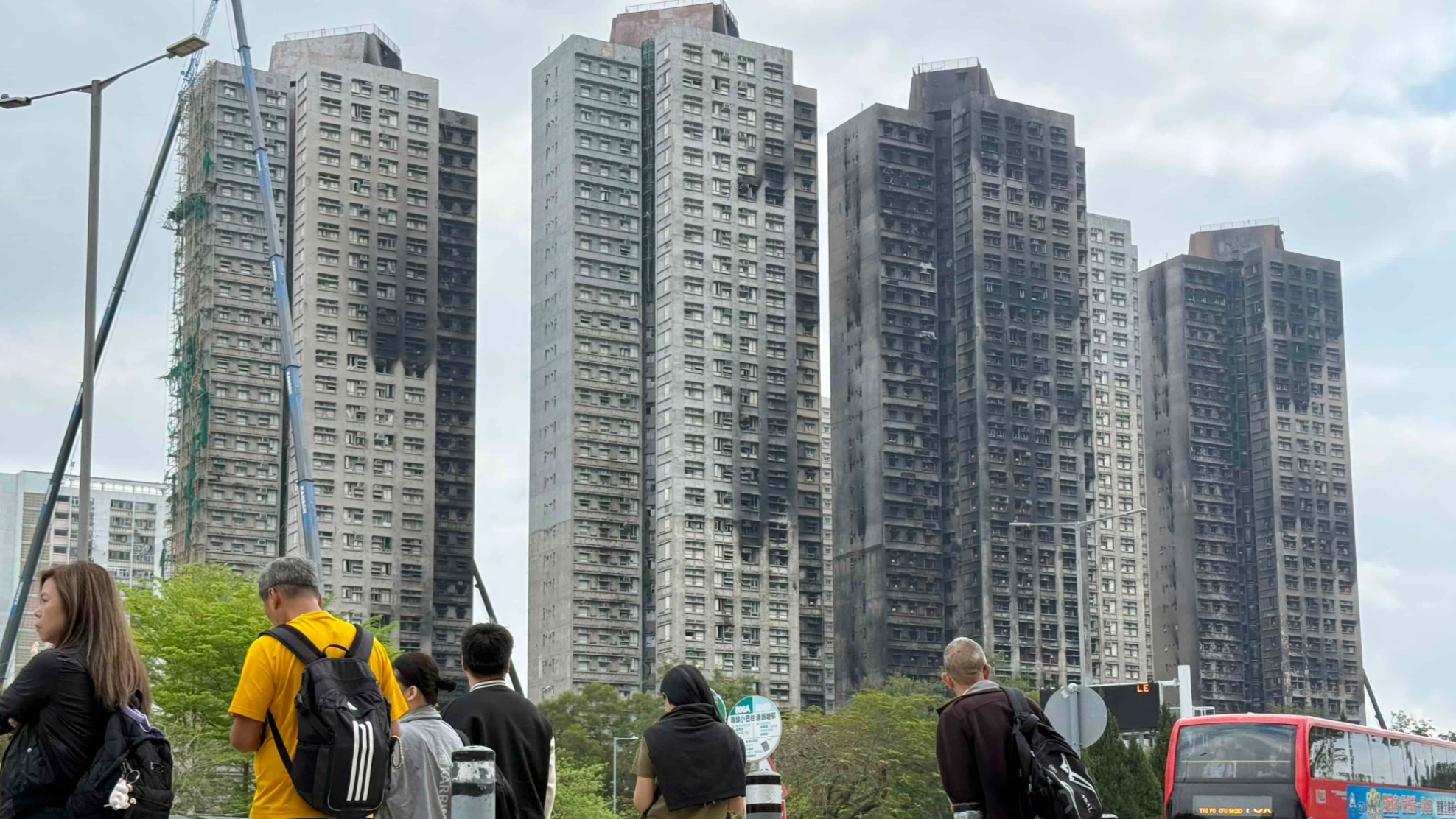
A public inquiry into November’s deadly Wang Fuk Court fire revealed on Thursday that the estate’s renovation exposed numerous problems, including serious deficiencies in fire risk management, an allegedly manipulated Owners' Corporation; and contract violations.
The 43-hour blaze in the city’s Tai Po district, which claimed 168 lives, ranks among the city's deadliest. Thursday's hearing — the 13th session held by a judge-led independent committee — heard testimony from four residents of Wang Fuk Court and two subcontractors involved in the estate’s external wall renovation.
SPECIAL PAGE: Tai Po fire inquiry hearings
Danny Fung Yiu had lived in Wang Tai House for over 40 years before his mother died in the fire. He testified that during the renovation, several fire doors on Floors 28 to 31 — which were supposed to be kept closed to slow the spread of smoke in the event of a fire — were often left open or half-open, with some being “in bad condition”. He also presented photos showing buckets and bags of powder stacked beside the doors, blocking escape stairwells.
Fung said that he had reported the issues to the property management company and had asked for more patrols and vigilance, but the situation did not improve. His complaints about workers smoking illegally also went unanswered, he said.
Ng Pui-kwan, head of the company responsible for the external wall renovation of Wang Kin House, Wang Tai House and Wang Cheong House, testified that he was given safety courses that lasted "only a few minutes", with no images, videos or notes.
He said he could not recall whether basic safety rules, including smoking bans or the use of temporary openings for renovation workers to access external walls for maintenance (known as sang hau), were covered. He also acknowledged that while workers had been instructed not to smoke near the scaffolding and protective netting, there had been no way for him to confirm compliance, as up to three buildings were simultaneously under renovation, involving around 50 workers.
RELATED ARTICLES:
- Fire commanders admit to evacuation gaps with inactive alarms
- Time gap revealed in Wang Fuk Court fire safety system oversight
- Booking opens Thursday for public hearings into Tai Po fire
- HK's first public hearing on Tai Po fire scheduled for March
Lee Chun-ho, a resident of Wang Tai House on the 19th floor, lost his mother, brother, 15-month-old niece, and domestic helper in the fire.
He testified that before the blaze, his family had complained to the renovation contractor about workers smoking and the damaged protective nets after a typhoon, and had also sought advice from the Independent Commission Against Corruption and authorities about the renovation. Fighting back tears, Lee described his feelings as "anger, pain and a sense of injustice”, urging the committee to uncover the truth and deliver justice for his deceased family members. Committee Chairman David Lok Kai-hong also choked up in response, promising to do his best to find out the truth.
Lee Kwok-hung's mother and two foreign domestic helpers, who lived Wang Cheong House, died in the fire. Lee testified that at owners' meetings of the estate, he had questioned why the contractor — Prestige Construction and Engineering — was working on all eight buildings at once instead of in phases, as previously agreed. He said he was told in response that the former owners' committee chairman “wanted to finish the work early”.
Noting many instances of noncompliance with the contract, Lee said the walkways on the ground to shelter residents and passersby, which were required by contract to have metal ceilings, were instead covered by bamboo scaffolding — which may have directly affected the residents’ escape as debris was constantly burning and falling from high during the fire.
Residents' testimony repeatedly mentioned Peggy Wong Pik-kiu, a Tai Po district councilor and a former adviser to Wang Fuk Court's owners' corporation committee, saying she allegedly obstructing residents from speaking and manipulating votes to foil a bid aiming at overturning the committee at that time.
Tai Chi-man, an estate resident, said Wong used her authority as a district councilor to obtain authorization votes and to exploit elderly residents' reluctance to get involved. Tai called on Wong to attend the inquiry to answer residents' questions.
Contact the writer at amberwu@chinadailyhk.com
