

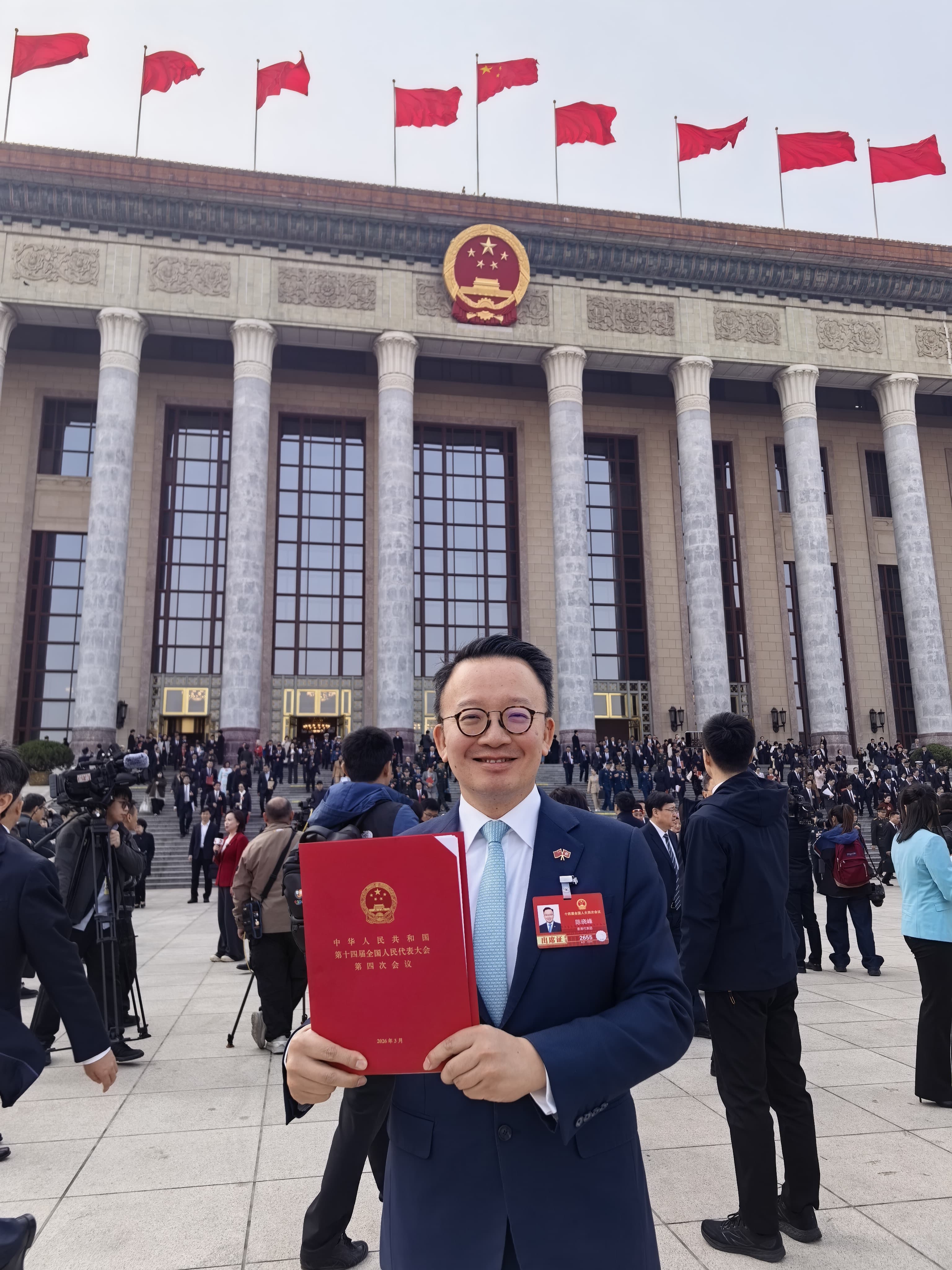
The Hong Kong Special Administrative Region can use its legal edge to serve national development, including refining legal frameworks for emerging industries, bolstering the foreign-related legal system, and deepening judicial cooperation within the Guangdong-Hong Kong-Macao Greater Bay Area, national legislator Nicholas Chan Hiu-fung said.
Chan, a Hong Kong deputy to the National People’s Congress — China’s top legislature, spoke to China Daily on the sidelines of the fourth session of 14th NPC which concluded on Thursday in Beijing.
Chan, a veteran lawyer who has been teaching laws at top institutions in Hong Kong and the Chinese mainland, urged Hong Kong to integrate its judicial strengths into national development in response to the goals listed in the draft of the 15th Five-Year Plan (2026-30), which was approved by national legislators at Thursday’s NPC closing.
Citing Hong Kong’s place at the 2025 World Justice Project Rule of Law Index rankings — sixth in East Asia and the Pacific, 24th out of 143 countries and jurisdictions globally, Chan highlighted the city’s advantages in rule of law and a sound judicial system.
With the 15th Five-Year Plan calling for advancing emerging industries, he said Hong Kong should use its expertise to shape and refine local legal frameworks for “blue ocean” industries, including renewable energy, fintech, crypto, stablecoin, new materials, artificial intelligence, big data and life sciences.
Some laws may have fallen behind the pace of technological and societal development, he added, suggesting that the city’s legal sector “think outside the box, be innovative and creative”.
“We need to make sure the laws are adaptable and suitable — not just allowing these industries to grow, but providing good-fertilized ground for them to grow fast and lead in their areas,” Chan said.
Strengthening international influence
Such legal improvements should not be limited in Hong Kong. In his suggestions to the NPC this year, Chan called for the establishment of a comprehensive legal framework for AI to support the industry’s long-term development to be speeded up and urged the removal of bottlenecks in the commercialization of research outcomes and strengthening of intellectual property protections.
Chan said that Hong Kong can serve as a “compliance interface” to align with international rules and enhance legal protection on domestic AI products going global, stressing the need to establish a tiered governance system that balances flexibility with rigor.
Another focus of his suggestions is in strengthening the foreign-related rule of law system to enhance international influence.
He said that China’s legal sector should export its excellence to other parts of the world, thus promoting a fair level playing field globally, opening up new markets and supporting collaborative growth. “It’s something called co-competition, you cooperate whilst you compete”, the legal expert added.
Also featuring among his suggestions to the national legislature, Chan called for legislation to drive the nation’s institutional opening-up, and enhancing educational cooperation to boost mutual understanding between Chinese and foreign legal communities.
He also suggested implementing a “full-chain” foreign-related legal service mechanism to better protect Chinese enterprises overseas, and emphasized the importance of participating in international rulemaking.
Chan said Hong Kong is an ideal anchor for advancing the nation’s foreign-related legal system, as Hong Kong is the sole Chinese city operating under a common law system, a legal framework recognized by nearly one-third of the world’s population.
He highlighted Hong Kong’s sound experience in mediation and arbitration, noting that the city and Singapore shared the accolade of the world’s second-most-preferred seat of arbitration globally, according to a Queen Mary University of London survey last year.
“Hong Kong should contribute to world economic growth by exporting our legal services, our courts, our arbitration, our mediation — (they are all) second bar none”, he said, citing the decision to establish the International Organization for Mediation’s headquarters in Hong Kong as proof of that.
Deepening regional cooperation
To strengthen the country’s foreign-related legal system, Chan recommended establishing a national-level international commercial mediation center in Hong Kong, specifically to serve Belt and Road Initiative projects. He envisions the center deepening judicial assistance coordination across regions, and enhancing the cross-border enforcement of mediation agreements.
As the Greater Bay Area cities continue to thrive, Chan called for deepening judicial cooperation among the three jurisdictions, including regularizing the pilot program of the annual Guangdong-Hong Kong-Macao Greater Bay Area Legal Professional Examination, which was introduced in 2020.
The program allows Hong Kong and Macao legal practitioners who pass the exam to provide legal services in the nine mainland cities of the Greater Bay Area on certain civil and commercial matters under mainland laws.
“We now have a few hundred very good GBA lawyers and they've helped a lot of domestic businesses take off and explore the world, and attract businesses and finances into China as well.”
Chan said he believes the program fully harnesses the 11-city cluster’s unique institutional advantage of “one country, two systems and three jurisdictions”, contributing to the construction of a regional rule of law, its legal service integration, and the nation’s foreign-related legal development.
Hong Kong has a sound rule of law under ‘one country, two systems’, where numerous legal experts, scholars and judges from around the world gather and discuss topics of mutual interest,” Chan said, and called for Hong Kong to extend its legal leadership to contribute to the nation’s growth.
Enhancing roles of Hetao, IP protection
Chan also focused on biotech, particularly policy barriers to cross-border biospecimen flows. He suggested establishing a pilot project in the Hetao Shenzhen-Hong Kong Science and Technology Innovation Cooperation Zone to unify biospecimen standards and smooth cross-border mechanisms.
This would include establishing a whitelist for biospecimens in Hetao and creating fast-track clearance channels. He also suggested mutual recognition of ethical reviews and sharing of research results between the mainland and Hong Kong — underpinned by clear risk control and legal safeguards.
For innovations across emerging industries, Chan is encouraging mainland-originated intellectual property to come to Hong Kong for internationally recognized IP valuations, financing and trading.
Contact the writer at amberwu@chinadailyhk.com
