

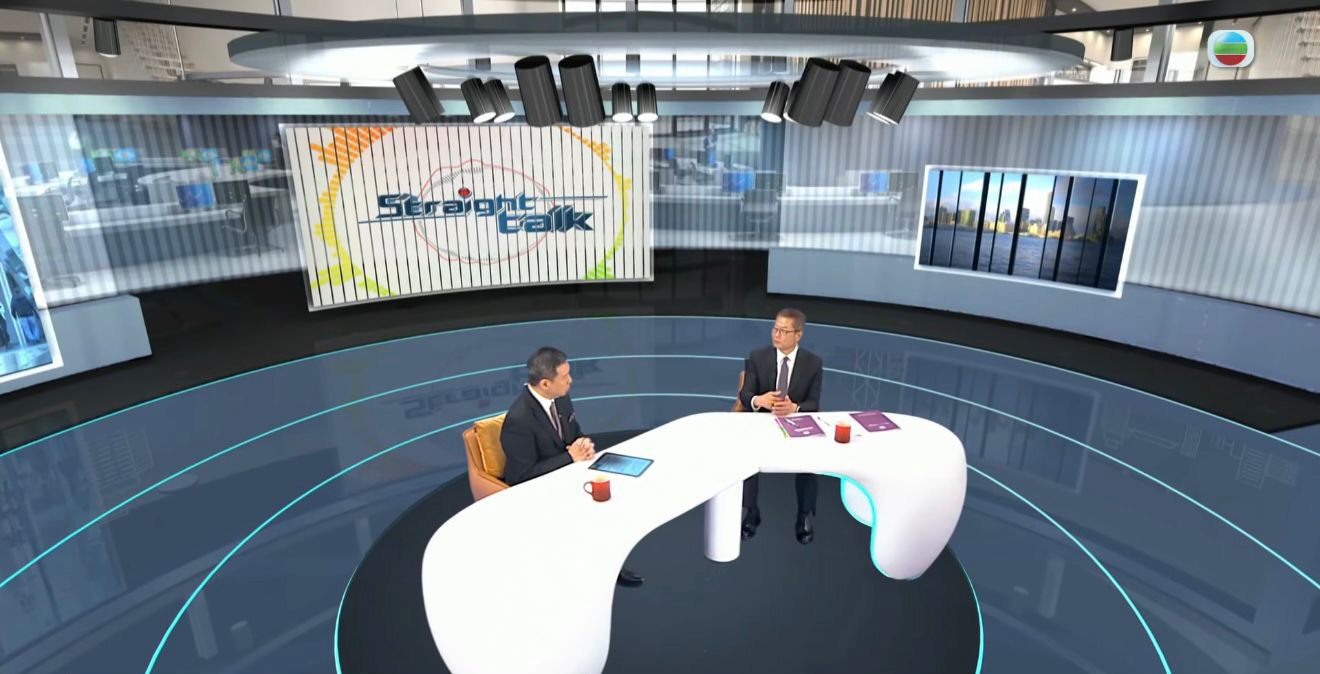
The theme of this year’s Budget is: “Driving High-quality, Inclusive Growth with Innovation and Finance.”
On Straight Talk this week, Financial Secretary Paul Chan Mo-po breaks down what this means for our economy, businesses, and ordinary Hong Kong people, and how his vision will redefine Hong Kong’s economic trajectory for years to come.
Check out the full transcript of TVB’s Straight Talk host Dr Eugene Chan Kin-keung’s interview with Financial Secretary Paul Chan.
Eugene: Good evening! I'm Eugene Chan. Welcome to this special budget edition of Straight Talk. With us is Financial Secretary Paul Chan. Paul needs no introduction and was on this show last year to talk about the 2025 Budget. The theme of this year's Budget is “Driving High-quality, Inclusive Growth with Innovation and Finance.” And we have invited him again to break down what this means for our actual economy, businesses, and ordinary Hong Kong people. Welcome back to Straight Talk, FS!
FS: Yeah, thank you, Eugene.
Rebound – the economic recovery
Eugene: FS, last time this year, we were talking about fiscal pressures.
FS: True.
Eugene: But today, we can congratulate you on returning the operating account to HK$2.9 billion surplus and a very healthy growth of 3.5 percent. So, my heartiest congratulations to you.
FS: Yeah, thank you. Very kind. It is the collective efforts of the Hong Kong people.
Eugene: This is very good news, the first one in four years, and actually, it has happened sooner than expected.
FS: Yep.
Eugene: Can I say that Hong Kong is officially back on a stable footing?
FS: Well, you know, in the operating account, in the coming five years, we are going to register continuing surplus on the capital account because of the intensive investment to expedite the development of the Northern Metropolis and taking into consideration the fact that land-related income would need a little more time to fully recover. So, there would be a deficit in the capital account. But in order to move on with speed, our Northern Metropolis development and as well as the other public works projects, we decide to issue some bonds to help us to bridge this financing gap.
Eugene: You know, for the general public, when you see a surplus, some will say is this masking sort of deeper structural challenges that we might actually encounter? How will you answer them?
FS: Well, you know, our financial footing is strong. The tools available to us are many. As you may have read from the Budget in terms of the Northern Metropolis, we propose a public-private partnership. We also propose in terms of land disposal, large-scale size land disposal to certain tech enterprises. So, all this together creatively would help us continue to build our economic strength on very healthy financial footing.
Eugene: Paul, you know, we just talked about earlier when we go for dinners, you can see all the restaurants are getting full again. There could be queues and all that. Would you say that we are firmly in recovery mode or some say a fragile rebound? Where do you see us right now?
FS: This is a very strong sustained rebound. In terms of visitors, last year, slightly below 50 million, which is already a 14 percent growth compared to last year. This year we expect more to come. A lot of mega events, sport events, cultural events, exhibitions and conferences are going to be held here. And there are some very innovative exhibitions too. So, we expect visitors to continue to come. And apart from visitors, capital flowing in from different parts of the world also support our capital market, in particular, the stock market.
Eugene: Since you mentioned the stock market, I think we have been talking about in Straight Talk that there have been a lot of IPOs coming.
FS: Very strong.
Eugene: And what if the capital market cools down again? Will we be exposed again? Sorry, I have to ask very direct questions.
FS: Well, you know, we are very confident that this year, 2026, our capital market will continue to be strong. Companies lining up for IPO, over 400 quality companies. We have also received applications from companies outside of the (Chinese) mainland, from Southeast Asia, from the Middle East. So, this stock market development will be on a sustained basis. When you look at the daily turnover, it is also elevated to another level.
Eugene: Right.
FS: But at the same time, we are sensitive of the different geopolitical risks and the consequential effect on the volatility of the market. So, in terms of financial security and stability, we have been very vigilant and put in different contingency plans. But in a nutshell, we strongly believe, given in particular the mainland's two-way opening up, a lot more mainland companies will be taking advantage of the Hong Kong platform to raise funds to support their overseas expansion, just like CATL last year.
Eugene: Right. So, thank you for very reassuring words to the viewers that Hong Kong is sort of firmly in a recovery mode. By the way, I saw that on the table this year, your budget is in purple color. Any particular reason for that?
FS: Well, purple, on the one hand, it is elegant and charm, but on the other hand, also represents keeping a cool head and being perseverant. So, given the different challenges, we stick to our core, count on the support of the country, and at the same time play to our strengths in terms of the sectors that we have competitive advantages in. For example, trade, finance, will continue to grow it, enrich it, make it even more vibrant, but at the same time, incubate the new sectors, technology and innovation in particular, putting investments into the Northern Metropolis, which will be our future engine of growth and also a major area for housing and the other social needs.
Eugene: FS, I mean, we have seen that you have separated the operating and capital accounts for us for clearer sort of understanding and presentation. And the operating account shows a very healthy HK$51.3 billion surplus. But the capital account remains in deficit that you just mentioned. And you are now raising bond borrowing limit up to HK$700 billion. I've worked it out roughly about HK$93,000 per citizen. So, for the men on the street, how should they, sort of, interpret this? Are we borrowing from our children to build for them or is it a risk that we're passing on too much debt to them?
FS: About half of the proceeds from the bonds issuance are for repayment of previous borrowings for good reasons because you know when you issue bonds for short term the interest rate is low. Since we have a very strong credit standing, if we want to borrow we can do it anytime. Over the past few years we tend to issue short-term bonds to take advantage of the low interest. So, going forward in terms of bond issuance, about half of them are for repayment of previous bonds. That is number one. Number two, our borrowing is not for government recurrent expenditure, not for operating expenditure. It is for investment into the future, putting it into public works, infrastructure, in particular Northern Metropolis. That is to create the capacity for future growth. That is how we see the purpose of the bonds. And in terms of the borrowing ratio at the moment, it's about 14.4 percent. Five years later, rising to about 19.9 percent, which is by international standard, very healthy, very safe.
Eugene: Right, so, we won't be passing on too much debt to the next generation, you don't think?
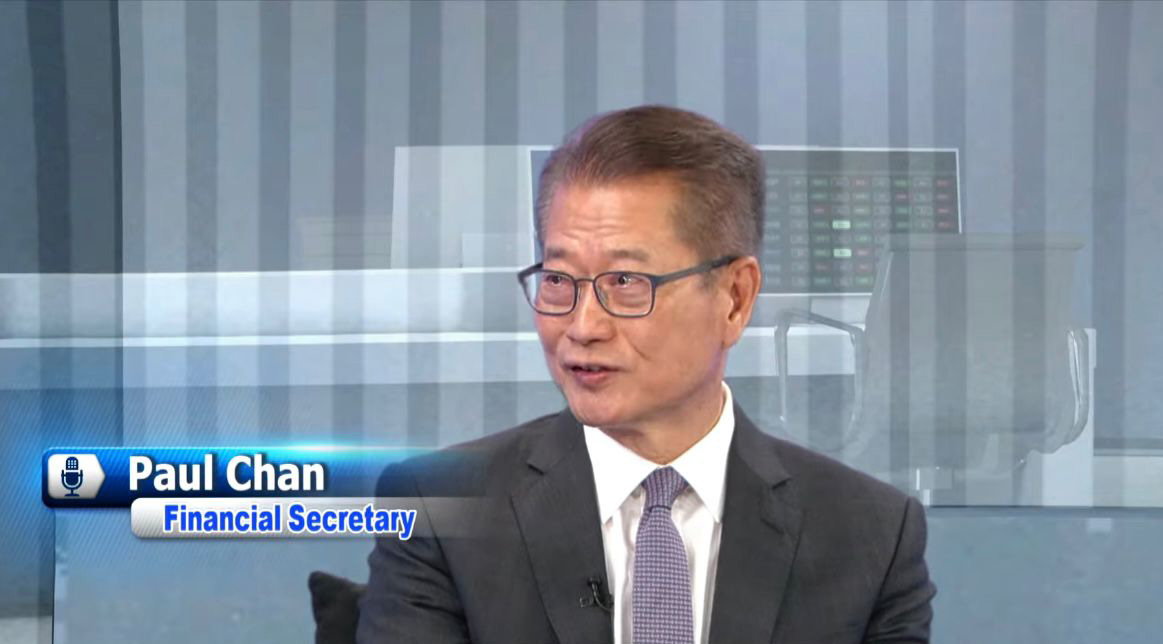
FS: Well, the money borrowed is for investment into the future. And it is indeed building economic momentum for the benefit of them.
Eugene: So, it will be very worthwhile.
FS: I think so.
Eugene: Good. Another thing I've noticed is that land revenue remains a bit sluggish over the last two years.
FS: True.
Eugene: And in the past, for decades, Hong Kong has relied on land sales for fund public works. That's the reason why we're doing bonds right now. Is that era now over? Or if so, how do you see we can replace that in the future so that we have a sustainable revenue source? How do you see it?
FS: The land-related revenue, we put a very prudent forecast. In the coming few years, it will rise to about 2 percent of our GDP. But when you look back, the historical average over the past 20 years was indeed 3.3 percent. So, that demonstrates the very prudent approach that we have been taking in terms of estimating the land-related income. But at the same time, even with this reduced level of land-related income, we can still balance our book and produce a surplus. So, we are on a healthy footing. And in particular, if I may invite the attention of our audience to the fact that despite all the volatilities, our profits tax remain very resilient and continue to grow. Same applies to salaries tax. So, our economy is resilient. Hong Kong people are very agile and adjust to the external environment.
Reimagining HK through AI & advanced industries
Eugene: Right. Let's move on to today's title, which is sort of a “rebound”, as we've talked about. We talk about reimagining. So, you have a noticeable shift with a strong emphasis on artificial intelligence and emerging industries. And I can see that you have promoted what we call the AI for all. And you have announced you will personally chair that new AI+ and industry development strategy committee. Just want to ask you, we know each other for a long time, you are an accountant, not a technical person. Why was it necessary for you to take this committee personally?
FS: Well, AI+ is a national policy, and indeed this is the global trend, how to apply AI to transform different sectors to upgrade, to become more competitive, and even in terms of business model, coming up with new business models and new products.
So, it is a very important empowering growth. When it comes to Hong Kong, the way I see it is that AI+, but at the same time, Finance+. We need to play to our strength using our IFC, International Financial Center, status to empower and expedite the development of A+. So, I will be chairing this committee to ensure A+ and Finance+. These two major engines will reinforce each other and be even more forceful in terms of pushing our economic development. That is one. And on the other hand, it is important in terms of government to come up with the right policies, facilitations, and streamline our process, internal process, to enable this innovation to flourish. That is why I chair this committee. One is externally tapping the market wisdom and intelligence, and then coming back within the government, making sure our different bureaus and departments are aligned in terms of this important initiative for the government.
Eugene: Thank you, FS. Time for a short break now, and we'll be right back with more Straight Talk.
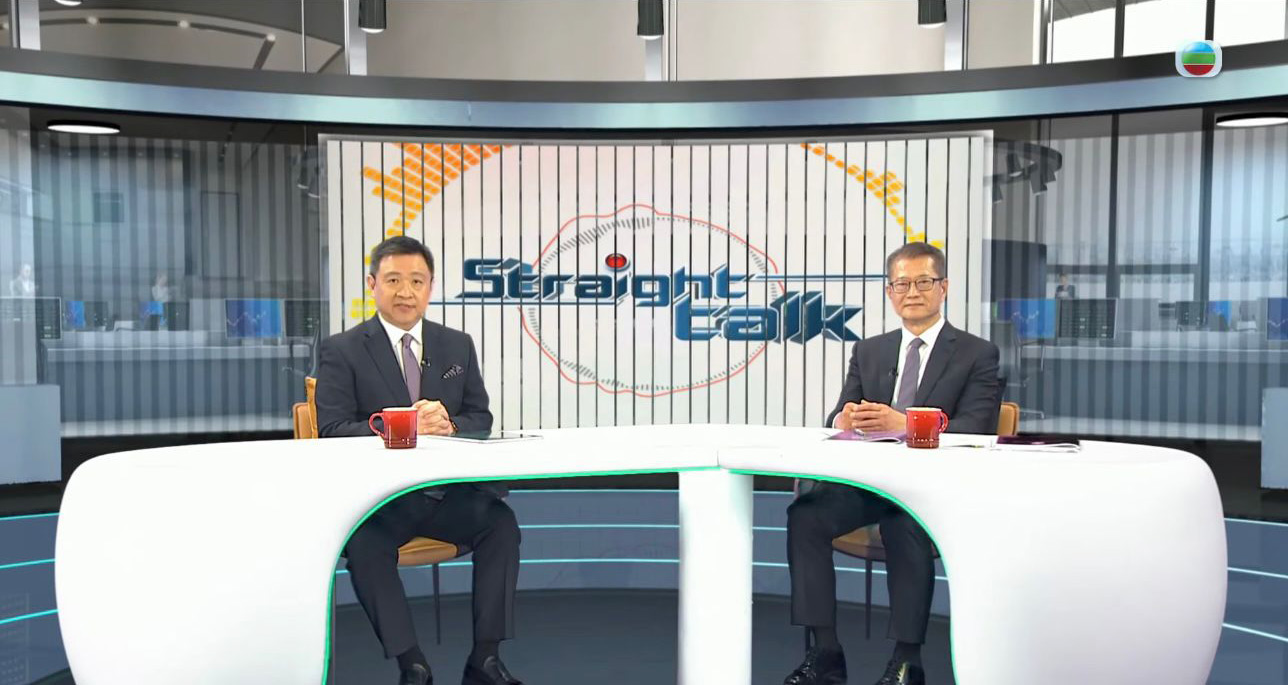
Eugene: We are back on Straight Talk with Financial Secretary Paul Chan, talking about the Budget. So, Paul, before the break, we were starting to reassure our viewers that we are on the road to a sort of recovery, and I think time for us to spend more money in Hong Kong, making sure everything goes well. And we also mentioned that you will be working on AI and finance things hopefully on the right track.
FS: True.
Eugene: And in your Budget, you mentioned a focus on embodied intelligence and aerospace. These are very highly specialized fields. Does Hong Kong currently have the talent pool to compete globally? And if so, are we importing further talent?
FS: Embodied AI is the future trend, in terms of AI application. We see it happening in terms of using in manufacturing settings. And going forward, there will be increasing use in the domestic setting. So, in fact, in the Science Park, we have a couple of those embodied AI companies. Indeed, when I went to the mainland to visit these companies, I invited them to come to Hong Kong for listing, to use Hong Kong as a platform to expand overseas. So, in terms of these companies, I think the role of Hong Kong is, number one, finance empowerment, Finance+, help them with IPOs and help them getting funding from a full range of funding options. But at the same time, Hong Kong is an international platform. As you know, globally, in terms of AI expertise, scientists, engineers, many of them, of course, are on the mainland. But a lot of them are also overseas, in the US. Some of them want to come back to this part of the world to develop their career. So, Hong Kong would be the best platform to host these people, to enable research and application of this AI+ development.
Eugene: Right. Paul, I have also noted that by supporting AI education, you have allocated HK$2 billion to advance digital education in schools. So, how early will our students be sort of beginning structured AI learning? What would be your suggestion?
FS: At the moment in the school curriculums – primary schools, secondary schools and universities – AI is already included in the curriculum. What we are trying to do is to allow people in Hong Kong at different walks of life, in different occupations, to better understand what AI means. How does it apply to them in their working setting? To enable people to better embrace this new technology and enjoy using it.
Eugene: So, it looks like AI will be the theme for our schools and for the school children for years to come.
FS: True, true.
Reform
Eugene: Right. Let's move on to sort of another work that you do. I mean thank you for chairing another advisory committee on tax policy. I mean already you are very busy. Some see this as sort of what we call a long overdue overhaul of our tax system. Is this the beginning of a fundamental rethink of Hong Kong's tax model, since you are chairing the committee?
FS: Well, this committee, the purpose is to come up with very competitive tax policies and measures to attract investments, to attract businesses. So, the focus is attracting investment and businesses to develop our different industries. It is not going to touch upon something like our tax base.
Eugene: Right.
FS: I think we have to better focus ourselves in terms of attracting investments because globally different jurisdictions are competing for investments, competing for talents, competing for businesses. So, we are trying to use this to enhance the attractions of Hong Kong, so that we can have increasing investments.
Eugene: So, Paul, you also mentioned earlier that we have sort of 400 plus companies lining up for IPO to come to Hong Kong, and it is very encouraging. But the men on the street, they will worry more about trading volume or what we call the market depth, not just the listings. Anything the government is trying to making sure to continue keeping this high daily turnover and liquidity, so that the market will be really flourishing? Anything that you will be doing?
FS: Yeah, you know the average daily turnover last year was about HK$250 billion, a very substantial increase, more than 100 percent compared to the year before. And this year so far, it is even higher. So, liquidity is important for our market. We are working on it from different fronts. Number one, the listing regime, to further enhance it, to facilitate more new economy companies in different forms to get listed. Number two, reducing the costs of transaction. Number three, enhancing the efficiency. So, we are approaching this on multiple fronts, involving the Stock Exchange, the SFC, and, to a certain extent, also the HKMA, in terms of custodian services. We are all in to enhance the competitiveness and the liquidity of this market.
Eugene: Paul, another area that I have been reading about, considered for levies, is the virtual asset sector and selected emerging industries. I am just wondering, could sort of, I won't say over, but I have used the word “overtaxing”, on such a fast-growing sector hurt the investors' confidence and we might push the innovation of capital elsewhere? Am I over-worrying on that?
FS: In terms of digital asset, our philosophy is that we need to embrace this. This is financial innovation. But at the same time, it comes with risks, in terms of investor protection, financial stability. That is why we will put it into a regulatory regime, so as to enable it to have sustainable and responsible development. We start to give license. And indeed, when I talk to the players in this market, they appreciate this because Hong Kong is an IFC, very reputable. If they got license here to operate, that adds to the credibility of their business. So, we are approaching this on this philosophy.
Citizens' share: ‘Candies’ and EV policy
Eugene: Right. Thank you for clarification for me. So let's move on to the most popular question I get asked all the time. It is the candies that you will deliver to the people and we will talk about the EV policy as well. I think as we said, every year when the budget comes, people will expect some candies and that is a benefit for the ordinary Hong Kong people. You have announced a HK$3000 tax rebate, increased allowances, and the extra month payment for CSSA recipients.
FS: Yeah.
Eugene: But there are no consumption vouchers like before. So, I am sure you have thought about that. Was it a difficult decision and how do you respond to the viewers that the government may not be doing enough for the grassroots?
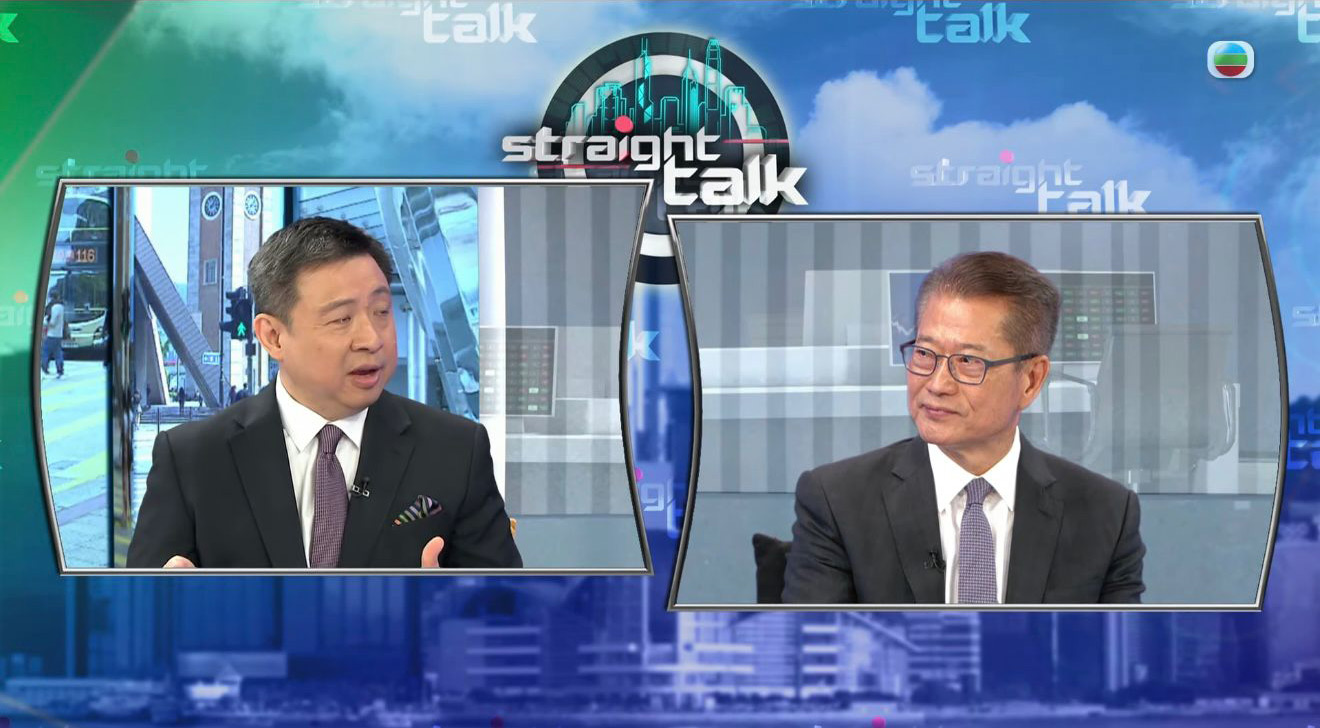
FS: Well, indeed for the grassroots, we increased the CSSA, for example, from previously half a month, now it is double. That also includes the Old Age Living Allowances. Well, I think we have to approach this in this perspective: we have gone through a couple of challenging years, and this year we start to register a surplus. Going forward, we are cautiously optimistic, but at the same time, there are a lot of uncertainties surrounding us. So, if I need to … I wish to give support to our people, but we have our limitations in terms of means.
Eugene: I understand.
FS: How best to use that means? Having considered different options, we think the current way of doing it, by expanding, increasing the different allowances, at the same time giving extra CSSA, would take care of both the grassroots and our middle class.
Eugene: Right.
FS: And indeed the change to the tax deductions, the total amount this year cost us about slightly more than HK$5 billion. And that would continue on, it is long-term structure.
Eugene: Right.
FS: The benefit to our middle class will be long-term. So, we decided, perhaps, this is a more balanced use of resources.
Eugene: Thank you for explaining again. One area that I must touch on is personally I drive an electric vehicle, and we saw that the one-for-one scheme would end on March 31. And you have defended this by saying that EV prices have already fallen, and nearly 70 percent of new registered cars are now electric. But for a family which is planning to buy one next year, they are going to feel the pinch that they’re going to pay more. Why not phase it out more gradually, rather than having this sort of hard deadline?
FS: Well, we introduced tax relief, in terms of registration tax for EVs since 2018. So, over the past few years, this has been phasing out. And indeed, about two years ago, it should have been expired. But at that time I extended it for two years.
Eugene: Right.
FS: And taking into consideration the fact that in the market, there are a lot of different models of EVs, very comfortable and the price has indeed come down a lot with the advancement in technology.
Eugene: True.
FS: So, EV in itself at the moment is already very competitive.
Eugene: Okay.
FS: That is why we think perhaps this is the time to end it.
Eugene: Right. Thank you, FS, for sharing your insights. This Budget sets out a bold vision, driving high-quality, inclusive growth, powered by innovation and finance. That vision will redefine Hong Kong's economic trajectory for years to come. And we look forward to more opportunities, better jobs, and renewed confidence for Hong Kong people.
Have a good evening and see you next week.
