

Tongguan kilns give ancient art form its modern shape with perfect geography and precise techniques, report Yang Feiyue and He Chun in Changsha.

The late January snow settled sporadically along the Xiangjiang River's banks, draping the ancient gray tiles of Tongguan Old Street with a gentle dusting of frost.
Ceramics have been woven into the very fabric of this winding lane in Wangcheng district, Hunan's provincial capital, Changsha, that took shape during the Tang Dynasty (618-907), from walls of stacked pots and murals inlaid with porcelain shards to the towering kiln chimney.
The view from Yunmu Mountain, beside the old street, reveals Tongguan's millennial secrets: the ancient town to the north, the farmlands to the south, the flowing Xiangjiang to the west, and river islets scattered throughout.
This is the "mountain-water-isle-polder" natural formation, the precise geographical endowment that nurtured the birthplace of the world's underglazed polychrome porcelain 1,200 years ago, says Chen Kuang, an official in charge of cultural affairs with Wangcheng district.
READ MORE: Innovation and efforts bring fire to the renaissance of Tongguan Old Street
"Water was the lifeline of ceramics," Chen says. "Sheltered by mountains on three sides and facing water on the other, this was a major production and transit hub for porcelain in the Tang era."
Between the Tongguan kilns and the Xiangjiang sits Shizhu Lake, from where finished wares embarked on their journey, connecting the Yangtze River and the coast, and eventually traveling across the seas as key commodities on the Maritime Silk Road.
According to the Northern Wei Dynasty (386-534) geology record, Commentary on the Waterways Classic, Yunmu Mountain's soil is suitable for pottery, and over a thousand households of potters lived along the river.

The mountain's quality clay, the dragon-shaped kilns built into its slopes, and the convenient water transport made this area one of China's largest export kiln complexes in the mid — to late-Tang Dynasty, with wares reaching 29 countries and regions.
"Transforming a lump of clay into a finished piece involves at least 70 steps over 10 days or more," explains Liu Zhiguang, a provincial-level intangible cultural heritage inheritor whose workshop is on the old street.
The first step is clay refining. Tongguan's iron-rich clay is mixed with five other types of earth and sand according to a secret formula, then repeatedly pounded and kneaded to remove air bubbles until it reaches a state of being "malleable but not sticky, soft yet cohesive", Liu says, adding that it is a process governed entirely by the artisan's touch.
Then, with wet hands, artisans coax the spinning clay upward, thinning and shaping it, using just the right pressure. Once dried, the bisque enters the design stage, where Changsha kiln's famed underglaze technique shines.
Minerals like copper and iron are used to create pigments in brown, green and blue.
"Copper turns green under an oxidizing flame, and red in a reduced flame. The slightest variation in temperature or atmosphere changes the color completely," Liu says.
Tongguan's traditional dragon kilns, built into hillsides, are a sight to see, using the natural slope for draft, saving fuel, and ensuring even temperatures.
"Firing is the ultimate test of skill," Liu says. "The temperature is gradually increased to over 1,000 degrees."

Additionally, the flame needs constant observation through peepholes, timing the wood just right. The true magic happens during the yaobian, or kiln transformation. At a critical temperature, complex chemical changes in the glaze's metallic oxides create unexpected colors and textures.
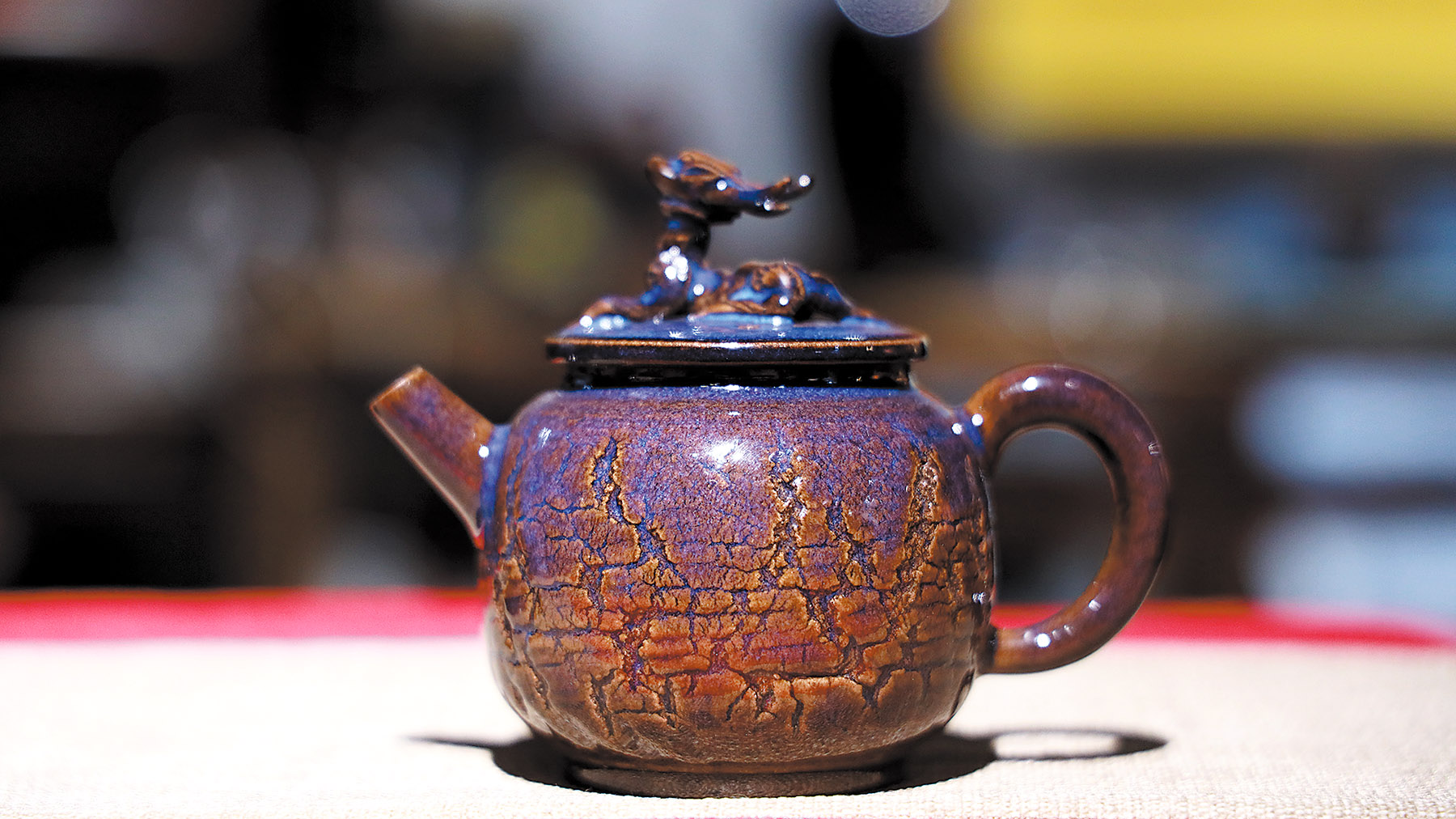
"Yaobian is the art between control and chance," says Huang Haofu, a young artisan who also set up shop a few steps away from Liu's.
Many of his works, including lidded bowls, appear blue-black in the dark, but when natural or electric light hits them, specks of blue crystal seem to float within the glaze like a starry sky.
"These blue spots are iron crystals that precipitate at specific temperatures. Each piece is unique, and you can never predict what will emerge when the kiln is opened."
He admits that the success rate in his studio is only around 30 percent:" A good yaobian has layers, a sense of movement, something that sparks the image of landscapes or clouds."
Perhaps the Changsha kiln's unique cultural contribution was firing poetry onto ceramics.
Among Liu's collection are ewers inscribed with various ancient poems that have been preserved under the glaze. Those verses run the gamut of human emotions, from romance to sorrow and reflection.
"Over 160 poems have been discovered on Changsha kiln wares, a record of the Tang merchants' journeys," he explains.
Huang Haofu has also explored the modern expressions of this poetry. His recent teaware features verses carved inside, only revealed when used.
"The traveler returns from a thousand miles away, peace found in a single cup of tea" — is a line hidden at the bottom of a cup, faintly visible when tea is poured.
"I don't want to be too direct. Good art should be subtle, leaving room for imagination."
Over a decade ago, Liu, the sixth-generation heir to a Tongguan kiln ceramic family, faced a choice. The old town was fading, traditional skills were ignored, and many peers were changing trades.
The turning point came when Wangcheng launched a "two riverbanks" strategy, revitalizing the entire kiln area based on the principle "repair the old as old, build the new as if ancient".
In 2024, the Changsha Tongguan Kiln Cultural Tourism Resort achieved national-level status, one of only four in the province.
"Now we have dedicated staff, mechanisms, funding, and museums, all making up a complete, integrated system," Chen Kuang says.
A "short drama plus cultural tourism" model has also been applied, further drawing more visitors to the area, Chen observes. After a series featuring local kilns was broadcast, a sweet rice wine shop on the old street saw daily sales rocket from 20 bowls to over 200, she shares.
As local authorities upgraded Tongguan Old Street to attract visitors, Liu seized the opportunity, transforming his workshop into an experience center.
Today, his workshop is celebrated as one of the old street's most complete traditional handcrafting studios. His workspace resembles a living museum. Ceramics from the Han (206 BC-AD 220) to Qing (1644-1911) dynasties line the shelves, charting the kiln's evolution.
At the center stands a Tang-style urn, its surface a miniature panorama of the Silk Road.
"At peak times, dozens of tour buses and hundreds of people come daily. That gave me confidence in knowing that tradition is wealth,"Liu says.
His products range from modest teaware to reproduced art, catering to varied needs. He also maintains traditional craftsmanship while developing hands-on experience.

In 2024, his workshop hosted more than 10,000 visitors. "When visitors throw a pot or paint a piece, they take home not just an object, but a memory connected to a thousand years of history," he says.
Unlike Liu, Huang switched from his computer science background into a "tech-artisan" to fulfill his fascination with his hometown's porcelain charm.
He learned from a local porcelain master who warned him that he would not make money for three to five years. "Now, in my 11th year, I'm finally feeling upward momentum."
Six years of training and nine years of entrepreneurship have forged Huang's distinct style.
ALSO READ: Sparking a colorful commercial revolution
His "kiln-transformation blue" series creates blue crystalline formations within celadon glaze, sparkling like galaxies under light. More innovative is his functional adaptation of teaware. To better enhance the tea's aroma, his pieces' interiors are often left unglazed.
"Water passing through sand becomes clear, and the unglazed surface is more porous than porcelain, better for releasing the tea's fragrance," he explains.
For many artisans on the old street, the ultimate ambition for Tongguan may not be measured in visitor numbers or revenue.
Liu envisions a landscape where "every studio can showcase its unique culture and artistic concept, presenting the ceramic culture and innovative spirit that Tongguan has accumulated over the years to the outside world".
That will be a place where "those who are truly curious or passionate about ceramics can visit 10 studios and have 10 different stylistic experiences".
Contact the writers at yangfeiyue@chinadaily.com.cn
