

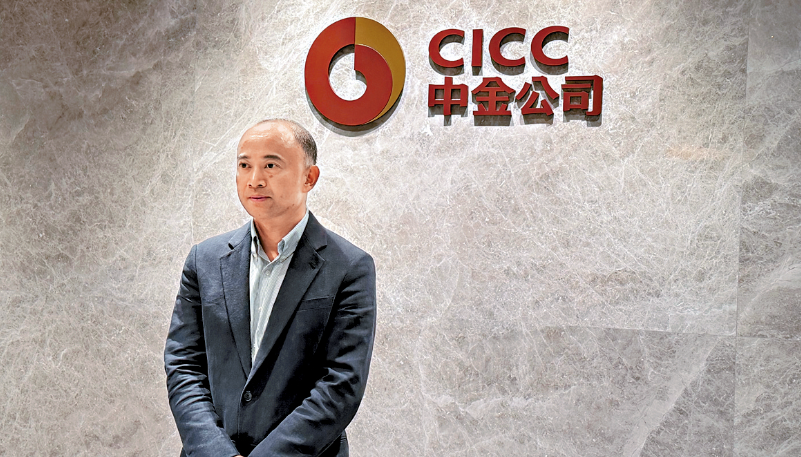
The Hong Kong Special Administrative Region will stay more relevant than ever to the country’s future development, as the city has all the elements required to become a major hub for capital and wealth management, ultimately surpassing what it has achieved historically, said Miao Yanliang, senior managing director and chief strategist at China International Capital Corp.
 “We are now living through an unprecedented reshaping of the global monetary order — and, more broadly, of the international economic system itself,” Miao said. “It could be the once-in-a-generation, or even once-in-several-generation opportunity that the SAR, together with China’s other financial centers, should capitalize on.”
“This will see Hong Kong evolve into both Asia’s equivalent of New York — a renowned hub for capital markets — and Asia’s equivalent of Switzerland, a leading center for global wealth management, with its influence in global finance ultimately exceeding its historical peak,” he noted.
On Thursday, Premier Li Qiang delivered the Government Work Report at the opening of the fourth session of the 14th National People’s Congress in Beijing.
Li said the central government will further leverage the Hong Kong and Macao SARs’ unique strengths and important roles, derived from the backing of the motherland and from their close links with the rest of the world.
In Miao’s view, “the highest level of competition between economies” comes down to currencies and financial systems. In that arena, Hong Kong’s strategic importance becomes more critical than ever.
The framework of “one country, two systems” endows access to two markets and two regulatory systems within one financial hub. Historically, Hong Kong’s role was largely the gateway for international capital to invest in the Chinese economy. Nowadays, Miao pointed out, the capital flow is more two-way. Increasingly, Chinese companies expanding overseas are using Hong Kong as their platform for global reach.
The draft outline of the 15th Five-Year Plan (2026-30) was submitted on Thursday to China’s top legislature for deliberation, which voices out unequivocal support for consolidating and enhancing Hong Kong’s status as an international financial, shipping and trade center, and reinforcing Hong Kong’s role as a premier global offshore renminbi business hub.
ALSO READ: SARs urged to contribute to national goal
Miao underscored that Hong Kong could play a bigger role in the rise of the renminbi as a global currency. This requires closer coordination with the central government and the central bank, along with a coherent long-term strategy for developing offshore renminbi markets. Currently, Hong Kong holds a renminbi liquidity pool of around 1 trillion yuan ($145 billion) and handles approximately 75 percent of global offshore renminbi settlement, according to monthly data released by the Society for Worldwide Interbank Financial Telecommunication.
As the heightened geopolitical tensions in the Middle East kept investors on edge, rising safe‑haven demand has put the US Dollar Index on track for its best weekly performance in over a year.
Despite all the “de-dollarization” talk, the “knee-jerk reaction of capital markets” during moments of crisis is still a rush into the US dollar. “There is no alternative — a phenomenon referred to as ‘TINA’,” Miao explained, adding that the US dollar’s supremacy as the world’s primary reserve currency is unlikely to experience a “sudden collapse” but take the form of a gradual weakening.
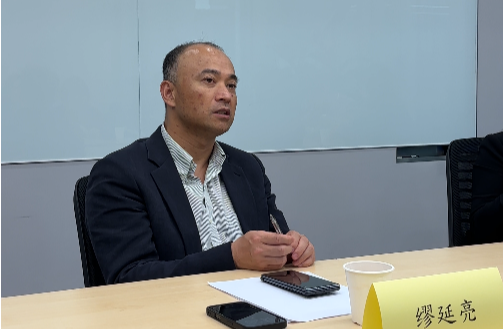
Citing previous episodes of dollar weakness, Miao said the currency has a track record of managing not only to stabilize but often to reinforce its dominant position. Cases in point include the end of the Bretton Woods system in 1973 and the global financial crisis in 2008.
READ MORE: PBOC governor: China has no need to weaken yuan for trade edge
However, Miao pointed to a “fundamental difference” this time, where both sides of the equation are structurally evolving. One side of the equation are potential alternatives to the dollar system. Today, attention increasingly turns toward China.
At the heart of the shift is the renminbi’s journey of increasing its global footprint, which will inevitably depend on the coordinated development of both onshore and offshore markets. Among those offshore centers, Hong Kong remains by far the most important, and the city “has what it takes to be a key beneficiary from a gradual reassessment of the dollar-centered system”, Miao noted.
Ultimately, he stressed the focus should return to expanding the scale of Hong Kong’s market, improving offshore liquidity, and deepening its overall breadth and depth.
As the new planning cycle unfolds, Miao said he expected more detailed initiatives on capital account reforms, the practical implementation of renminbi internationalization, and the development of offshore markets — particularly Hong Kong’s — to turbocharge the push.
Contact the writer at sophialuo@chinadailyhk.com
