

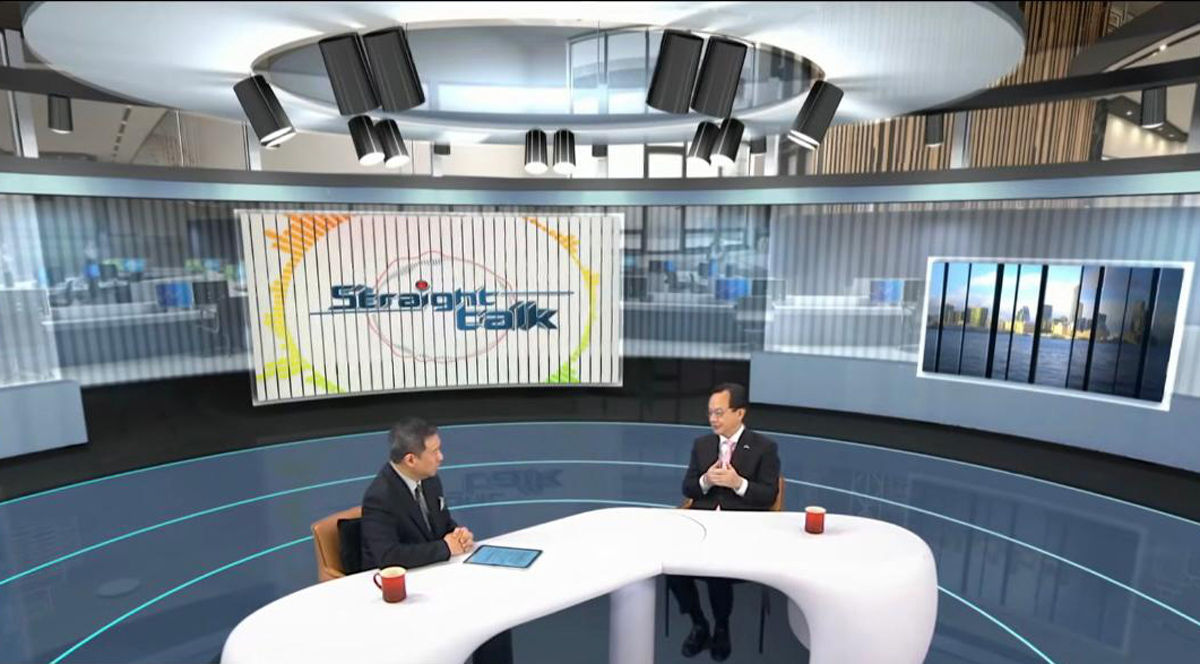
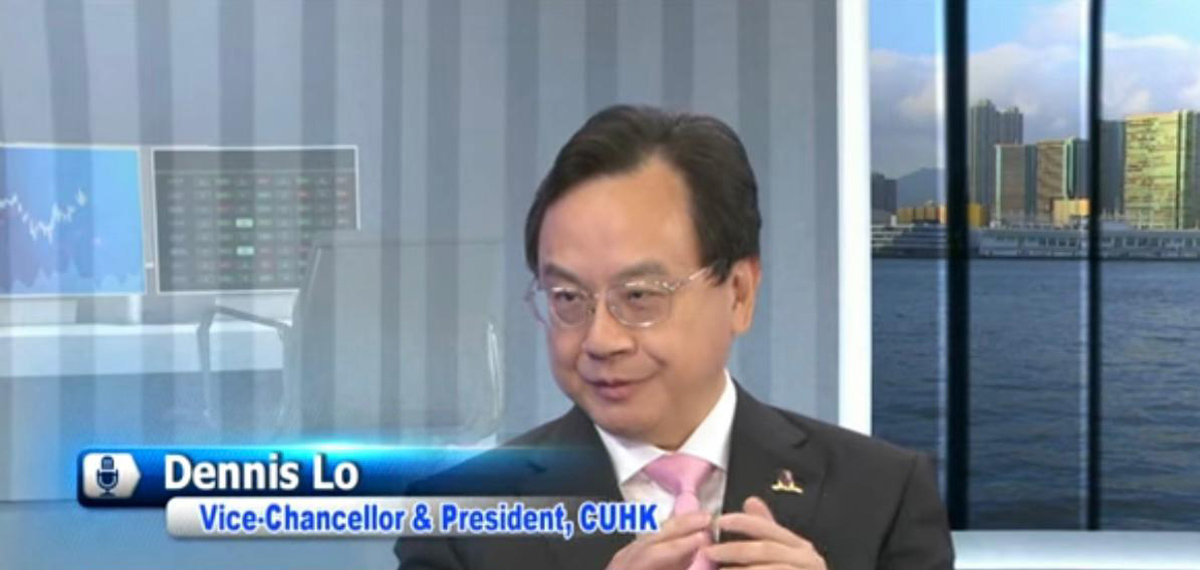
Dennis Lo Yuk-ming, vice-chancellor and president of the Chinese University of Hong Kong, is on Straight Talk today to talk about turning discovery into impact.
Check out the full transcript of TVB’s Straight Talk host Dr Eugene Chan Kin-keung’s interview with Dennis Lo:
Chan: Welcome to Straight Talk. I'm Eugene Chan. With us is Professor Dennis Lo, vice-chancellor and president of the Chinese University of Hong Kong, to talk about transforming discovery into impact. Prof Lo is one of the world's most influential biomedical scientists, known as the father of non-invasive prenatal testing for his discovery of cell-free fetal DNA, which revolutionized prenatal care. His work has earned global recognition, including election to the Chinese Academy of Sciences, the Royal Society, and the US National Academy of Sciences. He has also won numerous international prizes, including the King Faisal International Prize for Medicine, the inaugural Future Sciences Prize in Life Science – regarded as China's Nobel Prize –and the Lasker Award, the US’s top biomedical research prize. Dennis is also an awardee of Ten Outstanding Young Persons of Hong Kong and the World. Welcome, Prof Lo!
Lo: Hello, Eugene!
Discovery -> impact
Chan: Thank you very much for coming to discuss how all this technology can impact Hong Kong in the future. For many viewers, we see success for scientists means publishing papers and being recognized. But nowadays, discovery can lead to patents, startup companies, and even life-saving technologies, and you have done just that. You have discovered cell-free DNA, not only transformed prenatal care but also have opened the door to modern liquid biopsy technologies for early cancer detection. Maybe you can share with the viewers how all that has come about, from prenatal testing to early cancer detection.
Lo: Thank you. So, the journey started when I was a medical student at Oxford. And I learned about obstetrics, I learned about how, when a woman is pregnant, she would like to know about the health of a baby, including the genetic health. But at that time, to obtain fetal DNA and chromosomes, you required invasive techniques, like amniocentesis. And so, I was thinking is it possible that I could provide an alternative to all of that, just by inventing a blood test that can do it from a blood sample of the mother? That journey actually then started, in 1989. And in Asia, trying to look for fetal cells that end in the mother's blood, but it actually ended in failure. After eight years, I could not get it to work. And I remember then, in 1997, I decided to come back to Hong Kong and joined the Chinese University of Hong Kong. And I knew at that time that would require a completely new direction. So, asking myself, okay, in the mother's blood, apart from blood cells, what else is there? And the answer is, there's a fluid called plasma.
Chan: Right.
Lo: And I was wondering, is it possible that the fetal DNA I was looking for is actually in the plasma, rather than in the blood cells? And so that led to this breakthrough.
Chan: So, in a way, it's not really a real plan, but sort of discovered along the way, isn't it, in a way?
Lo: Yeah, so I think it's a “goal first.” I want to have a non-invasive and safe blood test, and that takes me on a journey of discovery. And interesting, initially, we all know that DNA or chromosomes should be living inside cells. But the answer is that those materials are actually swimming outside cells.
Chan: Right.
Lo: That is the unexpectedness of it.
Chan: Right, so when you look back, what is the formula for success? If you restart everything again, would you have done anything differently?
Lo: I would say that there's actually no “one formula” for success. I think when we listen to the discovery or invention story of many scientists, each one actually has a different story. For example, for myself, I would wonder what would happen, for example, if I, at that juncture, did not actually take a gamble, right, from the cells to blood, which is actually … to blood plasma, which is actually very counterintuitive in that time. It's almost like you're trying to find a processor of a computer, somehow a processor, not inside some computer, but it's actually lying outside. It's very counterintuitive.
Chan: Right. Anyway, it happened, and it's done. Something great for the human being. At what point in the research journey did you realize that your discovery could sort of move beyond the lab and actually move into the marketplace? I mean, do you always have that in mind?
Lo: Well, as a doctor, I was trained to know about what is a requirement of the patients. I always wanted to help them. And as a scientist, I know what the frontier of science is. And so basically, being a clinician scientist, I'm trying to act as a bridge of both. But I must say that for the first maybe 15 or 20 years, we were focused on really a journey of scientific discovery. For example, even after the 1997 discovery, it's not until 2011, when the test was finally launched clinically. So, it actually still took a long time.
Chan: Right, it does. And I also read that at the CUHK now, your university had held over 240 granted patents in 2025. And that's kind of the leader of this field for universities. Why is intellectual property protection so important to get a patent, sort of before it becomes a product?
Lo: Now, the CUHK has always been very emphasizing on intellectual property. Now, for example, just now, we mentioned our patent portfolio, our portfolio, actually, in terms of number, and in terms of the royalty income, we are leading amongst the different universities here in Hong Kong. And I think it's important because, ultimately, the inventions that we make in the university can only reach the society through a process of commercialization. And if we have to ask companies to invest millions or even more into developing technology, the companies will need some reassurance that they have some sort of protection, and this is where IP comes into play.
Chan: I see.
Lo: And also, actually, at a time when I was a medical student or even PhD student, actually, nobody would teach us how to apply for patents. And, actually, for myself, it was a process of trial and error. And now that we have succeeded in this area, then I'm trying to make sure the next generation will have a more guided journey in this important endeavor.
Chan: Right, Dennis, having a patent is one thing, as you just said, and turning it into a sort of a usable medical test or treatment is another field. What would you say will be the biggest hurdle, or the biggest challenge, to make a patent, to something, sort of, can be marketable?
Lo: I would say that, now, conventionally, as you previously said, many professors would think that scientific publications is the end, is the goal of their research. And they actually look at patents as just an adjunct, right? And so what happens is that they will usually rush towards the end when the paper is going to be published, let's say, in a week's time. And they just start to think, well, maybe I should file a patent. But the answer is that you cannot really have a good pattern if you rush it this way. So, for example, for my team, I've always actually looked at the patenting side, and a scientific discovery side to be parallel. So, we're actually planning the patenting as these assignments proceed. And I'm trying to actually give this type of philosophy to my team members, and now also, hopefully, to other young scientists in the university.
Chan: Right, so that being said, that means being a sort of university academic now, has another job – to make it into reality. You could work with all the investors or even industry partners.
Lo: Exactly. And then, in this very yard, I could streamline aspects of the university's administration. Because previously, for example, in our university, the research office, and an enterprise office are actually two separate departments. But now, I'm thinking, actually, they are very important. So, now we have actually moved them together and put it under one pro-vice-chancellor of research.
Chan: Right.
Lo: And that's important. And, of course, also, when I first started, at that time, very few professors will start their own companies, right? And at that time, the preferred mode of commercialization was through licensing. But actually, after I've been through the process, I think it's actually better to have your own company.
Chan: I see.
Lo: And the reason is, because your license to other companies, whether your technological development or not, is really at the mercy of the company rather than yourself. But however, if you found your own company, then actually, you have the way to direct the progress.
Chan: Yes.
Lo: And ultimately, it's better for the ecosystem in Hong Kong.
Being vice-chancellor
Chan: So, Dennis, you have been a medical doctor, scientist, and now you're now the president and vice-chancellor of the CUHK. That must have been that sort of decision they have to consider very thoroughly. What makes you take on this job to lead the CUHK?
Lo: I've actually served the CUHK for 29 years now.
Chan: Right.
Lo: Most of the time, as a frontline professor, and although I was also appointed as a chairman of one of the departments, and also as associate dean of research at the Faculty of Medicine. So, I've also experienced the administration side. And now I think that the ability, or the chance, to become a vice-chancellor, will actually give me an opportunity to serve the CUHK in a different capacity. And I also feel that my previous experience, and also my experience as a frontline researcher, and will also allow me to actually push the CUHK to another level.
Chan: Right. Alright, Dennis, let’s take a short break now. We’ll be back with more Straight Talk.
Turning education into impact
Chan: We are back on Straight Talk with Professor Dennis Lo, vice-chancellor and president of the Chinese University of Hong Kong, talking about how breakthroughs in research, move from the lab to society, and how our universities are helping Hong Kong connect that innovation to the world. So, Dennis, we have touched on from a university, from a scientist, and with the help of investors in the industry, to get into reality with the patents, and talking about having your own companies to have more control.
Chan: So, now you're being the leader of the CUHK, and knowing that Hong Kong has five universities in total in the top 100 in the world, where is this going to lead Hong Kong? I mean, we are looking for new directions always, especially in the 15th Five-Year Plan. Do you see the Hong Kong as our government's aim of making Hong Kong and Asia's leading education hub as a doable and achievable goal?
Lo: Yes, I think that Hong Kong is unique in having such a concentration of internationally known university. And I think that in the next phase is try to capitalize on this asset and to further push forward. For example, one of the items that I have on my list is to actually develop the five-year plan from Chinese University of Hong Kong. And in this regard, we also take reference to the plan in the country and also the plan to build China into international stronghold of higher education by 2035. And one of the aspects, of course, is the internationalization. Because Hong Kong is the most international city in China, I think we would further internationalize our student population and we'll further internationalize our researchers and professorate ranks. And also we have to think about each university have a set of unique strengths. And the CUHK is very unusual in that we're a comprehensive research university which is collegiate in nature. So, similar to Oxford and Cambridge that I had previously studied as a student. Now, currently in the CUHK, we have nine colleges. But interestingly, actually those nine colleges are all undergraduate college. And so, when I became vice-chancellor, one of the questions we asked is that it would be good if we're able to extend this collegiate experience to postgraduate students like our PhD students. So, in this regard, now we're actually planning our 10th college which will be a postgraduate college.
Chan: Right, and also having such a strong research background as well at the CUHK, I'm sure you'll be able to contribute a lot to what Hong Kong is aiming to be - an I&T hub. Do you see that happening through the university support as well?
Lo: Yes, so we now actually have some important infrastructure which is coming online, for example at the CUHK very soon, like over the next few months, we'll have a new School of Life Science Building and at the end of next year, in 2027 December or so, we'll have a new Faculty of Medicine Building. This will actually combine new teaching facilities with research facilities. The research part can actually hold some 850 researchers. So, I think this is going to be a very important development in biomedical science here. And of course we also have a campus in Shenzhen, and this is important because the closer integration of Hong Kong into the national development is one of the goals for the next five years. We actually have a lot of synergy with the CUHK Shenzhen because I'm the chairman of the governing body there, and of course the CUHK Shenzhen also has a new medical school, and so I think we can collaborate that way. Also, the CUHK Shenzhen in 2025 also started a school of artificial intelligence, and of course AI is also very strong in our charting campus. We will actually further develop those areas.
Chan: Dennis, I mean, if you look to our past when we were students, we often looked for not only the Hong Kong universities, we looked for beyond Hong Kong, like England, Australia, Canada and the US. But nowadays you see that students now are looking even back to Hong Kong. And we see a lot of mainland students here as well. Hong Kong is being very attractive. Do you see that we are attracting better and better quality of international students, or just having international students come into Hong Kong because of various other reasons?
Lo: Well, we will definitely have an increasing population of international students. For example, thanks to the Hong Kong Special Administrative Region government for lifting, relaxing the threshold for non-local students from 20 percent to 50 percent. So, we are actually very actively developing in that area. But of course, in anticipation of the increase in non-local student population, we have to actually look at the accommodation side. That's why we're actually now very actively building some new student hostel. Also, more recently, we've also experimented with some new concepts, for example, like renting brand new flats developed by the property developers for our students. And so we have actually very good feedback from those.
Chan: A lot of the viewers are going to ask you that with a lot of non-local students joining the CUHK and other universities in Hong Kong, will that sort of affect local students' opportunities of going for the so-called popular courses? Would it happen with extra competition?
Lo: Well, first, I would say that, of course, we're funded by the UGC to educate the students of Hong Kong, so that one we will continue to do. But at the same time, we'll also develop our non-local student population. But from my previous experience, for example, studying in Oxford and Cambridge, I think, at that time, of course, a non-local student is a non-UK student, and then, basically, the Oxbridge accept top students from everywhere on the globe. And actually, I find that experience is very useful, because you cannot be the best until you have actually seen what the best are, and you interact with them on a day-to-day basis. And also, ultimately, in the future, that will also affect the network, because of the top people, then after they graduate, you will continue to keep in touch, and that will help each other's career development. So, hopefully, we will also do that, and also benefit the students who graduate from a university based in Hong Kong.
Chan: Before we move on to the upcoming international education conference, there is one area I always want to ask the interviewees, is that with sort of growing the geopolitical tension between major powers, do you actually, I mean there are concerns about so-called technological decoupling or even more difficult for universities to maintain international academic exchanges. Have you seen that so far?
Lo: I would say that Hong Kong is very unique in that we're the most international city of China, and so in that regard actually we can act as really a bridge between China and the world. And actually this is also one of the founding principles of the CUHK, which is to combine traditional modernity and to linking China and the West. And so we continue to do that role. And for example, I serve a number of capacity in which we organize many international events. For example, like last year, we had a World University Network event, which was attended by presidents and vice-chancellors from many international universities, and we will continue to do that. And of course the student population from outside is one way their ambassador from their countries or region. And similarly we continue to have a very active exchange program of CUHK students going elsewhere. And also collaboration-wise, like in my group or in other groups, we have continued our international collaborations.
Chan: In other words, you haven't seen much problems arising from all this geopolitical tension.
Lo: Well, there are certainly challenges, but then I think we work together to overcome them. I think ultimately, research is an international effort. We cannot just solve all the problems in one region, right? So, ultimately, I hope that ourselves and our partners know that. And then we'll try our best to work together.
APAIE
Chan: Dennis, I mean, Hong Kong must be very thankful to you because the CUHK will be hosting the second time, after 13 years, the Asia Pacific Association for International Education in a few weeks’ time, where more than 2,500 participants from over 70 countries will come. How significant is that for Hong Kong, for this sort of one of the top three education conferences in the world to be held here?
Lo: I think it's a really very exciting event, it's actually an event that echoes with the ambition of Hong Kong to develop into an international education hub, and we're very pleased that we have really participants from 70 countries or region or a register, and yesterday when I look at the latest statistics, we have hundreds of booths have already been sold. And, so, I think basically become a carnival, a gala of international education professionals, and hopefully also during the event I think that the different representatives from different regions will share with them the opportunities and challenges of the region. Also we have a very exciting forum in which student themselves will talk about their own experience.
Chan: So, you see this conference where we can say a milestone in position in Hong Kong as one of the leading education hubs in Asia.
Lo: Yes, it's a very timely event.
Chan: Thank you, Dennis, for sharing with us your insights on how Hong Kong can be one of the leading hubs in education in Asia. As we have heard, how discovery turns into impact and universities become global bridges, Hong Kong's role as both an innovation hub and an international education center has never been more important.
Have a good evening and see you next week.
