

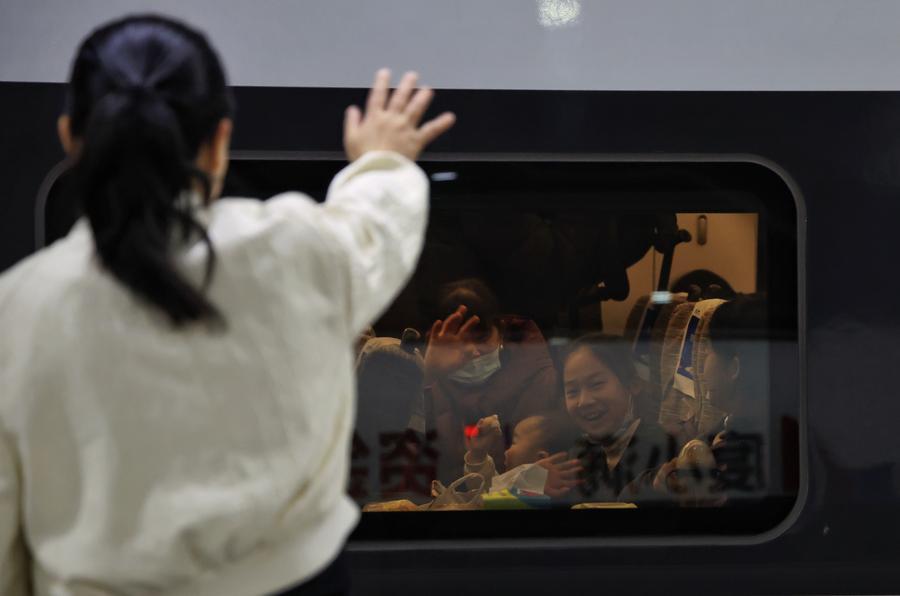
Reverse Spring Festival travel is gaining momentum this year, reshaping the world’s largest annual human migration and driving fresh consumption patterns during the holiday period.
As China’s biggest festival, the Spring Festival sees huge cross-regional human migration each year, traditionally with millions of workers traveling back to their hometowns for family reunion.
Guangdong province, known for its manufacturing industry, is home to a large migrant-worker population. In the first nine days of the Spring Festival travel rush that kicked off on Feb 2, travelers made about 270 million cross-regional trips, according to the province’s Department of Transport.
ALSO READ: Over 2.05m daily cross-border trips expected during Spring Festival
But, compared with previous years, a growing number of trips were made the other way, from hometown to work cities. The trend in “reverse Spring Festival travel” is gaining momentum as family members in the hometown travel to their loved ones’ work cities for the Chinese New Year.
According to a recent report from ride-hailing platform Dida Chuxing, the proportion of hitchhiking trips from first-tier cities to lower-tier cities fell from 19.68 percent in 2022 to 16.63 percent in 2025.
As more people travel in the opposite direction, Guangzhou, Shenzhen and Dongguan — all in Guangdong province — grabbed the top three spots as the most popular destinations for hitchhiking trips during this year’s holiday period. Two other cities in the province — Foshan and Huizhou — were also on the top 10 list.
Data from online travel platform Meituan Travel shows that ticket bookings for Shenzhen in the festive season surged by 180 percent year-on-year.
“The major reason I chose to stay in Shenzhen this year is to escape the Spring Festival travel rush and the associated costs,” said Chen Lina, who hails from Huangshi, Hubei province and has been working as an English teacher in a Shenzhen primary school.
READ MORE: Tracks to home
It cost her family around 10,000 yuan ($1,450) to go back to their hometown last year, taking into consideration transportation, catering, gifts, red packets, etc. She expects the cost for this year’s Chinese New Year to cut by half as spending the festival in Shenzhen will free the family from social gatherings.
Li Weiwei, a 34-year-old Shenzhen accountant from eastern Jiangxi province, said reverse travel during the festival is not just a practical choice, but also a way to redefine what family reunion means.
“Spring festival is about being with family. It doesn’t matter where we are. Staying at home, cooking together, talking quietly — that’s the kind of companionship I’ve always wanted for the Chinese New Year,” she said.
The new migration trend is also bringing changes to the consumption model during the Spring Festival, as the younger generation emerges as the main force behind New Year goods purchases.
The tradition of bulk stockpiling for Spring Festival shopping is gradually giving way to a more flexible and on-demand consumption model, said Lin Mengna, marketing director of Dingdong Maicai South China, a fresh-groceries e-commerce platform.
“As post-90s and post-00s generations become the main shoppers, they prefer buying as needed and sending gifts to relatives and friends via instant delivery (so that) ‘gifts arrive before people’,” she said.
Contact the writer at sally@chinadailyhk.com
