

Popular social media phrase encourages self-acceptance, eases expectations
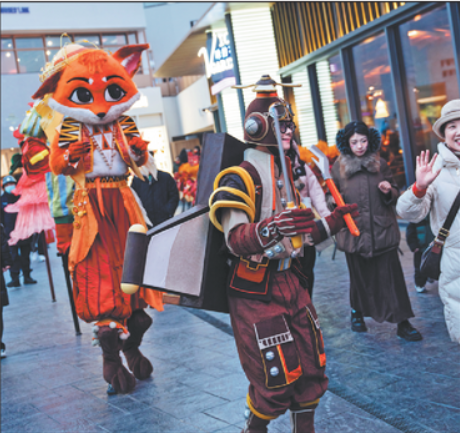
As 2026 began, a curious expression became a widely shared internet catchphrase in China - aini laoji, literally, "love you, my oldself" or more accurately, "love you, my dear self".
At first glance, it looks like gibberish. But it is the imprecision of the phrase that gives it emotional weight. It doesn't sound like a typical brand slogan designed by a marketing team, but words someone typed late at night that contain a kernel of truth.
No one knows exactly when the phrase started circulating, but it has quietly seeped into the social media lexicon. On Xiaohongshu, or Red-Note, it has garnered 800 million views.
Stand-up comedian Bai Xue has received warm feedback for her show Aini Laoji, telling stories about her own experiences especially in her former workplace.
Her interpretation of the phrase? "It doesn't promise transformation. It suggests acceptance. It doesn't say 'you are the best'. It says - 'you've made it this far'," she said.
"Don't be too harsh on yourself at work. You've got to be good at everything, do everything well, and if you don't, you'll lie awake at night staring at the ceiling. Does hair loss count as a workplace injury?" she said with the room erupting in laughter.
But the laughter lingers a second longer than usual.
"The moment I started working, I suddenly became a perfectionist. And when things go wrong, I'm over here slapping myself like it's my fault," she continued.
"You can cheer yourself on, but don't start yelling 'Giddy up!' like you're trying to get a horse to runfaster!"
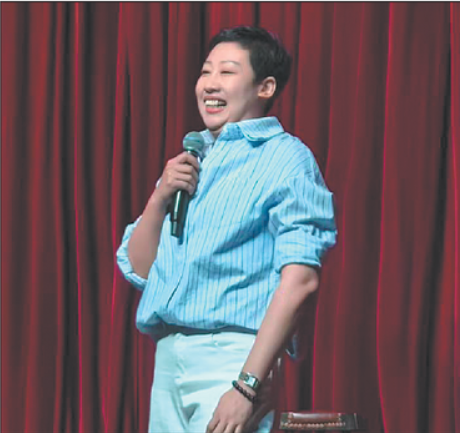
Bai, 40, who has been performing full time since October 2021, said the show began with a simple yet profound realization. She had beenon tour and tickets weren't selling well despite her promotional efforts."I had this idea that every show 'must' sell out," she said. "But one day, I stopped and thought, "Why does it have to be perfect? Why do I demand so much from myself?'"
Born and raised in Shenyang, Liaoning province, Bai worked in a corporate job before her comedy career, and witnessed firsthand how self-acceptance can be a radical act, especially in a world that is quick to judge. As she continued to talk about her self-growth, it became clear that "loving yourself" isn't just a trendy slogan for Bai - it's a mindset.
"I think a lot of people have been conditioned to judge themselves based on external standards," she said.
"How we look, how successful we are, how much we achieve - it's all measured against a mold created by society. But 'loving yourself' is about breaking free from that. It's about saying, 'I'm enough just as I am.'"
Nobody'sperfect
The rise of the aini laoji trend reflects a broader cultural shift, one expert said, and is a rejection of perfectionism and a celebration of individuality.
Psychologist Huang Haihong, who is the head of a youth hotline in Fujian province, said in today's society, social interactions have become "lighter," while loneliness has become"heavier".
Young people, living in a fast-moving world, are increasingly yearning for warmth and acceptance, and are turning to "self-companionship" as a cure.
The phrase aini laoji is a form of emotional expression that "objectifies" the self, she said.
It encourages people to be more proactive in reflecting on their inner feelings and understanding their own needs. Surprisingly, it's not about self-indulgence or being self-centered - rather, it's about recognizing and acknowledging one's own self.
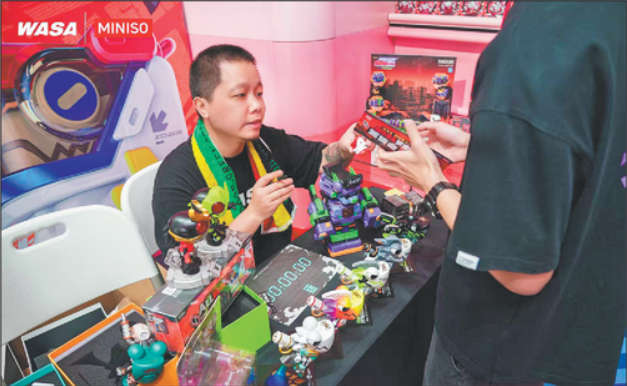
"It is not just an internet meme -it has evolved into a psychological coping mechanism that young people have developed to handle societal pressures and emotional deprivation," Huang said.
"It represents a psychological shift from seeking external validation to building internal support, reflecting a positive, adaptive way to cope with the challenges of modernlife," Huang noted.
"This psychological shift holds positive significance. People who are good at listening to their inner voices and can take care of themselves tend to have healthier mindsets and more stable emotions. As a result, they're able to engage in learning, work and social interactions with a fuller, more composedattitude."
For Lin Mei, a 38-year-old single mother working in customer service, aini laoji is not just a concept.
She divorced five years ago and now lives with her child in a small suburban apartment. Her days are measured in commuting time, homework, grocery bills, parent-teacher messages, and constantly calculating how much energy to expend on these tasks.
"I don't really think about 'lovingmyself' in a big way," she said. "Most days, I just try not to collapse."
She encountered the phrase one night while scrolling social media after putting her child to sleep. "I remember thinking: this sounds like something for people who are already very tired."
When she was younger, she believed life was about achieving something important. Now she thinks it is more about not losing what you already have.
"The 'old self' is not just about age. It's about the part of you that has been used up a little," she said.
She admits that for a long time, she blamed herself - for not having a better marriage, for not being more successful, for sometimes wanting to disappear for a day.
"Then one day I realized the person I'm being so harsh on is the same person who got me through all this. I should stop worrying and start loving myself," she said.
She paused, then said, "If I don't treat that person better, who will?"
"For a long time, mainstream culture was about constant 'self-upgrading'," she continued. "Study harder, work harder, optimize yourself, manage your body, manage your time, manage your emotions. But psychologically, people cannot stay in "improvement mode' forever. Eventually, exhaustion turns into self-negotiation."
Lin describes the phrase as a sign of "emotional repositioning". "It'snot depression. It's not lying flat. It's a softer form of realism - acknowledging that the self is not infinitely renewable."
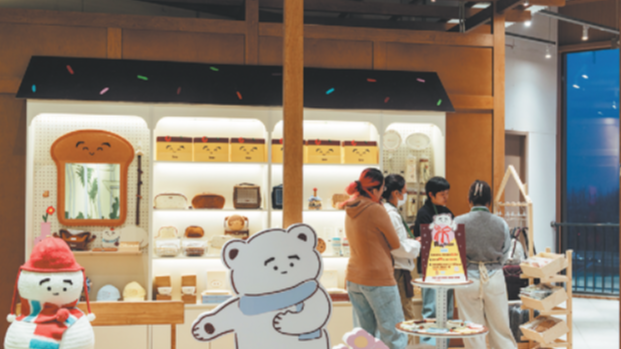
In recent years, multiple consumer and lifestyle reports have pointed to a noticeable shift in young and middle-aged urban populations from "ambition-driven consumption" to "comfort-oriented consumption" from "rewarding the future self" to "compensating the exhausted self".
Sales of massage devices, sleep aids, emotional companionship products, and "small but certain happiness" items continue to rise. So do keyword searches like "healing", "relief", "slowing down", and"emotional stability".
From collecting designer toys and attending concerts to going on themed trips and immersive winter sports holidays, the idea of "putting your own happiness first" is part of many layers of consumption.
The 2025 Generation Z emotional consumption report, co-released by the Shanghai Youth & Children Research Center in November 2025, showed that emotional value is significant to today's youth.
Over 90 percent of young people recognized "emotional value" and nearly 60 percent were willing to spend money on it, according to the report.
A total of 46.8 percent of young people said emotional value is "a good remedy for relieving stress and anxiety". The report said 43.1 percent of them felt that emotional value "makes them feel needed and seen". Almost a third, 32.8 percent viewed emotional value as "a source of life energy" or a "tool for survival", while 22.8 percent said they were becoming increasingly aware of the importance of emotional value.
Toys, are us
Zhou Qi, 29, works in a game design company in Shanghai and lives alone with two cats.
At 9:30 pm, after finishing work, his eyes were fixed on his phone screen, constantly refreshing the Pop Mart blind box sales page to secure The Monsters: High-Energy Series, which would be released at 10:00 pm on Jan 7.
He not only canceled a dinner plan with friends but also organized a "purchasing team" with his family to help him.
"I have stayed up late multiple times to grab blind boxes. I really like it. It's going to make me happy for the next month," he said.
Zhou said he is not simply buying a blind box or a figurine because it's a collectible; he's engaging in a form of self-care. His excitement and joy over receiving a figurine give him emotional satisfaction.
"Whether it's through collectible items, AI companionship, or quirky cultural creations, young people are increasingly embracing self-love by investing in things that make them feel good, reflect their personality, or help them manage stress and anxiety" said Miao Chengbin, 42, founderof BadMarket, one of the most popular stores among young Chinese consumers, catering to their emotional needs.
With its first store launched in Guangzhou, Guangdong province, in 2016, BadMarket has since gained a large fan base with its concept "buy for fun, not for need". Now, it has ten stores across the country, including Beijing, Shanghai, Guangzhou and Qingdao, Shandong province.
On Dec 26, 2025, Miao launched a new store in Beijing, named BadVillage, gathering nearly 10 fashion brands from home and abroad.
"People don't come to the stores with a shopping list," Miao said."They come because it's fun. It's aplace to get lost in - no pressure, just excitement. Whether it's a rare vinyl toy, a crazy-cute T-shirt, or a coffee cup that feels just a little too fun to resist, shopping is all about pleasing yourself."
Miao, a former graphic designer who used to create edgy campaigns for fashion and restaurant brands, has gained insight into the young generation that is paying dividends.
"Today's young people don't lack anything," he said. "They don't need more clothes or more cups. What they're really after is the experience of shopping - the fun, the excitement, and the entertainment that comes with it."
In 2022, when most brands were clamoring for online traffic, Miao did the opposite: he closed the company's online store. He understood that online shopping just wasn't offering what the younger generation craved.
"People born after 1990 and 2000, who've grown up with online shopping at their fingertips, are nowlooking for something more," Miao said.
Young generations have made "loving yourself" feel more natural and straightforward compared with older generations who view eating well as an extravagance and relaxation as laziness, he added.
Contact the writer at chennan@chinadaily.com.cn
