

A veteran novelist reflects on sincerity shaped by hardship, recalls rural memories, and explains how conscience guides writing across decades of steady work.
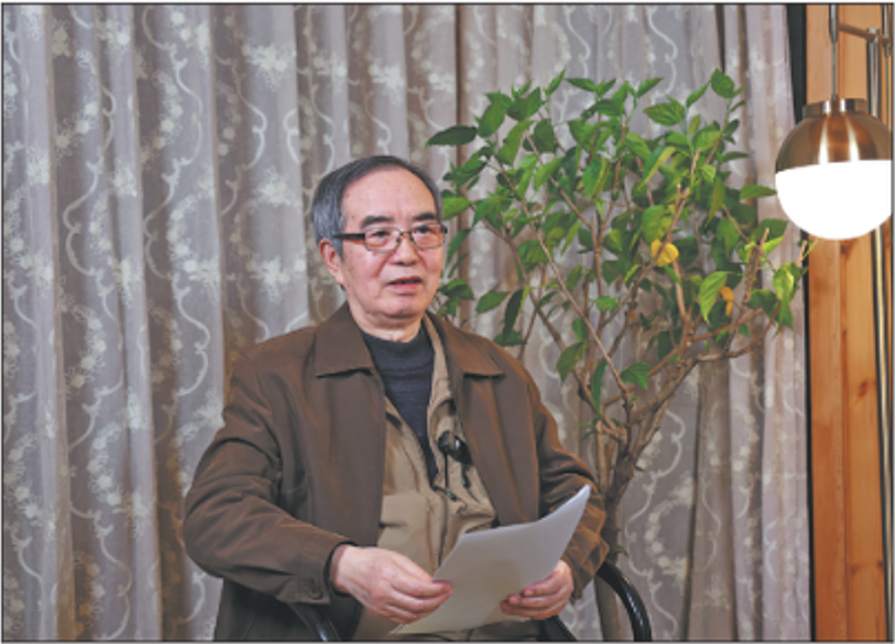
For Chinese writer Li Rui, the most precious lesson in writing is not technique or reputation, but to be honest, earnest, and sincere.
Don't let yourself be swayed by various social trends. Write honestly. Respond to changes genuinely, from the heart with conscience and sincerity" says Li at a talk on his writing career with David Der-wei Wang, professor of Chinese literature at Harvard University.
"One so-called truth arrives and colors the world one way. Another follows and changes it to a different color. Truth keeps changing. As individuals, especially as artists or writers, being sincere, earnest, and honest is, I believe, what matters most," he says.
Born and raised in Beijing, Li was 19 when he was sent to a village called Dijiahe in Lyuliang Mountains in Shanxi province as an educated youth in 1969 during the "cultural revolution"(1966-76). There, he worked in the fields for six years. Within three of those years both his parents died.
"At that time, my family had collapsed. I took on side jobs to survive, collecting acorns. I often found myself alone with a sack deep in the forest. The deeper I went, the more it felt like I was the only person left in the world, with nothing but the sound of dry leaves underfoot and the sound of forest waves moving through the trees," he says.
Sitting alone in that forest, under a tree, he experienced a sudden sense of unity with the universe. Personal loss and all the upheavals of fate became an invisible education for him.
"Without this experience, the underlying tone of all my later works would not exist," he says."
No book has ever inspired me asprofoundly as the Lyuliang Mountains did." In despair, Li decided to fight againsthis fate in the only way available to him by writing.
At the discussion. Wang recalls a story about Li's passion for writing when he was about 22 years old.
At that time, Li was trying hard to prove himself as a writer. One day, he heard that a well-known author had arrived in the county, and decided to seek his advice. Li rose early in the morning to catch a tractor ride but missed it, and spent much of the day chasing after it on foot. By nightfall, his legs were badly swollen.
In 1974, Li published his first short story in Shanxi provincial literary magazine Qunzhong Wenyi (People's Literature and Art). "The story of you rushing to meet that author adds a special significance to your first published work. Not every piece of writing can truly allow us to relive the hardship behind it, nor the sincerity and dedication, or the sheer physical effort a young author poured into it," Wang says.
He says he sees a young and energetic educated youth pursuing his dream of writing with an almost hysterical determination, trying to prove through his words that his efforts and existence mattered. "This process almost has the flavor of an absurdist hero. and perhaps even a failed hero, because hiswork didn't immediately demonstrate his remarkable talent. It took many more years of practice and perseverance, step by step, to finally achieve the dreams he had back then," Wang says.
"It moves me deeply," he says, "that earnestness."
In 1986, Li published his first book Hou Tu (Deep Earth), a collection of short stories, which Li said in previous interviews was the true beginning of his literary career.
Later, he published works including short story collections and novels such as Jiu Zhi (Former Site), Trees Without Wind, Silver City, and No Clouds for Ten Thousand Miles. as well as essay collections. His works have been translated into English, French, Japanese, German, Korean,Vietnamese, and Swedish. In 2004, he received the Ordre des Arts et des Lettres (Order of Arts and Letters) from the French Ministry of Culture. Among the earliest scholars to Lis's works was the late Swedish Sinologist Goran Malmqvist. In 1986, he translated Hou Tu into Swedish and later Jiu Zhi, Trees Without Wind, No Clouds for Ten Thousand Miles and other works he liked by the Chinese writer.
"I hope that one day I can fulfill a great wish: to go to the Lyuliang Mountains and meet the characters from Li Rui's novels. Trees Without Wind and No Clouds for Ten Thou-sand Miles," Malmqvist once said. That wish was fulfilled in 2004.
He Ping, literary critic and professor of Chinese literature at Naniing Normal University, describes Li as "a very important writer in the transformation of Chinese literature from the 1980s to the 1990s". Wang recalls that in the late 1990s, when the "root-seeking" literarys school and avant-garde movement dominated the Chinese-language literary world, Hou Tu stood out for its concise yet powerful language. It vividly depicts the struggles of people on the Loess Plateau in the Lyuliang Mountains, constrained by their environment and fate. but still resisting, enduring, and producing stories marked by tragedy and moments of dark comedy, he says.
Since 2024, the Yilin Press has published a series of works by Li, including three fictional works -Trees Without Wind, Taiping Feng-wu (Farm Tools), Ren Jian (Tales of the Mortal Realm: A New Retelling of the White Snake Legend, coauthored with Li's wife Jiang Yun), and two essay collections Yongshi Jiayuan (Homeland Lost Forever). and BiChangshi Gengin Yibu (A StepBeyond Common Sense).
Trees Without Wind, first published in 1996," continues Li Rui's focus on the Lyuliang Mountains depicting the endless struggle between people and the land, and with nature. This struggle is cruel and absurd, yet it possesses a certain dignity that compels deep reflection" says Wang. It is a work that made Li believe that he had truly surpassed himself as a writer.
The short story collection Farm Tools serves as a modern elegy for ancient farming equipment.
Li's six-year farming experience in Djiahe gave him a distinctive understanding of history.
"What is history? History is the millet turning yellow thousands of times and the sorghum turning red thousands of times," he says.
"The 5,000-year history of Chinese civilization is, in a sense, a 5,000-year history of agricultural civilization. Only in the past half-century has large-scale industrialization taken place. This process, formed in the context of globalization, has prompted me to understand the shared fate of farmers and their farming tools," Li says, explaining the inspiration for the book.
The book contains 14 short stories, each named after a farming tool, such as a pickaxe shovel, hoe, sickle, axe, and shoulder pole. Li displays the sorrow and rebirth of a 5,000-year agricultural civilization in this "farming tools exhibition" on paper.
Homeland Lost Forever gathers essays ranging from travel notes in Northern Europe to memoirs and reflections on language. The collection reveals. through restraint and clarity, the purity of modern Chinese prose.
A Step Beyond Common Sense, also an essay collection. includes observations on everyday life with his wife Jiang Yun and daughter LiDi'an, reflections on films, and responses after reading works by Lu Xun and US writer William Faulkner. With sincerity, Li Rui showcases the intellectual beauty of Chinese prose.
He says that he is a pessimist, but this pessimism is the attitude a sincere person holds toward people, fate, themselves and history.
Li Rui aspires in his works to portray a history that reveals the truth that "humans are rational creatures, yet the history created by humanity is often irrational. This irrational history has swallowed countless lives. It's a dilemma faced by everyone, not just by individuals, but by all of humanity as a whole."
Contact the writer at yangyangs@chinadaily.com.cn
