

From AR storytelling to AI health tools, women developers designed technology rooted in empathy, lived experience, and social needs.
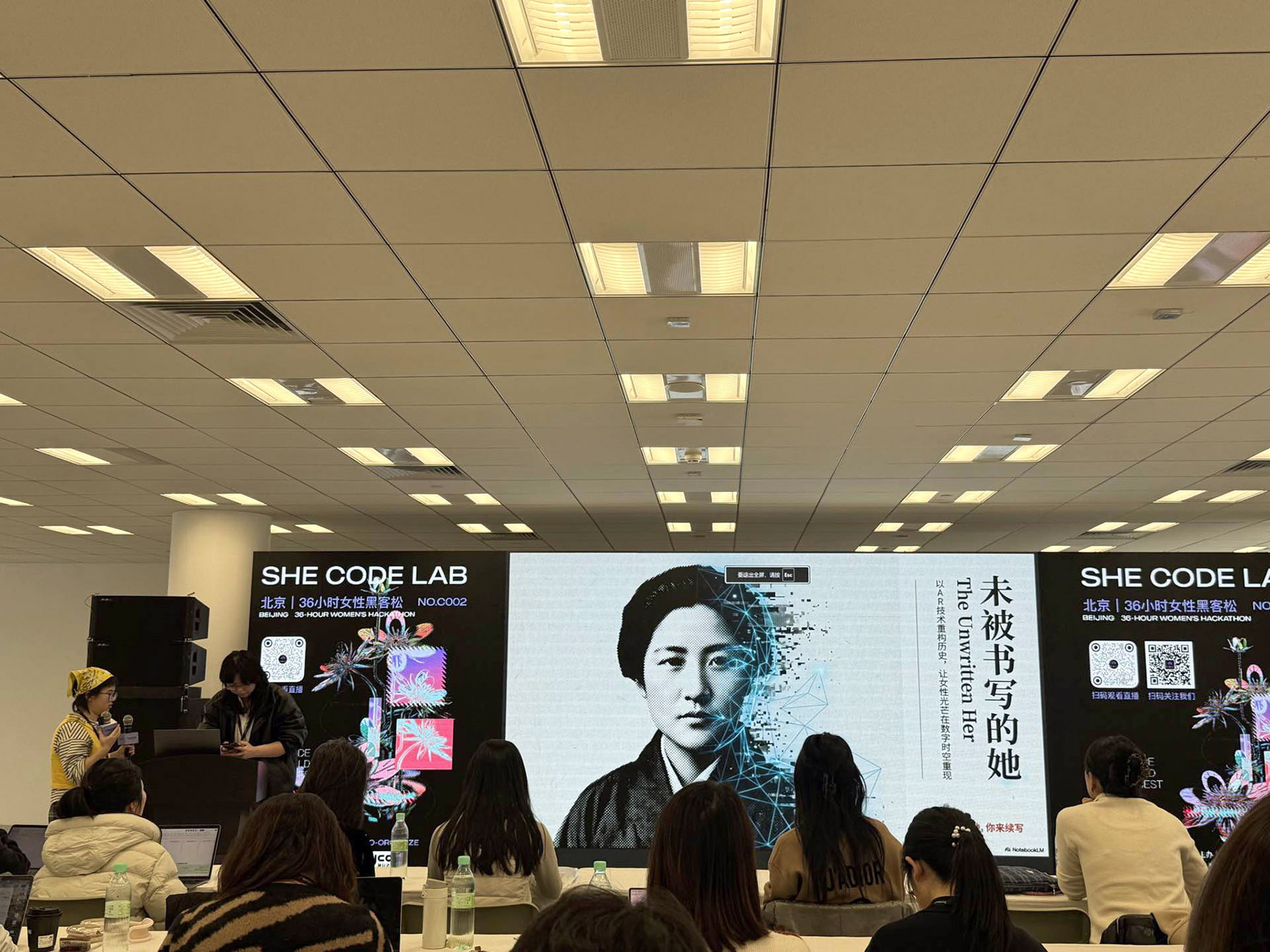
At 1 am on Jan 17, Wang Wanchen, a mechanical engineering student, and her two teammates, Huang Xuwei and Li Ziqi, were still deep in discussion, refining the prototype of an app they had been building. They called it "The Unwritten Her" — an immersive AR experience designed to bring the long-buried stories of real women back to life at historical sites.
Despite their fatigue, their eyes shone with excitement and determination. "With an all-female team, we can work day and night together," Wang said. "It feels very pure, and the atmosphere is warm and supportive."
Wang and her teammates were among more than 100 participants at the She Code Lab 36-Hour Women's Hackathon, held in Beijing from Jan 16 to 18. Over the course of 36 hours, they formed teams, brainstorming, designing, coding, and ultimately delivering functional product prototypes under tight time constraints.
While female-focused, the event welcomed participants of all genders. Still, women led the work and set the tone. Organized by She Nicest and Coding Witch, the event emphasized "technology for good" and promoted a women-friendly value system. With the theme "Her Perspective", its mission was captured in the slogan:" Women Hack the Future Together. The Future is Something We Code Together".
READ MORE: New hub empowers future female leaders
The results reflected a wide range of concerns and creativity. Apart from "The Unwritten Her", one team developed an app to help users navigate the emotions of saying goodbye — to loved ones, pets, or cherished belongings. Another created an AI health companion designed specifically for women living with polycystic ovary syndrome, a common hormonal condition.
Events like this are urgently needed, participants said, because the tech world has long been male-dominated. Wang described feeling isolated in her daily study and work environments. From university classrooms to internships, being one of the few women often meant being overlooked.
"If there were more women in the tech industry, maybe one day we could discuss technology at a nail salon — not just in smoking areas," she said."Right now, so many industries are led by men, so things naturally cater to their preferences."
Peng Jing, one of the organizers, believes the smaller presence of women in tech has little to do with ability and far more to do with expectations."Even when women have strong skills and leadership potential, they're often not encouraged to take charge. When people don't expect a woman to lead, she may be less likely to pursue leadership roles herself," she said.
Another organizer, Song Yuhang, examined the issue from a broader structural perspective: "If new productive forces are dominated by only one gender, it will lead to greater inequality in the future, excluding women from having a say in decision-making and access to wealth distribution," she said.
Inclusive innovation
According to She Nicest, female developers bring unique perspectives to the tech field. Drawing on real-life experiences, they are often able to identify overlooked needs and design solutions that address specific challenges more directly.
One example was Dai Xinru, who developed the "Babycare Simulators" app with teammates Si Xiaoyu and Du Yilin. Users can upload photos to generate a virtual avatar of their baby. As the baby "grows", users are assigned tasks such as feeding, soothing it to sleep, changing diapers, and even holding emotional conversations.
Dai said the idea was inspired by a dilemma young people face today: uncertainty about whether to have children. "Many people around me — especially women — feel torn about having kids," she said.
The app aims to challenge the traditional belief that child-rearing is primarily a woman's responsibility by simulating the demands both mothers and fathers face during early childcare. It encourages more rational decision-making and shared responsibility between partners.
The project won the hackathon's Best Problem Definition Award.
Several teams developed apps focused on mood tracking and emotional support. One standout was "Mood Trip", created by Lu Feiyu and her teammates. The app features a playful interface built around a pink pig character that lives its own life, while also remaining ready to listen, provide companionship, and act as a friend.
"Emotional struggles aren't exclusive to women — men experience them too," Lu said. "However, men are often taught to suppress their feelings, while women are encouraged to express them. That difference can make women more sensitive when designing emotional support tools."
Lu, an environmental design student, said the hackathon helped her connect with women from varied fields.
"I had so many ideas, but I didn't know how to turn them into something real in such a homogeneous environment," she said. "Now I'm working with teammates in product, visual design, engineering, and other fields — and I finally feel that I'm equipped to bring my ideas to life."
ALSO READ: Recognizing the reality of women
In fact, both organizers and participants came from diverse academic backgrounds, including many liberal arts majors. One organizer, Liu Siyi, studied gender and media communication and believes liberal arts students have a unique advantage in the AI era.
"In a world driven by speed and anxiety, the humanistic spirit and critical judgment of liberal arts are invaluable," she said. "Technical skills need the perspective and aesthetics that the liberal arts bring."
Following the event's success, the organizing team is now planning an even larger women's hackathon this summer, with more than 1,000 participants.
Ni Zhen, founder of She Nicest, recalled a common perception she encountered while fundraising: in the world of capital, women's issues are often treated as "frosting on the cake" — nice to have, but never the main course.
She rejected that framing. Looking ahead, she envisions a bigger future for women in tech. "I've done many small and beautiful projects, but I'm tired of being limited to just that. Why can't women have grand narratives and pursue ambitious goals?" she said.
Contact the writers at guiqian@i21st.cn
