

A journey through the island reveals leisure, adrenaline and living traditions reshaped by opening borders, Yang Feiyue reports in Hainan.
The tropical perfume of sunbaked earth, seawater mist and flowering frangipani work an instant magic, loosening the tight knots of mainland life.
It ushers you into Hainan's perpetual state of vacation. This sensation feels especially welcome when arriving from the frozen north in deep winter, as I did, fleeing Beijing's gray chill in late December.
Yet, it does not take long to realize that beneath this hypnotic languor lie layers of more elemental thrills. The morning ferry the next day to Wuzhizhou Island in the northeastern bay of the Sanya city (the city is in south of the province) offers no gentle preamble.
As the vessel leaves the shelter of the bay, it begins to labor, its hull rising and falling in deep, rhythmic troughs against the open South China Sea.
A chorus of gasps and nervous laughter rises and falls with the swells. A few passengers retreat into green-faced silence, gripped by seasickness.
But the reward, upon disembarking, is immediate and dazzling. Before us lies an intensely green island, fringed by a ribbon of sand so white it glows against water shifting from tourmaline to sapphire.
ALSO READ: Re-creating history in the 21st century
Wuzhizhou's carefully curated experience begins with the electric buggy, the only way to navigate its narrow coastal ring road.
Our guide, Zhang Qiong, greets us brightly and cautions everyone to buckle up, keeping hands and feet inside the vehicle at all times.
"Unless, of course, you'd like to get a 'spark of love' from our rocks and trees!" she chirps over the speaker system.
Her warning is playful, but the road demands respect. It is a tortuous lane clinging to cliff edges, with sporadic explosions of spray where waves crash against dark volcanic rocks below.
The journey is a moving panorama. Zhang's narration weaves geology with folklore, pointing out "stone crabs" scuttling over wet rocks and transforming abstract rock formations into stories: the "golden turtle exploring the sea" basking in sunlight and the poignant silhouette known as "a wife waiting for her husband".
The island boasts a unique ecology. It is among the few in the area with its own freshwater springs and is famed for the clarity of its surrounding waters, where visibility ranges from 6 to 18 meters down to vibrant coral gardens.
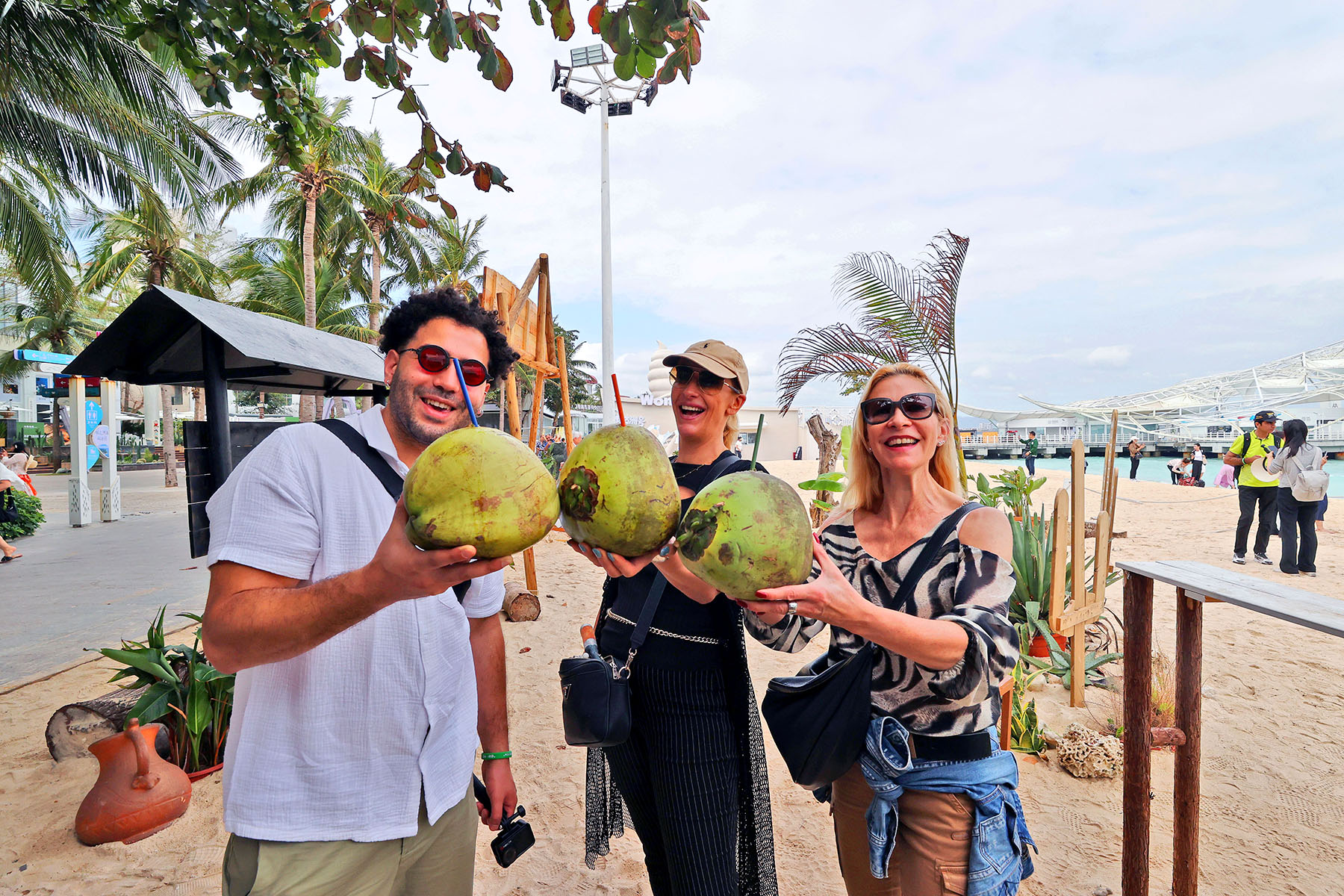
At a southern cove, we disembark onto a scene of perfected leisure. The beach, with its powder-soft coral sand, is a vacation bliss. Visitors pose for photos, sip from fresh green coconuts, or sway on swings arcing toward an infinite blue horizon. It is a textbook tropical idyll, one that has begun to travel far beyond the shores.
"We received about 5,000 international visitors last year," explains Yan Yi, deputy manager of member services with the administration overlooking the bustling marina.
"Nearly half came from Southeast Asia, with Russians dominating during the winter months."
Historically, she notes, inbound tourism was minimal. The turning point came around 2024, catalyzed by the expansion of Hainan's visa-free policies.
"We've since actively partnered with airlines and cruise lines to offer tailored packages," Yan says.
The adaptation is visible across the island. Multilingual signage dots the pathways and a more polyglot team is steadily taking shape.
"We are recruiting more driver-guides with foreign language skills and have even begun hiring native speakers from places like Russia," she adds.
Hainan's second face emerges as I travel inward to the Yanoda Rainforest Cultural Tourism Zone. The cable car takes me flying over the lush slopes of Baoting Li and Miao autonomous county, offering a stunning bird's-eye view of the 45-square-kilometer preserve billed as a "living museum" of tropical ecology.
Below stretches a world of primeval banyans, hanging gardens, and cascading waterfalls.
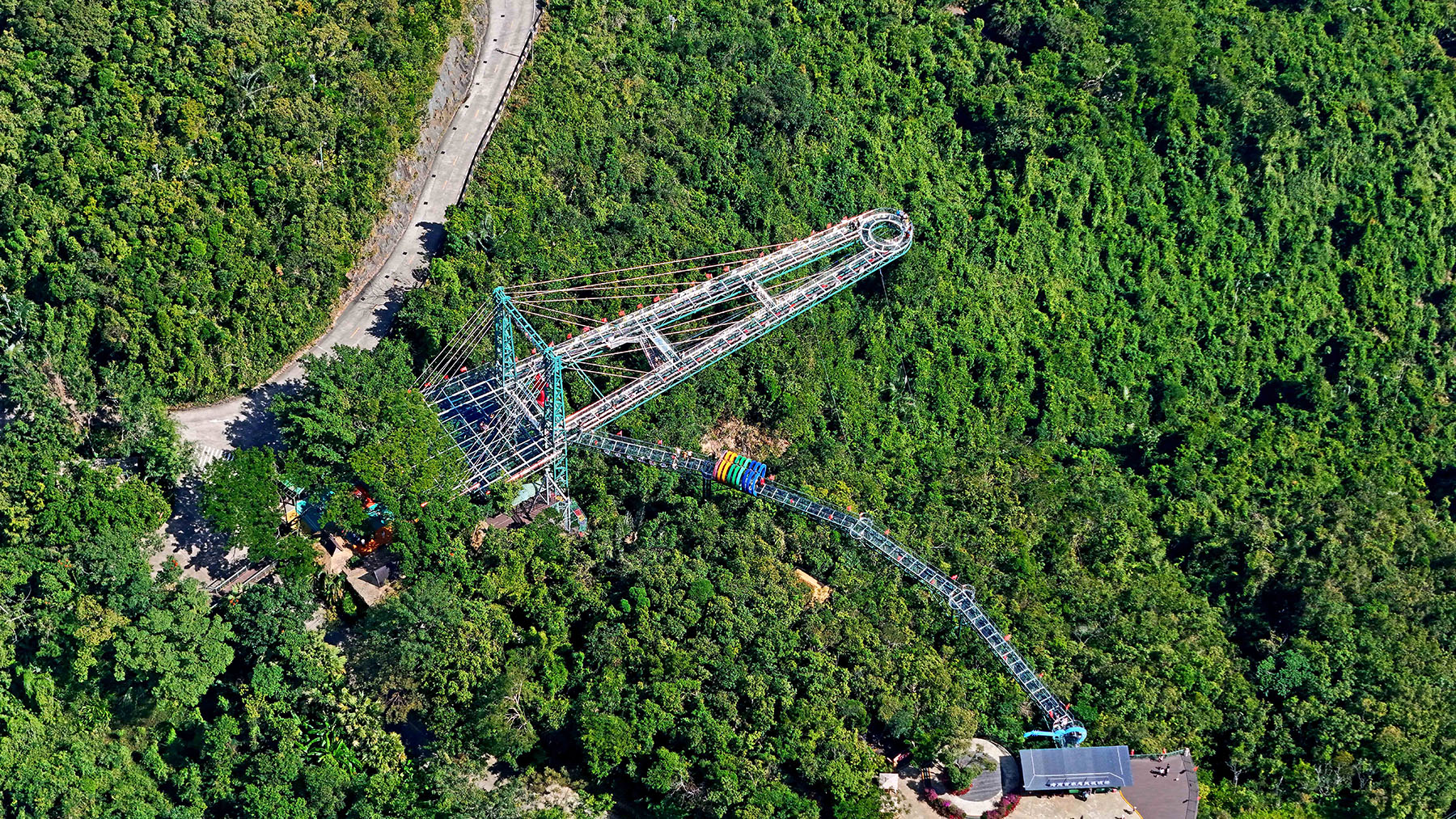
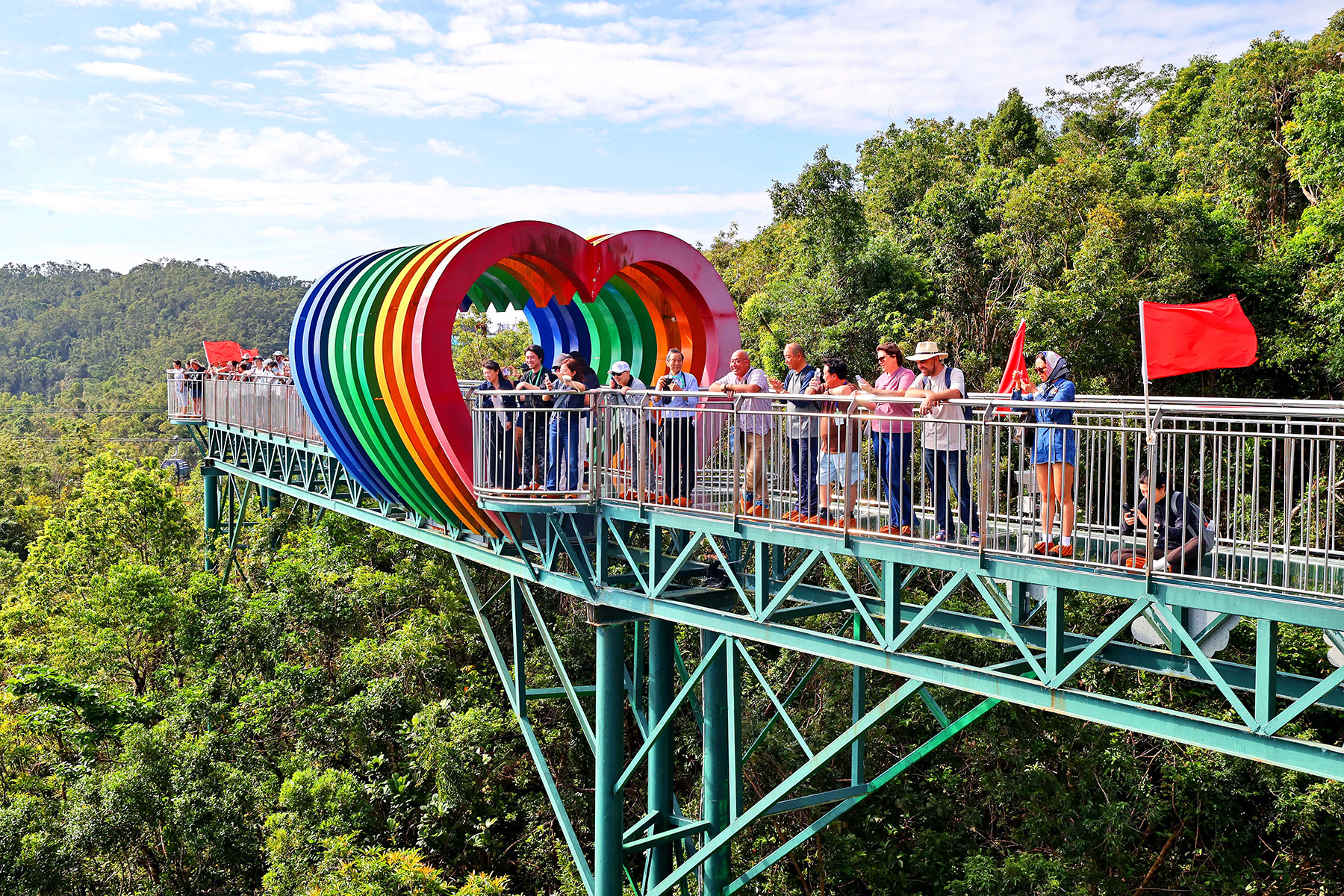
But at the summit, the experience pivots sharply. Here, the main attraction is a stark ribbon of modernity in the form of a 365-meter glass-bottom bridge suspended 90 meters above a deep, green gorge. "Many tourists come specifically for this," says Chen Yifu, a team leader at Yanoda.
The appeal lies in the terrifying thrill of transparency, amplified by the perfect contrast between dense rainforest below and the distant shimmer of coastline on the horizon.
Maintaining this illusion requires relentless labor.
"We clean the glass constantly. If dirt accumulates beneath, the transparency is ruined. The experience fails," Chen notes.
The bridge, however, is merely a gateway to Yanoda's adrenaline circuit. Nearby lurks the "Devil's Swing", a harnessed launch that sends participants shrieking in a giant arc over the abyss. Participation is strictly limited to 20 people per day.
"It's almost all foreign visitors. Over 50 percent annually are international tourists," Chen shares.
While Yanoda's foundation lies in ecological and cultural education, its strongest pull for overseas guests is universal: controlled fear paired with spectacular vistas, he explains.
"The visa-free policy has driven growth," Chen confirms, citing travelers from Russia and Kazakhstan. On peak days, they can number 1,000, a significant part of the park's visitors.
This influx creates a logistical dance of adding shuttle buses and staff based on tour group schedules.
Yet, like many attractions, Yanoda grapples with a communication gap.
"Foreign language ability is a weakness," Chen admits frankly.
For now, translation apps offer a pragmatic solution. The park is also playing catch-up, conducting basic Russian training for staff and actively seeking Russian-speaking hires, he adds.
The air grows heavier, fragrant with damp earth, decay and a scent of profound life as I arrive at Binglanggu, a 20-minute drive from Yanoda.
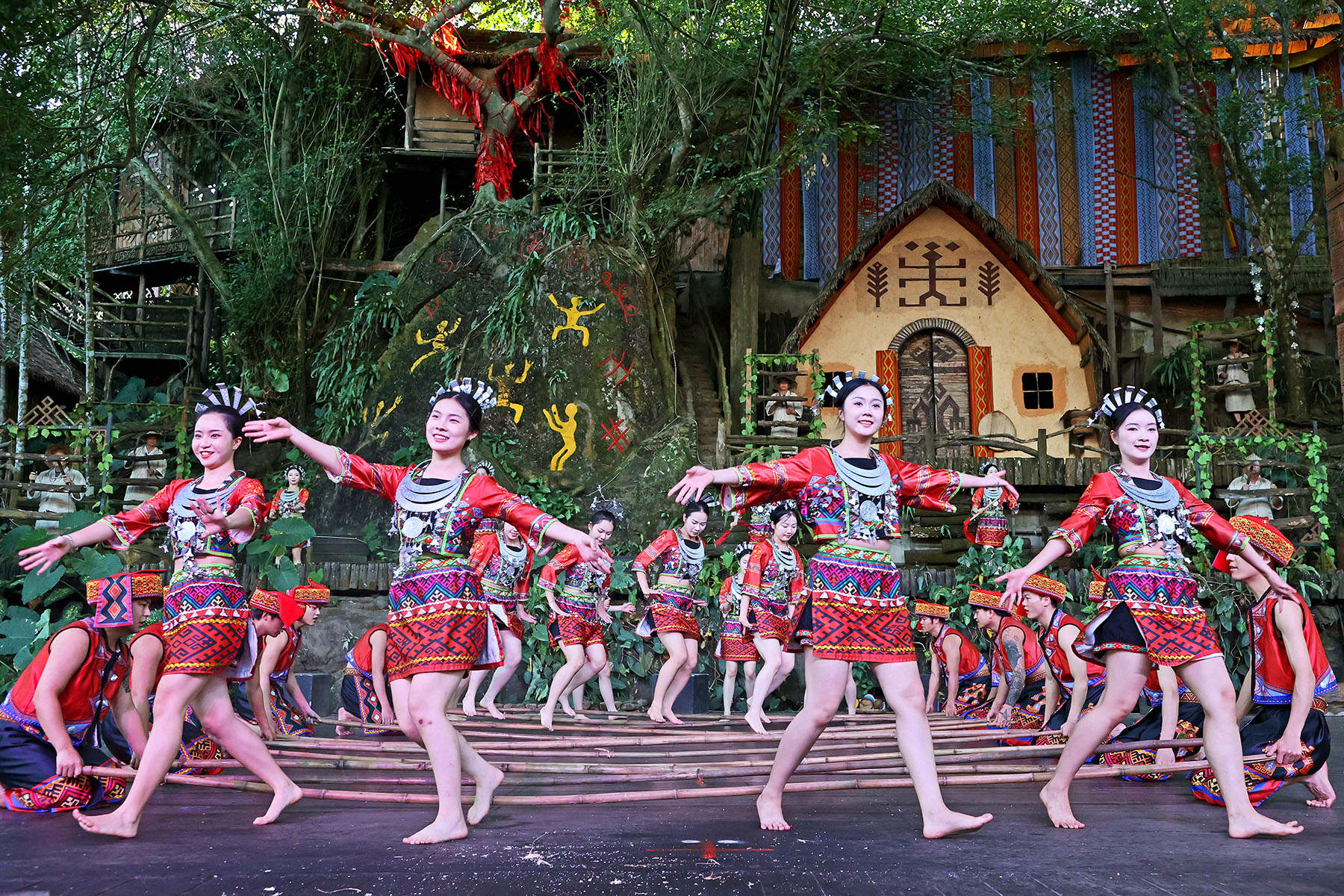
Women bend over looms weaving in distinctive rural dwellings; children dance amid the bamboo poles that snap open and shut as performers hold both ends. Elsewhere, musicians coax melodies from flutes played not with lips, but with noses, as I wander through the vast mountainous landscape.
"Since our founding in 1998, our principle has been to excavate, protect, pass on, and promote the culture of the Li and Miao ethnic groups," says Deng Daoshun, a manager with the preserve's marketing center.
It explains my curiosity that the whole place is not a constructed exhibit but has been built around existing ethnic villages.
"After the park was established, some elders chose to move to the neighboring village for peace and quiet," Deng reveals.
"Others, whose roots were here, have stayed."
He emphasizes that all ancestral homes have been preserved, becoming Binglanggu's living heart.
The arrangement has created a unique symbiosis, in which former residents often return as cultural practitioners and quietly engage with travelers.
In the cool shade of a traditional boat-shaped house, its arched roof fashioned from wood and thatch, Huang Xi, a woman in her 30s, weaves rattan with practiced ease.
"This was originally my home," she says, her fingers moving with unconscious skill.
"Now, I come back here to work."
ALSO READ: Strategy expects tourism sector surge
Her craft unfolds at an unhurried pace. A single large basket can take months to complete, beginning with foraging vines deep in the hills.
As I watch visitors pause before her, pointing and asking about her craft, I feel her presence transforming the site into a living dialogue.
The park has now provided practitioners like Huang with a stipend, lodging, and meals, anchoring heritage to livelihood.
"We've moved beyond static displays, and now have over 300 interactive activities daily," Deng emphasizes.
This shift toward experience is also felt by international guests.
"Many join the dances or ask how to play the nose flute," he observes.
The three faces of Hainan have given me a good taste of its commitment to service, pleasure and preservation.
From time to time, the sheer enthusiasm of my shuttle guide on Wuzhizhou Island and the unreserved smile of local residents at Binglanggu come back to me.
They give me confidence that deeper, more resonant discoveries are still waiting.
Contact the writer at yangfeiyue@chinadaily.com.cn
