

While China remains the world's dominant power at the ping-pong table, transitional challenges have cast a shadow over its Olympic preparations
For Chinese table tennis, the past year was defined by dual narratives: podium dominance persisted, but growing pains of a generational transition in the early phase of the Los Angeles 2028 Olympic cycle were evident.
The national team further cemented its status as the sport's dominant power by claiming four golds at the ITTF World Table Tennis Championships in Doha, sweeping all five titles at the 2025 World Table Tennis (WTT) China Smash, and securing a historic third consecutive ITTF Mixed Team World Cup crown in Chengdu, Sichuan province.
Yet, with Grand Slam icons Ma Long and Fan Zhendong absent from these major events, a layered reality emerged: a resilient women's squad continued to dominate, whereas the men's team faced mounting pressure, with particular concerns in men's doubles.
Statistically, China maintained its year-end supremacy, topping four of the five ITTF world rankings. Wang Chuqin and Sun Yingsha led the singles categories, Wang Manyu and Kuai Man topped women's doubles and Lin Shidong and Kuai in mixed doubles. They all capped off the year with displays of dominance.
A mixed bag
April brought a pivotal Olympic development as the International Olympic Committee Executive Board approved the addition of a mixed team event to the Los Angeles 2028 program, replacing traditional men's and women's team competitions. Though the new category's specific format is yet to be finalized, the Olympic program will now feature six table tennis events, including the return of men's and women's doubles, alongside singles and mixed doubles.
With the announcement of the mixed team event at the Olympics, last year's ITTF Mixed Team World Cup in Chengdu attracted a 16-team field of unprecedented strength, all eager to use the tournament as valuable preparation for LA28.
The Chinese team delivered a dominant performance, winning all 11 matches to secure a third consecutive title.
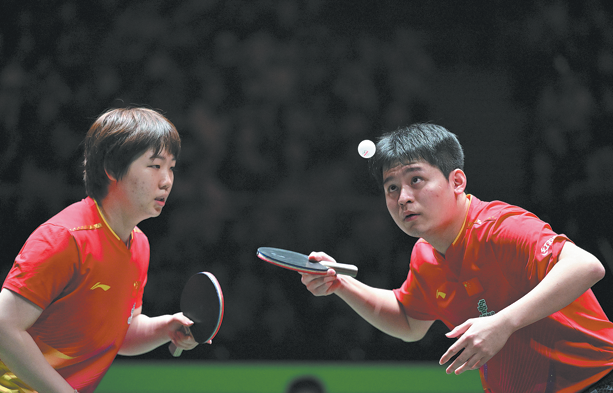
In the final, they overwhelmed Japan's full-strength squad 8-1:Wang Chuqin and Sun opened with a 3-0 sweep of Japan's Sora Matsushima and Satsuki Odo in mixed doubles, Wang Manyu followed with a flawless 3-0 victory over Miwa Harimoto in women's singles, and 20-year-old Lin Shidong — after dropping the first game against 22-year-old Tomokazu Harimoto — regained his composure to claim the next two games and seal the championship for Team China.
"The mixed team format breaks the boundaries of traditional men's and women's team events, prompting teams to pursue deeper integration in pre-competition training, talent pipeline development and match tactics," noted Wang Liqin, president of the Chinese Table Tennis Association.
"This format not only tests the individual abilities of top players, but also serves as a rigorous assessment of a team's overall strength and collaborative capacity."
China's "three-peat" demonstrated not only its adaptability to the innovative format and every player's commitment to collective victory, but also the stability of its core athletes. Sun, for instance, won all eight of her mixed doubles and women's singles matches at the tournament without conceding a single game.
"As time progresses, every team will conduct more in-depth research into the mixed team event. We may face increasingly tough battles, but I have unwavering faith in the strength of our team," said Sun.
Wang Chuqin attributed the success to "the team's comprehensive strength and cohesive spirit" during his post-final remarks.
Yet, the broader competitive picture revealed complexities and concerns on the men's side.
At the World Cup in Macao in April, Sun swept past Kuai Man to defend her World Cup title, while Lin Shidong fell 1-4 to Brazil's Hugo Calderano in the men's singles final.
In May, Sun defeated Wang Manyu to successfully defend her women's singles title at the Doha world championships, extending the Chinese women's team's uninterrupted dominance in the event to 16 consecutive championships since 1995.
Meanwhile, in Doha, Wang Chuqin claimed the St Bride Vase for the first time, and he and Sun made history as the first duo to secure three consecutive world championships mixed doubles titles, continuing their reign in the discipline.
Wang Manyu and Kuai Man rounded out the tournament with their women's doubles triumph.
Men's doubles, though, proved to be a trickier area: Liang Jingkun and Huang Youzheng bowed out in the round of 16, and Lin Gaoyuan and Lin Shidong were knocked out in the quarterfinals, making it the quietest performance in the event from the Chinese men in half a century.
More recently, at the WTT Finals 2025, which took place in Hong Kong from Dec 10 to 14, the women's singles draw became an all-Chinese affair from the semifinals onward — while the men's singles campaign encountered notable hurdles.
China's Lin Shidong fell 3-4 to Japan's Tomokazu Harimoto in the semifinals, and Wang Chuqin withdrew from his semifinal matchup due to injury.
In the mixed doubles final, Wang Chuqin paired with Sun — who had also pulled out of the women's singles semifinals with an ankle injury — and the duo lost 3-0 to South Korea's Lim Jonghoon and Shin Yu-bin.
"The men's team is our most pressing challenge. The skills and experience needed to perform well at major tournaments require further improvement, especially for younger athletes, who need to boost their overall competitiveness and performance at big events," Wang Liqin pointed out.
"Beyond that, we need to deepen our research on doubles events, strengthen athletes coordination, and refine our technical and tactical preparations for doubles in the future."
Withdrawal symptoms
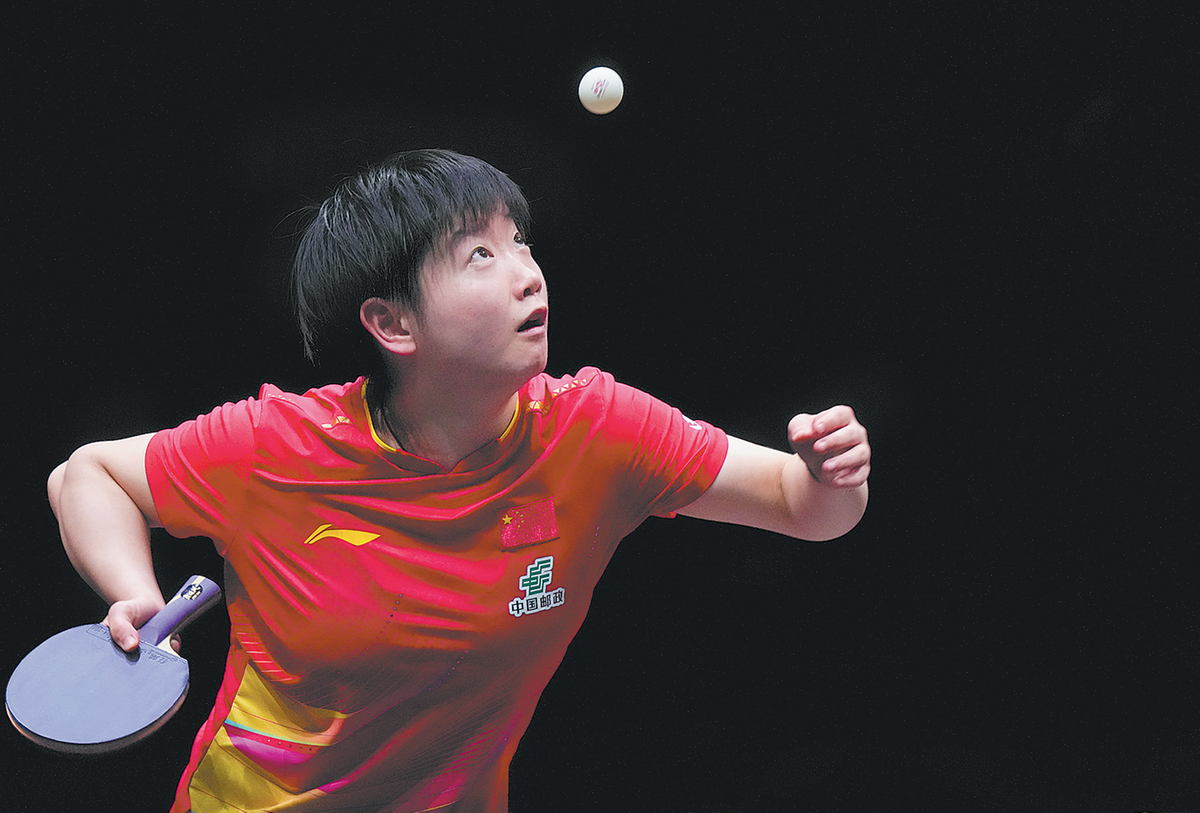
Notably, the back-to-back withdrawals of two Chinese star players due to injuries within 24 hours at the WTT Finals 2025 sparked fan concerns over their demanding schedule.
According to the WTT's 2025 calendar, the annual tournament count exceeded 45. During the Hong Kong stop, Sun had to play five matches within 28 hours, including three matches within a seven-hour span on a single day, with less than 90 minutes of rest between two of them.
"I hope to maintain a positive mindset, take some time to rest, and allow myself to make a good physical and mental recovery," Sun said.
The CTTA issued a statement on its official website on Dec 14 in response to the two players' withdrawals.
It stated that the association would further improve athlete health protection and injury prevention mechanisms and continue supporting athletes' long-term career development.
"The CTTA always puts athletes first," the statement read.
"We have been actively communicating with the ITTF, WTT, and related stakeholders to jointly advance a more scientific and sustainable competition structure."
It also called on the public to "help foster a rational and supportive environment for our athletes".
These concerns over schedule intensity and well-being were not isolated. Facing the WTT's participation mandates and financial penalties for top-ranked players, Olympic champions Fan Zhendong and Chen Meng announced their withdrawal from the ITTF World Rankings at the end of 2024.
The move meant they automatically opted out of WTT and ITTF-sanctioned events that award ranking points, essentially stepping back from the international circuit.
In reaction to player feedback and broader systemic critiques, the WTT introduced a series of reforms last February. Key changes included adjusted mandatory participation rules, permission for athletes to skip two WTT Champions events annually and an increase in prize money.
Paddling overseas
Freed from the shackles of his WTT commitments, reigning men's Olympic singles champion Fan embarked on a notable new chapter in his career by heading to Germany's Bundesliga to ply his trade with club 1. FC Saarbrucken in June.
In Germany, he had to adapt to an unfamiliar environment, manage his own daily life and face a whole host of new opponents and unfamiliar playing styles.
While embracing the move, and all of the new experiences that came with it, Fan had to fight, not always successfully, to reassert his dominance in his new environment.
Fortunately, after a shaky start, he quickly found his feet, but perhaps the competitive challenge of the German league has paid dividends. Fan arrived in China for the 15th National Games in November in fine form.
Representing Shanghai, he defeated world No 1 Wang Chuqin in the semifinals and then world No 2 Lin Shidong in the final, defending the gold he first clinched in 2021.
Competing in the team event as well, Fan maintained a perfect individual record and helped secure a silver medal for Shanghai.
Commenting on Fan's experience, Zhang Jiehai, a researcher at the Shanghai Academy of Social Sciences who specializes in German culture and closely follows table tennis, noted: "Fan Zhendong's journey shows that even a world No 1 player with a thoroughly developed technical system can still learn vital lessons and identify unseen gaps in an overseas environment. This suggests that Chinese table tennis does not possess all the answers — the global game is not simply following China's lead. Sustained leadership requires maintaining openness, diversity and a degree of technical unpredictability."
xingwen@chinadaily.com.cn
