

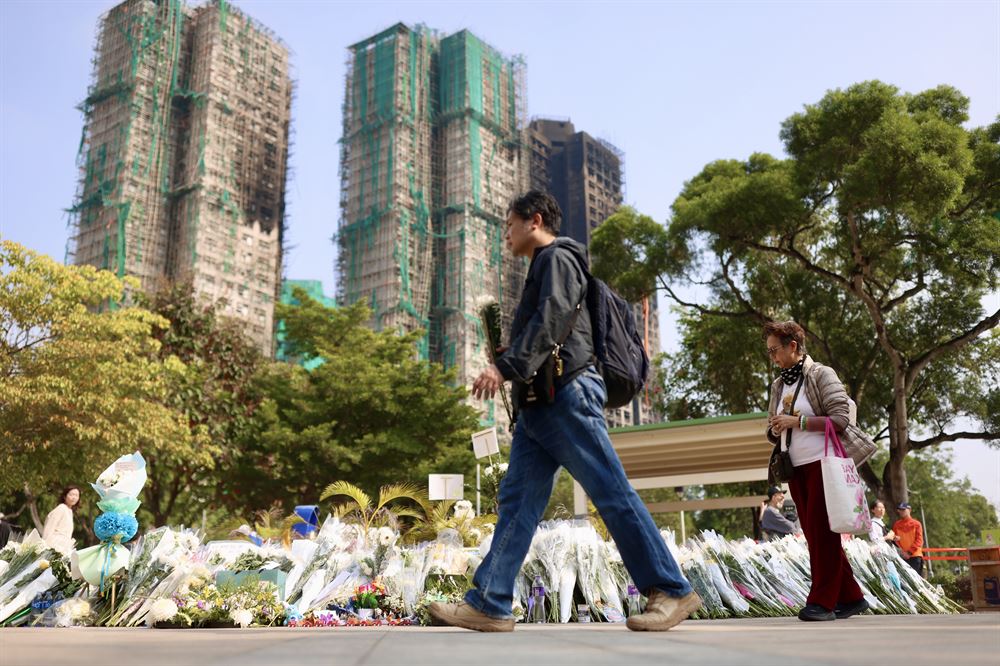
The tragedy of the Tai Po fire in Hong Kong, which claimed more than 150 lives, offers a point of reference for the United Kingdom. There the call for justice in another deadly fire remains unanswered after years of delay and a lengthy legal process.
On June 14, 2017, a fire fuelled by highly flammable cladding engulfed Grenfell Tower in London, killing 72 residents. In the aftermath, the then UK prime minister, Theresa May, launched a public inquiry to determine the facts behind the tragedy and prevent a similar disaster from happening again.
May said she was determined to ensure justice for all the victims and insisted that "we cannot wait for ages" to learn the lessons. Yet nearly a decade later, many of those pledges remain unfulfilled. The bereaved families left waiting are increasingly angry and frustrated.
READ MORE: Tai Po fire: Heroes in harm's way
Despite a 1,700-page report finally being published in September 2024, no one has yet been arrested, prosecuted or held accountable. Though the UK's Crown Prosecution Service said it has been working closely with the Metropolitan Police Service, it will not take a decision on who to charge for the fire before the end of 2026.
According to a report in The Guardian, survivors of the Grenfell fire have condemned the lack of accountability as "a deep and bitter injustice", noting that many of the officials criticized in the inquiry continue to work in related fields.
This prolonged process has eroded public trust and made many feel that the inquiry has become more a mechanism for managing public anger than actually delivering justice. At this year's anniversary of the tragedy, the vice-chairman of Grenfell United, representing the survivors of the tragedy and bereaved families, branded the disaster a "forgotten scandal".
READ MORE: Report says UK's worst fire 'culmination of decades of failure'
The contrast between the required urgency and the sluggish pace of the work offers an important lesson for Hong Kong. While the circumstances differ, the societal imperative is the same: swift, transparent and uncompromising accountability.
This is why Hong Kong's response to the Tai Po fire is worth mentioning.
First, the Hong Kong Fire Services Department, together with law enforcement agencies, moved quickly to investigate the cause of the fire, and 13 people have already been arrested for suspected manslaughter.
Second, Hong Kong's Independent Commission Against Corruption has set up a task force to probe possible corruption in the grand renovation project of Wang Fuk Court, detaining 12 individuals, including consultants, subcontractors and middlemen.
Third, John Lee Ka-chiu, chief executive of the Hong Kong Special Administrative Region, announced last week that he will invite a judge to lead an independent committee tasked with conducting a comprehensive review of the building works system and recommending reforms to prevent similar tragedies.
ALSO READ: A fire, a test, a display of governance: HK’s response under 'one country, two systems’
"Yes, we need a reform. Yes, we have identified failures at different stages," Lee said at a news conference. "That is exactly why we must act seriously to ensure that all these loopholes are plugged, so that those who are responsible will be accountable and the shortcomings will be addressed."
Without doubt those responsible for manslaughter or corruption will not be spared. With major renovation works currently underway in many residential buildings across Hong Kong, people are relieved to see the SAR government making devoted efforts to find out what happened and what needs to be improved.
It is imperative that the independent committee identify, as quickly as possible, the systemic causes behind the fire and press the government to implement reforms without delay.
