

Since the blaze erupted at Wang Fuk Court in Tai Po, the incident has weighed heavily on Hong Kong’s collective consciousness. The central government has attached great importance to it, with relevant authorities and local governments acting promptly upon instructions, delivering care and supplies with precision. The Hong Kong Special Administration Region government responded swiftly and devoted its full efforts, while all sectors of society mobilized in unity to support relief operations. Through efficient and decisive emergency efforts and compassionate, meticulous follow-up arrangements, Hong Kong has demonstrated that human life comes first.
What unfolded in the days that followed revealed something more than a rescue operation. It became a real-time demonstration of governance capacity under the framework of “one country, two systems” — where Beijing’s targeted, timely support aligned seamlessly with the SAR’s autonomous execution and institutional responsibility. The model was neither heavy-handed nor distant; rather, it operated on a principle of “support when necessary, respect where appropriate”, enabling flexible, adaptive measures in response to evolving on-the-ground needs. The outcome, marked by precision coordination, operational maturity, and strong societal cohesion, has drawn international attention as a case study in crisis management under this unique constitutional order.
Speed as shield, life as priority
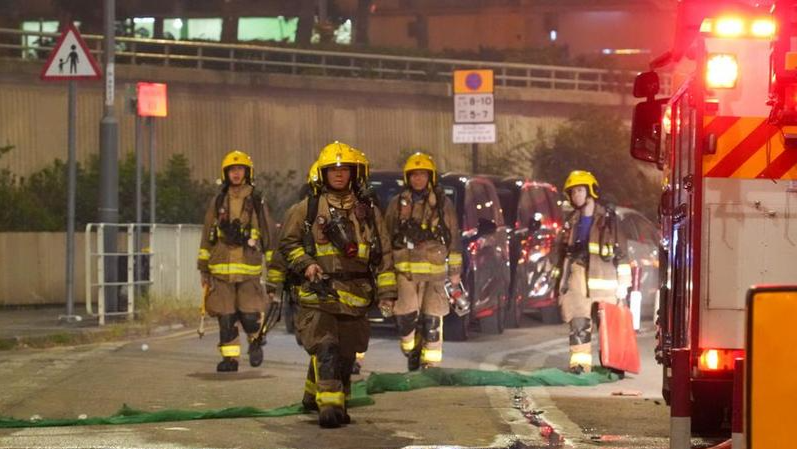
When disaster strikes, every second counts — and it is through decisive action that commitment is proved. At 2:51 pm on Nov 26, Hong Kong’s Fire Services Department received the first alarm. The mobilization was immediate. By 8 pm that evening, the operation had deployed 767 firefighters and paramedics, 391 fire engine dispatches, 185 ambulance deployments, and more than 1,000 police officers to maintain order and assist with evacuations.
Chief Executive John Lee Ka-chiu convened an interdepartmental emergency meeting within hours and activated the Emergency Monitoring and Support Centre. Later the same evening, he visited temporary shelters to meet affected residents in person — reaffirming that the government was operating under a “fully mobilized, all-out response” commitment, and signaling that the administration intended to confront the disaster with transparency and responsibility.
Firefighters faced searing heat and dense smoke as they moved floor by floor, door by door, forcing entry when needed and refusing to abandon the search even under extreme conditions. Among them was 37-year-old firefighter Ho Wai-ho, who died in the line of duty while attempting to rescue trapped residents — a loss that has come to symbolize the courage of those who run toward danger as others flee. For many survivors, his sacrifice became personal: “They were trading their lives to save ours,” one rescued resident said.
Recovery with dignity: No one left behind
Once the emergency phase passed, the focus shifted swiftly — from rescue to recovery, from urgency to care. The SAR government adopted a “one household, one response” approach, tailoring assistance to the specific needs of each affected family and ensuring that human dignity, not bureaucracy, guided policymaking. Shelter arrangements were put in place with speed and flexibility. Multiple community halls were opened for immediate accommodation, while additional options — including youth hostels, hotel rooms, and transitional housing — were coordinated to meet different needs. All government-provided shelters and support services were offered entirely free of charge, ensuring that no affected residents would be left without a place to stay or forced to bear additional financial burden.
Materials and financial assistance were delivered with precision and efficiency, ensuring that support reached those most affected. Beginning on Nov 27, the government distributed HK$10,000 ($1,285) in emergency relief to each affected household and HK$200,000 in condolence payments to the families of the deceased. The subsequent increase in the living subsidy — from HK$50,000 to HK$100,000 per household — further alleviated immediate financial pressure.
ALSO READ: Hong Kong fire relief work progresses as donations pour in
Meanwhile, the Support Fund for Wang Fuk Court in Tai Po was established with an initial government injection of HK$300 million. By noon on Dec 7, the fund had received HK$3.3 billion in public donations, forming a robust financial foundation for post-disaster reconstruction.
In parallel, the Social Welfare Department implemented a “one social worker per household” mechanism, while more than 6,000 civil servants joined the support teams. From livelihood assistance to psychological counseling, the response provided comprehensive care that addressed urgent needs, restored confidence, and conveyed not only administrative capability but compassion.
A comparison with major fire-response cases around the world suggests Hong Kong’s efforts have been notably effective. In terms of reaction speed, more than 2,300 personnel were deployed within hours of the fire. In terms of humanitarian support, the government managed to arrange temporary accommodation for nearly 4,000 affected residents in a remarkably short period, with supplies sufficient and services functioning smoothly. From a governance standpoint, Hong Kong relied on a coordinated, cross-departmental response mechanism in which fire services, medical teams, social welfare agencies and police units operated in concert — a demonstration of administrative capacity rather than bureaucratic fragmentation.
This stands in contrast to responses seen in some Western jurisdictions, where diffusion of authority and institutional friction often obstruct timely action and leave public safety exposed. When wildfires struck Los Angeles in January 2025, for example, the coordination process was marred by confusion; the state governor reportedly made repeated unsuccessful attempts to reach the White House, while emergency efforts lagged and many affected residents were left to navigate the chaos on their own.
National support as backbone: Solidarity revealed in crisis
Tragedy is ruthless, but humanity is not. In Tai Po, compassion moved faster than the flames. The central government’s firm support became the strongest pillar for Hong Kong’s relief and recovery efforts. Within hours, the disaster had drawn national attention: President Xi Jinping issued swift instructions calling for an all-out rescue effort, comprehensive medical support, and proper care for affected residents, with one overriding goal — to minimize loss of life and suffering. The central government acted as a decisive backbone: The Hong Kong and Macao Affairs Office mobilized immediately, coordinating with the Ministry of Emergency Management and provincial authorities. Supplies were deployed in batches based on the Hong Kong SAR government’s real-time requests — portable charging stations, blowers, respirators, lifting machinery, protective goggles, waterproof gloves, and organic vapor filter cartridges. Guangdong province worked through the night to dispatch medical supplies and specialized rescue equipment, including lighting drones, dual-spectrum reconnaissance unmanned aerial vehicles, robotic exoskeleton support, and dual-purpose fire and rescue boots — equipment that significantly increased operational precision and safety on the ground.
Financial and institutional support followed with equal clarity. The People’s Bank of China facilitated a fast-track cross-border renminbi donation mechanism to ensure contributions reached Hong Kong without delay. The China Charity Federation activated emergency mechanisms and donated HK$5 million, while launching nationwide fundraising channels that allowed citizens across the country to take part in relief efforts. Throughout the process, the central government upheld a clear approach: support when needed, never imposing. Respect for the Hong Kong SAR government’s high degree of autonomy remained constant. Every form of assistance was tailored to the SAR’s practical needs, offering a vivid example of how, under the “one country, two systems” framework, Hong Kong can confidently exercise its autonomy while also relying on the strength of the central government to build resilience and synergy in governance.
READ MORE: HK police: Central govt's professional equipment boosts efficiency in Tai Po fire rescue
From rapid rescue to meticulous post-disaster relief, from central coordination to widespread civic mobilization, the response demonstrated a governance ethos grounded in “people first, lives first”. It showed not only the Hong Kong SAR government’s administrative capability, but also the alignment, trust, and collective will across institutions and society. With the central government’s full backing, the efficiency of the Hong Kong SAR administration, and the united strength of Hong Kong’s wider community, the city is well-positioned to heal, rebuild, and move forward. Under the framework of “one country, two systems”, the city continues to advance steadily and confidently, writing a warmer, stronger and more resilient chapter in the lives of its people.
The author is a current affairs commentator.
The views do not necessarily reflect those of China Daily.
