

After decades of decline, Nandagang Wetland has been reborn through careful restoration and the vigilance of local guardians, Zhang Yu reports in Shijiazhuang.
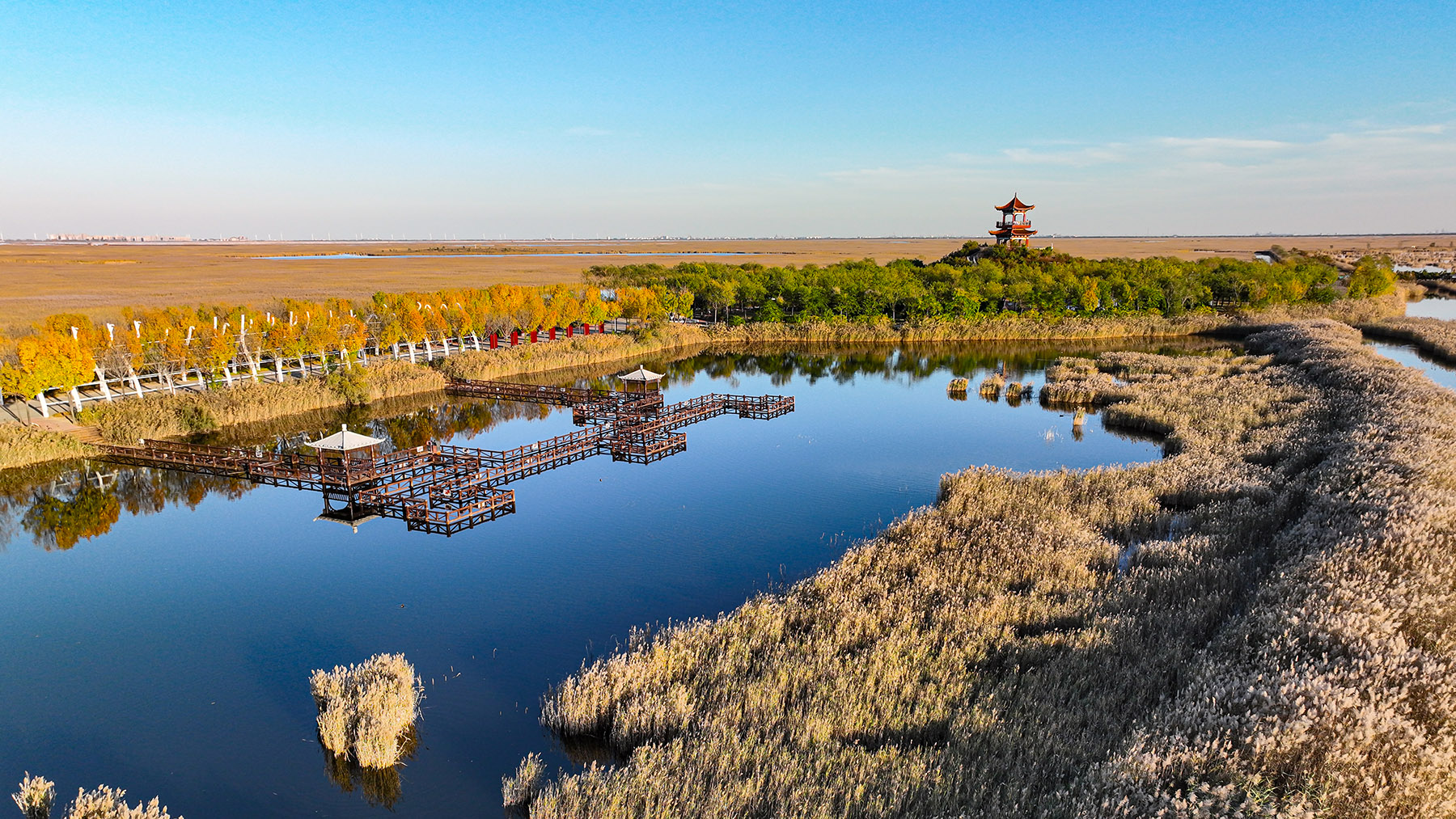
As the early morning mist hung over Nandagang Wetland in Cangzhou, North China's Hebei province, Pan Hongxi, a 59-year-old ranger, started his slightly old three-wheeler, beginning another day of patrols.
As he drove along the road, startled waterfowl rose into the air, their wings flapping as they disappeared deep into the vast reed beds.
"When I first started working here 40 years ago, you couldn't see this many birds," Pan says, his voice mingling with the noise of the engine, as he recalls memories from the 1990s.
Back then, this wetland on the western shore of Bohai Bay had fallen quiet, suffering from enclosed aquaculture ponds and ecological degradation.
READ MORE: AI-powered system assists Hebei nature reserve in protecting birds
"The water wasn't as clear, the reeds weren't as thick, and bird sightings were sparse," he says.
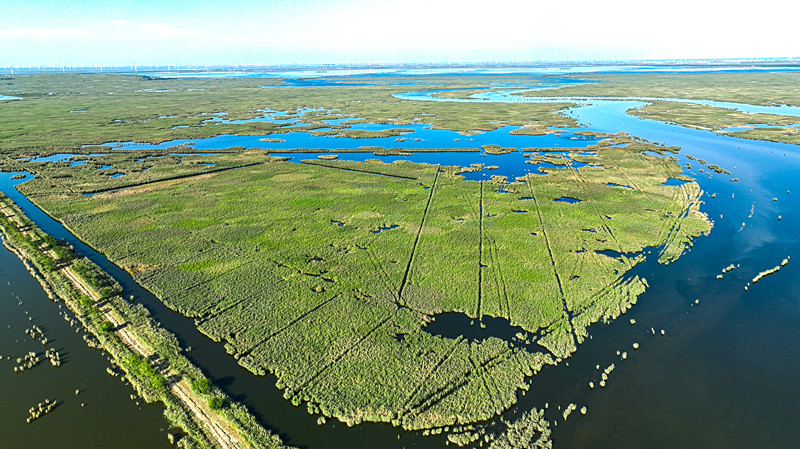
Today, moving through the 7,500-hectare wetland, his eyes meet an endless expanse of reeds, and his ears are filled with a constant chorus of birdsong.
This wetland has undergone a profound ecological transformation, the result of a restoration project that has lasted for years.
Meticulous work
"Ecological restoration isn't simply about removing dams and releasing water. It's a precise reshaping of the ecosystem," says Wang Lijun, deputy director of the management office of the Nandagang Wetland and Bird Nature Reserve, spreading out planning charts to explain the major surgery the wetland has undergone.
He pointed to a drawing marked with dense symbols.
"In the past, this area was divided into isolated aquaculture ponds. Water didn't flow freely, and ecological functions were damaged," Wang says, adding that the core task was to restore it to a natural wetland with a complete ecological cycle by returning aquaculture ponds to wetlands.
He details the interlinked steps of the restoration project: removing artificial embankments to restore natural water flow; creating diverse habitats like deep-water areas, shallows, and gentle slopes through careful micro-topography modification; and then replanting native vegetation like reeds and seepweed.
"But the most crucial step was building a safe home for the birds," Wang says, his finger pressing firmly on several areas of the chart marked in green.
"Birds, especially rare waders, have extremely high demands for habitat safety. Where there were no natural islands, we artificially created them," he says.
According to Wang, the size, vegetation and even gradient of these islands were strictly calculated, tailored for birds that have specific environmental requirements, like oriental storks and black-faced spoonbills.
This project, known as the "Northern Aquaculture Pond Ecological Restoration", successfully transformed 108.8 hectares of aquaculture ponds back into vibrant, natural wetlands and was selected as a national-level example of what could be achieved.
"But this was just the beginning," Wang says.
"Our goal is not just restoration, but enhancement: creating a healthy, self-sustaining and vibrant ecosystem," Wang says.
In recent years, by leveraging major projects, they have systematically addressed problems like wetland hydrological connectivity, water purification, and biodiversity recovery.
Smart monitoring
In the smart monitoring center at Nandagang, publicity director Zhang Jingxing clicked a mouse, and real-time images from the wetland appeared on the large screen.
"Human patrols have limitations, but technology gives us eagle eyes and sharp ears," Zhang says, demonstrating the core functions of the integrated scientific research and monitoring platform.
"What we've built is an integrated monitoring network combining AI image recognition and soundprint recognition."
Zhang says that 11 sets of high-definition video monitoring equipment armed with AI are distributed at key places.
They are like eyes that never need to sleep, able to identify species and count the number of birds with an image recognition accuracy rate consistently above 90 percent, he adds.
"Even more powerful is our sharpears system," Zhang says, highlighting the three highly sensitive soundprint collection devices.
"Our soundprint database contains data on the calls of 1,569 bird species. It's like a bird sound dictionary," he says, displaying sound wave graphs.
According to Zhang, the system collects sounds in real time and automatically compares them with the species identification database.
So far, it has accumulated more than 220,000 valid soundprint records and has successfully identified 197 bird species.
The advantage of soundprint recognition is that it can penetrate dense reed beds, work in darkness, and monitor the birds without disturbing them, minimizing human encroachment, he says.
"For instance, on Aug 8, the platform, using soundprint recognition, successfully captured and confirmed the season's first southbound migrants — Temminck's Stints — before they were visible to the naked eye, recording 25 valid soundprints.
"This provides first-hand scientific data that previously could not be monitored, helping us accurately study migration times, routes, and population dynamics," Zhang says.
Remarkable rebirth
"The changes in recent years have been tremendous," Pan, the ranger, says excitedly.
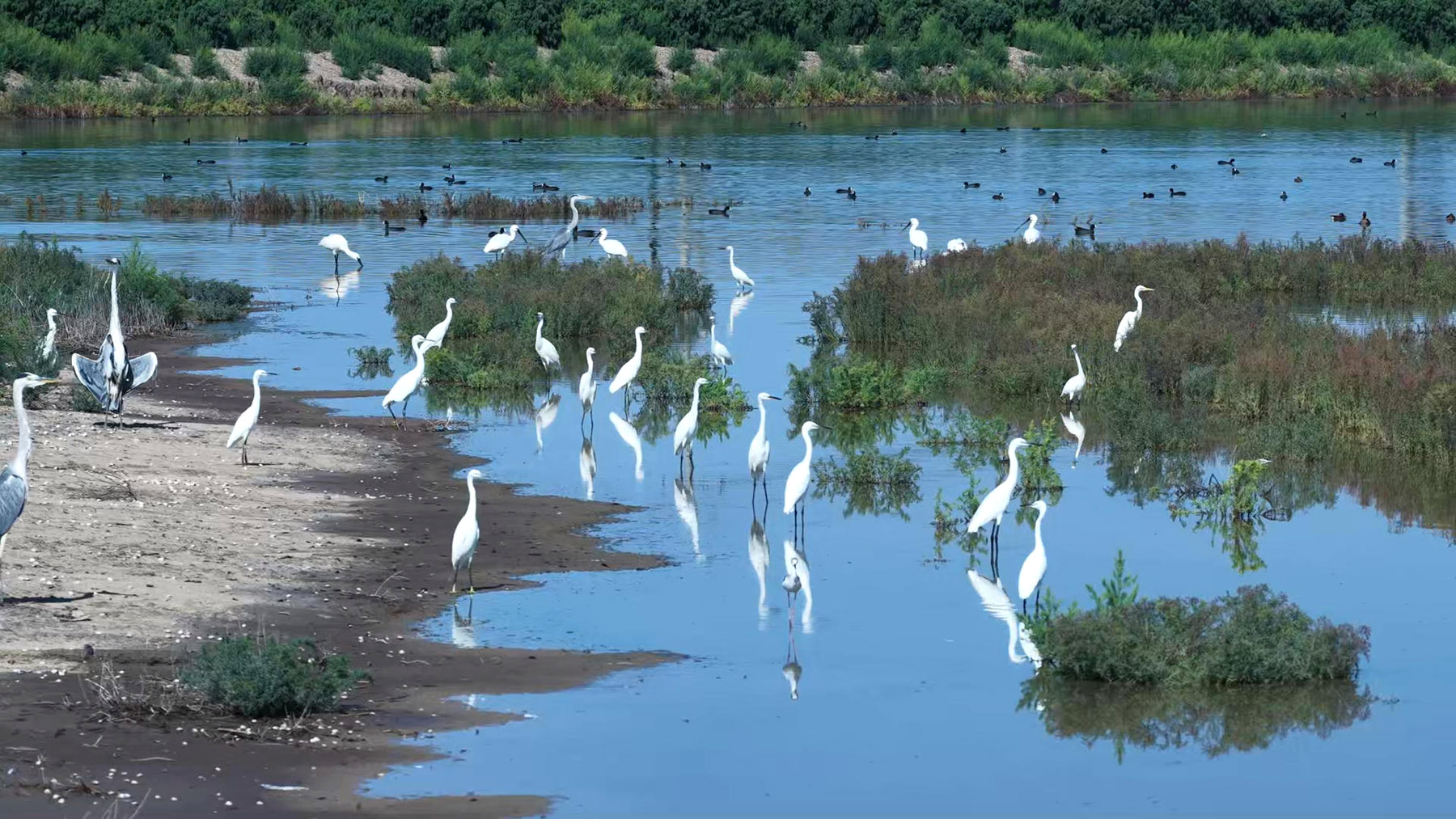
"In the northern restoration area, we see hundreds of Platalea leucorodia (Eurasian spoonbill) living and breeding there every year," he says, adding that a few years ago, he rescued an injured eagle, but now such emergency rescue cases are becoming increasingly rare.
The data gathered so far shows that there has been a great leap in the wetland's bird populations: Recorded species have increased from 268 to 272, and the number of national class I protected animals has grown from 8 to 17 species, while class II protected animals have increased from 40 to 52 species.
More surprisingly, the number of migratory birds has surged from 20,000 in 2022 to over 100,000 in 2024.
As a result, Nandagang Wetland was added to UNESCO's World Heritage List in 2024 as part of the "Migratory Bird Sanctuaries along the Coast of the Yellow Sea-Bohai Gulf of China (Phase II)".
"The successful inscription is not the finish line, but a new starting point," Wang, from the management office, says firmly.
"With the increased attention comes more pressure to protect the wetlands. We need to safeguard this golden ticket, achieving a win-win for both ecological protection and the development of cultural tourism," Wang adds.
ALSO READ: Wintering swans help tourism soar at nation's wetlands
Nowadays, tourists and study groups flock to Nandagang. In the first three quarters of this year alone, the wetland received 432,400 visitors, according to the local government.
"This beautiful place needs us to protect it, generation after generation," says Pan, gazing at the dancing shadows of birds in the distance.
Forty years of consistent protection and preservation have allowed him to witness the rebirth of this wetland.
As the sun sets, casting golden rays over the reeds, Pan concludes his day's patrol, the sound of his three-wheeler fading into the distance.
The success at Nandagang is part of a broader picture for ecological restoration across Hebei.
During the 14th Five-Year Plan period (2021-25), the province has coordinated efforts to reduce carbon emissions, cut pollution, expand green areas, and pursue growth, advancing green transformation comprehensively across the province.
Zhang Junhao contributed to the story
Contact the writer at zhangyu1@chinadaily.com.cn
