

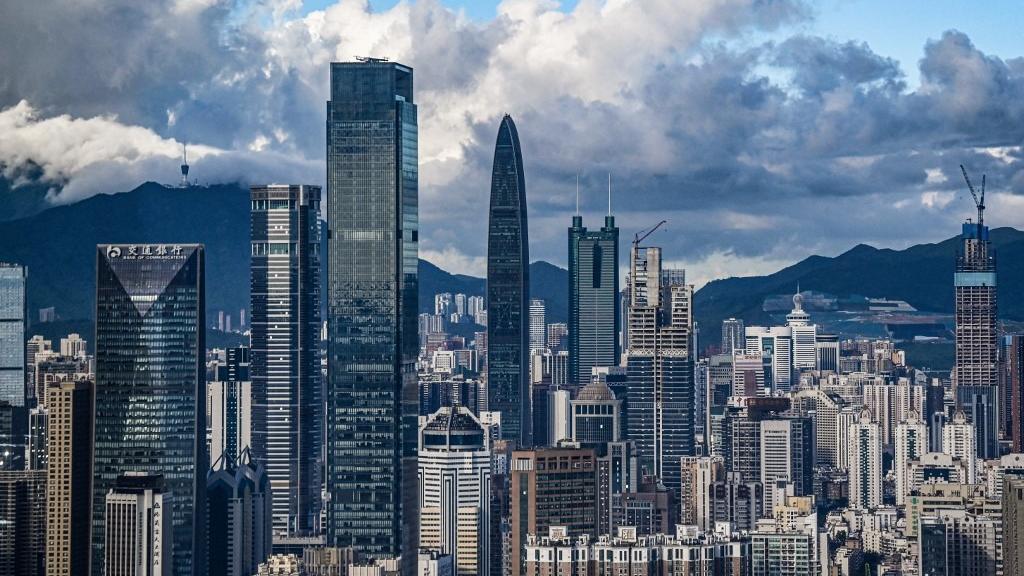
 This photo taken on July 8, 2022 shows a general view of commercial and residential buildings at Futian district in Shenzhen, in China's southern Guangdong province.
(PHOTO / AFP)
This photo taken on July 8, 2022 shows a general view of commercial and residential buildings at Futian district in Shenzhen, in China's southern Guangdong province.
(PHOTO / AFP)
Shenzhen’s appeal to talent has continued to grow despite the tightening of its household registration, or hukou, rules since 2021, which raised the requirements for those who want to settle down in the city.
According to a recent report jointly released by Shenzhen-based International Science and Technology Information Center and global analytical firm Elsevier, Shenzhen has 106,981 scientific researchers, representing an annual growth of 31.4 percent between 2018 and 2022
According to Shenzhen’s human resources and social security department, 42,128 hukou were issued in the first quarter of 2023 to new talent who have arrived in the city, representing an increase of 135 percent compared to the same period a year earlier.
Among them, 8,084 were fresh graduates, a surge of 212 percent year-on-year, and 30,653 were employed people, rising by 128 percent on a yearly basis.
ALSO READ:Shenzhen strives to attract young talent
The growth in talent introduction came as the city saw a slight decline in population last year. According to statistics released by the Shenzhen bureau of statistics earlier this week, there were 17.66 million permanent residents in 2022, about 20,000 fewer than a year earlier.
The decrease was mainly seen in the number of migrant workers, which dropped by 290,000. Permanent residents with hukou, meanwhile, rose by 270,000.
Shenzhen introduced tighter policies on talent introduction in May 2021, raising the threshold for academic talent as well as technical and skilled workers to obtain local hukou.
According to a recent report jointly released by Shenzhen-based International Science and Technology Information Center and global analytical firm Elsevier, Shenzhen has 106,981 scientific researchers, representing an annual growth of 31.4 percent between 2018 and 2022. The growth rate was the highest among the six Chinese mainland cities with the largest economic output in the country last year — Shanghai, Beijing, Shenzhen, Chongqing, Guangzhou and Suzhou.
ALSO READ:Shenzhen provides support measures for HK, Macao youths
Compared with the other five cities, where researchers work mainly in academic and medical institutions, a higher proportion of researchers in Shenzhen work for enterprises, accounting for 7 percent of the total, the report said.
More than 40 percent of the talent in scientific research in Shenzhen, or roughly 44,000 people, have engaged in cross-border collaboration with Hong Kong, Macao and Taiwan, compared with 31 percent in Guangzhou, 30 percent in Shanghai and 29 percent in Beijing, it said.
