

Art Basel Hong Kong and Art Central return in full force, with large-scale installations providing a healthy dose of maximalism at both fairs. Gennady Oreshkin reports.
 Korean artist BAHK (Seon-Ghi Bahk) created the site-specific installation An Aggregation-Space for Art Central. Made up of hundreds of charcoal pieces, the work is expected to remind viewers to treat natural resources with care. (PHOTO PROVIDED TO CHINA DAILY)
Art Basel Hong Kong (ABHK) and Art Central — the city’s two biggest international art fairs — returned this week in a big way. The two events now on at the Hong Kong Convention and Exhibition Centre (HKCEC) promise to enthrall us in many ways, not the least in terms of scale. And what better way to celebrate the end of a tumultuous period of semi-lockdowns and travel restrictions than with a healthy dose of maximalism? For larger-than-life installations, look no further than ABHK’s Encounters program, curated by Alexie Glass-Kantor, and Art Central’s Yi Tai Sculpture & Installation Projects, put together by Chris Wan Feng.
“It’s terrific to be back in Hong Kong,” Glass-Kantor, a Sydney native, says as we take a seat beneath the 10-meter-high, inflatable King Tut sculpture Gravity, by Ethiopian American multidisciplinary artist Awol Erizku. Placed inside Pacific Place mall, the piece is Encounters’ first off-site installation.
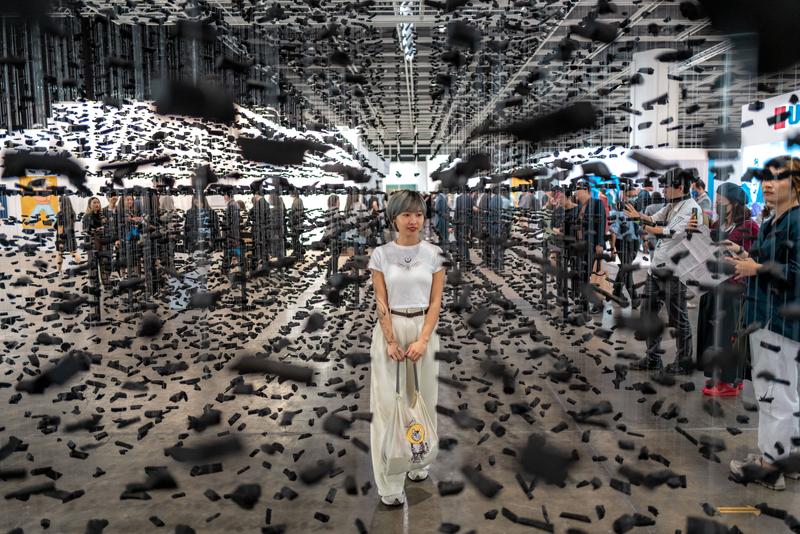 An Aggression-Space by BAHK, now showing at Art Central, is an interactive installation. Viewers are invited to walk through the piece, which appears impenetrable as a result of the artist’s clever manipulation of light and shadow. (ANDY CHONG / CHINA DAILY)
It’s Glass-Kantor’s sixth time curating the sector. “I had curated Encounters in 2020 when the world changed, and the show was unable to go forward,” she says. “And then I got the call last October. Usually around that time, the year before the show, we’d be finalizing all the works and locking everything in. This time around, we were just beginning.”
Assembling a collection of 14 colossal art pieces from around the world in a drastically shortened time frame, while also managing the sector’s debut off-site project, was no mean feat, and yet Glass-Kantor found the experience especially rewarding. “I was excited to celebrate Hong Kong,” she says. “The first two encounters this year are Trevor Yeung with Blindspot Gallery, and Jaffa Lam from Axel Vervoordt gallery.”
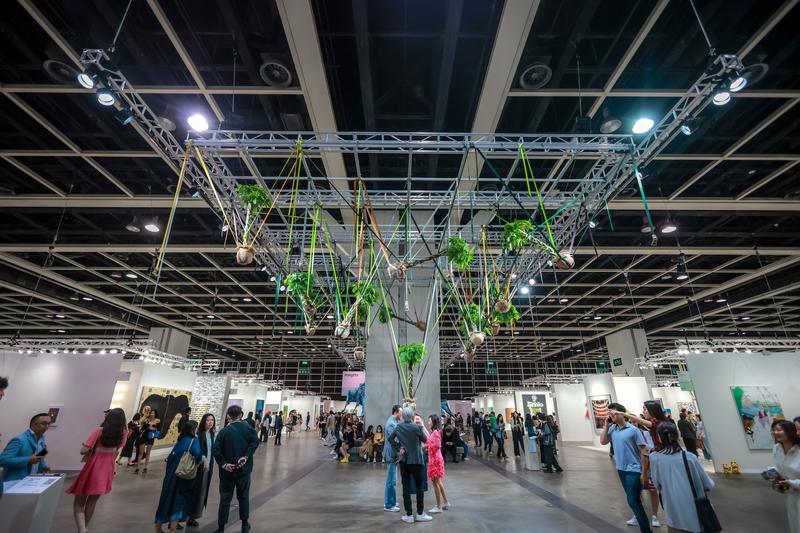 Trevor Yeung’s Mr Cuddles Under the Eave is a suspended, inverted pyramid made up of money plants. It’s a highlight piece in Art Basel Hong Kong’s Encounters sector. (ANDY CHONG / CHINA DAILY)
With projects such as the 12th Adelaide Biennial of Australian Art, the New Mexico-based 13th SITE Santa Fe Biennial, and most recently, the Australian Pavilion at the Venice Biennale under her belt, Glass-Kantor knows how to work a space like no other. Her approach is refreshingly democratic: “I think the worst thing you can say as a curator of art is that a space is not good. I’m not interested in connoisseurship: I’m interested in collaboration and exchange.”
Showcasing art at public venues like shopping malls can still raise eyebrows, but Glass-Kantor sees opportunity in such spaces. “Most people look at an art piece for three seconds on average,” she notes. “In this case, people are taking the time to take pictures of Gravity and post them. It’s about creating momentum — that’s the real encounter.”
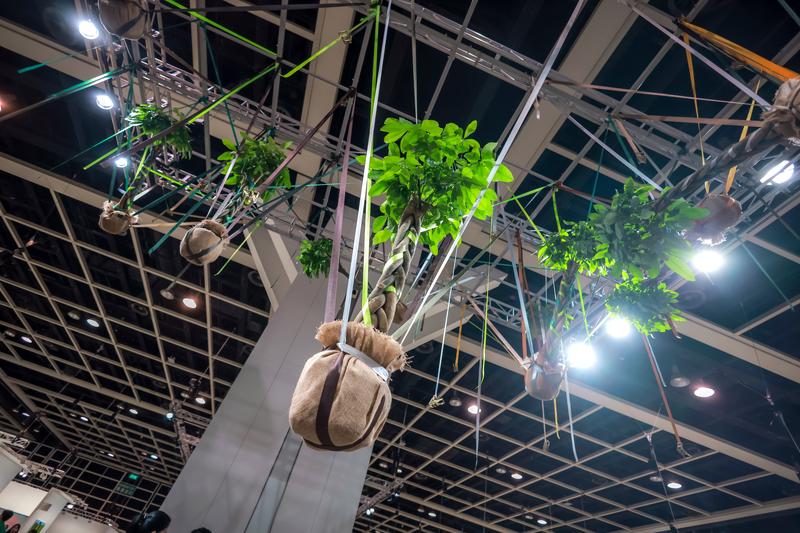 Trevor Yeung’s Mr Cuddles Under the Eave is a suspended, inverted pyramid made up of money plants. It’s a highlight piece in Art Basel Hong Kong’s Encounters sector. (ANDY CHONG / CHINA DAILY)
About time
Unlike in previous years, Glass-Kantor has a concept in mind for this year’s ABHK: the present moment. “It’s about the present as a gift — sentimental and nostalgic.” She emphasizes how her vision incorporates a philosophy of the past and present coexisting. “You don’t have to leave the past in the past: you can take the moments that bring you joy, grief, lamentation and longing with you.”
It’s a viewpoint that feels particularly relatable in the immediate aftermath of a pandemic, many of us having ended up experiencing time itself differently — whether due to lockdowns, quarantine stints or long-term separation from family. “Artists at this moment can use time as a material,” Glass-Kantor postulates.
Looking at the installations she has curated, it’s hard to disagree. Yeung’s Mr Cuddles Under the Eave, for example, is a 6-meter-wide inverted pyramid made up of money plants and suspended from the ceiling. It first debuted in Ukraine in 2021 but was subsequently destroyed, and had to be rebuilt from scratch.
 Large-scale installations showing at Art Basel Hong Kong 2023: 1. Indonesian artist Mella Jaarsma’s performance piece, The Constructor. (ANDY CHONG / CHINA DAILY)
Another cutting-edge artist showing at Encounters this year is Ukrainian-born, Bosnia-Herzegovina-based Stanislava Pinchuk, who took an apprenticeship with a monumental mason during the pandemic and learned to engrave gravestones. Her work, The Wine Dark Sea, is an arrangement of marble slabs she sourced in Türkiye just before the earthquake earlier this month.
Indonesian artist Mella Jaarsma’s The Constructor is a piece of performance art that invites viewers to see artists as buildings. A crew of five construction workers is building a structure around the artist even as you read this.
“This is an accumulative work that won’t be completed until the end of the fair,” Glass-Kantor comments. “What’s really great about performance-specific installations is the way they’re working to what’s essential and necessary, not performing to the expectations of the market, audience or context, but being generous in sharing their journey.”
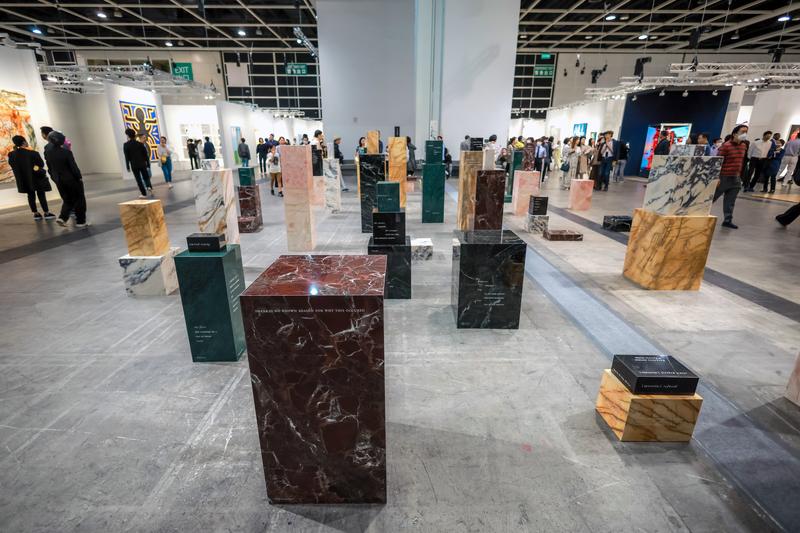 Engraved marble pillars in The Wine Dark Sea, by Ukrainian-born Stanislava Pinchuk. (ANDY CHONG / CHINA DAILY)
Few works could be more emblematic of the use of time as a medium than Gravity — the bust of King Tut holding, in an internal chamber, memorabilia from Erizku’s studio, including incense, history books, plants, and a creatively edited photograph of a young man, taken by the artist in 2012.
“I love the image of this young man sitting inside the image of another young man,” declares Glass-Kandor. “Neither of them belongs to this moment in time but both can have this conversation through time. It’s direct; it doesn’t need a thesis.”
The story of the monumental installation is nearly as fascinating as the life of the enigmatic figure it immortalizes. Erizku conceived the piece back in 2018, when he came to Hong Kong with his show Slow Burn. The idea caught Glass-Kantor’s attention. She’d decided to include it in the 2020 edition of Encounters. Then the installation had to wait three more years to greet its wider audience in Hong Kong. When the time came, Erizku and Glass-Kantor tried installing the sculpture in various spaces in the city before settling on Pacific Place.
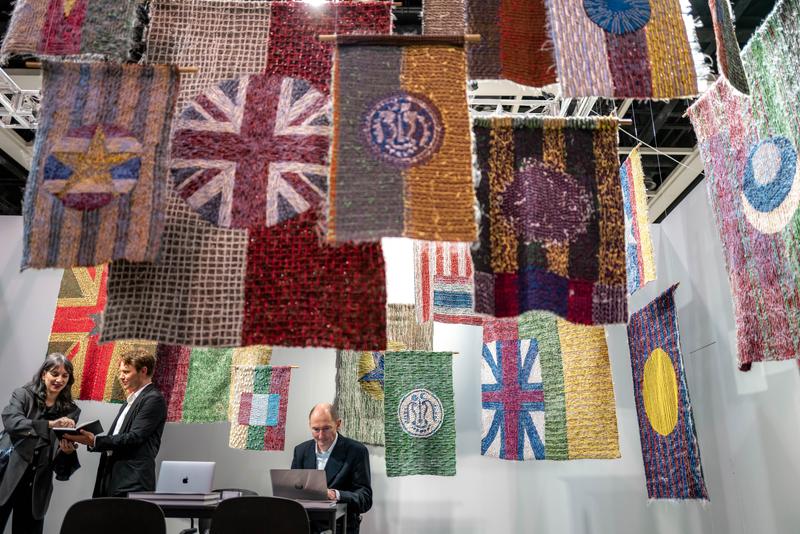 Thai textile artist Jakkai Siributr’s patchwork tapestries, The Outlaw’s Flag. (ANDY CHONG / CHINA DAILY)
“We took it to the Jockey Club in November and inflated it,” the curator recalls. “We looked at it outdoors, and I was able to go up the hill and see it from different angles. Then I realized it didn’t belong in HKCEC because you’d only see it from one perspective walking in. This work needs to be seen from different levels.”
“I don’t think there’ll be another opportunity to see Gravity from multiple floors and all angles,” Erizku says. Here, the scale itself is a medium speaking directly to the weight of culture and history the artist is referencing. “I tried to create these layers by presenting certain objects, providing clues and ways to access the work from different perspectives,” Erizku explains.
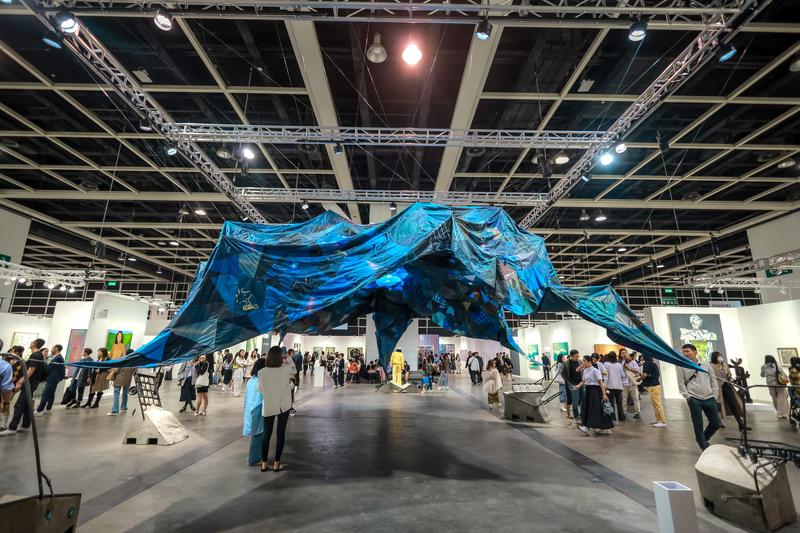
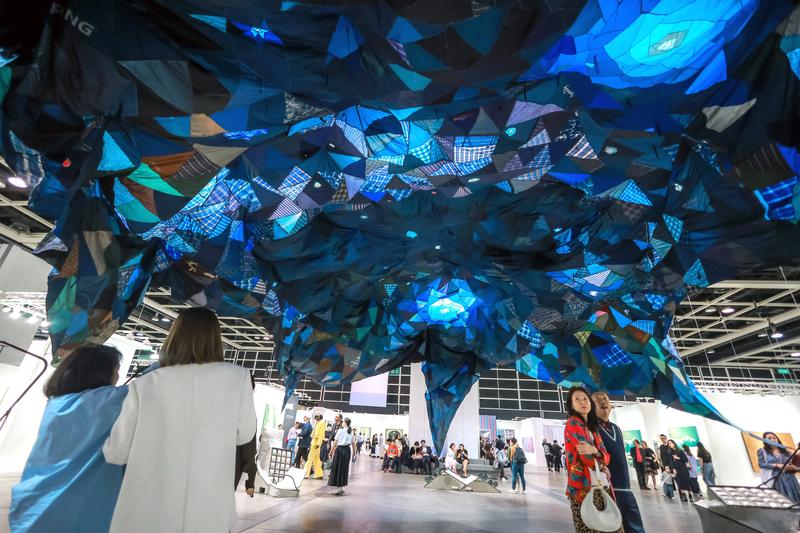 A canopy made out of recycled umbrella fabric in Trolley Party by Hong Kong’s Jaffa Lam. (ANDY CHONG / CHINA DAILY)
Lost and found
Found objects are at the heart of this multidisciplinary artist’s practice. “I gravitate toward things I find on the street or come across on my travels. These objects have their history: All you have to do is listen.”
The objects picked up from the roadside and brought back to his studio often “end up collecting dust for a year or two,” says Erizku, offering a glimpse into his process.
“Then one night in the studio, you’re thinking about something unrelated, and you realize (a particular object) could connect that dot for you and birth a new idea.”
 20230321_andy63.JPG
A number of artists showing at ABHK 2023 seem partial to found objects. A case in point is another installation (not in Encounters) titled The Outlaw’s Flag, by Thai textile artist Jakkai Siributr (Flowers Gallery). The piece is a collection of creative flags, supposedly representing fictitious countries. These are embroidered with beads and fishnets the artist found on a trip to Myanmar, where he was working with stateless communities.
As with Gravity, the work has a historical dimension: Each flag is composed of the state colors and emblems of Malaysia, Thailand, Bangladesh or Myanmar, representing the displacement of Myanmar’s Rohingya Muslims in 2017.
“I spent that week walking, seeing how things were, talking to people,” remembers the artist. “Suddenly, all these images started to appear. I saw beach debris, fishnets, animal bones, and plastic and glass bottles, so I thought of doing a series of flags.”
 Curator Alexie Glass-Kantor(left) and Ethiopian American multidisciplinary artist Awol Erizku posing with the inflatable sculpture Gravity. (PHOTO PROVIDED TO CHINA DAILY)
Flags usually represent a nation or a sports team. Siributr points out that the presence of religious symbols such as a cross, crescent or chakra in the design suggests lack of inclusivity.
One floor up from ABHK, Art Central’s Yi Tai Sculpture & Installation Projects section explores the concept of a spectacle — “not displacement of reality with images fueled by capitalism, but art spectacle, which is more fluid and, at times, elusive”, elucidates the curator’s statement.
Manifesting this year’s fascination with unconventional material is Korean artist BAHK (Seon-Ghi Bahk) and his work An Aggregation–Space. The installation is composed of hundreds of charcoal pieces suspended from the ceiling. The optical illusion created by the shadows they cast tricks the eye and boggles the mind.
“In my work, shadows are an important element that can be considered part of the artwork,” says the artist. “This is because they evoke an image of an Oriental painting composed of black-and-white gradations.”
 Erizku’s sculpture of King Tut is installed in the foyer of Pacific Place, so that it can be viewed from the mall’s different floors. (PHOTO PROVIDED TO CHINA DAILY)
An Aggregation–Space is one of the most interactive works on display: The viewer can walk amid the “levitating” charcoal pieces, underscoring BAHK’s intention to explore the relationship between humans and nature. “I hope that people will think about the problems humans have caused in the natural world: to the air, soil and oceans,” the artist says.
It turns out, charcoal is a bit of a grim signifier for BAHK. “It represents the end of nature.”
If you go
Art Basel Hong Kong
Dates: Through March 25
Venue 1: Hong Kong Convention & Exhibition Centre, 1 Harbour Road, Wan Chai, Venue 2: 88 Queensway, Admiralty
Art Central
Dates: Through March 25
Venue: Hong Kong Convention & Exhibition Centre, 1 Harbour Road, Wan Chai
