

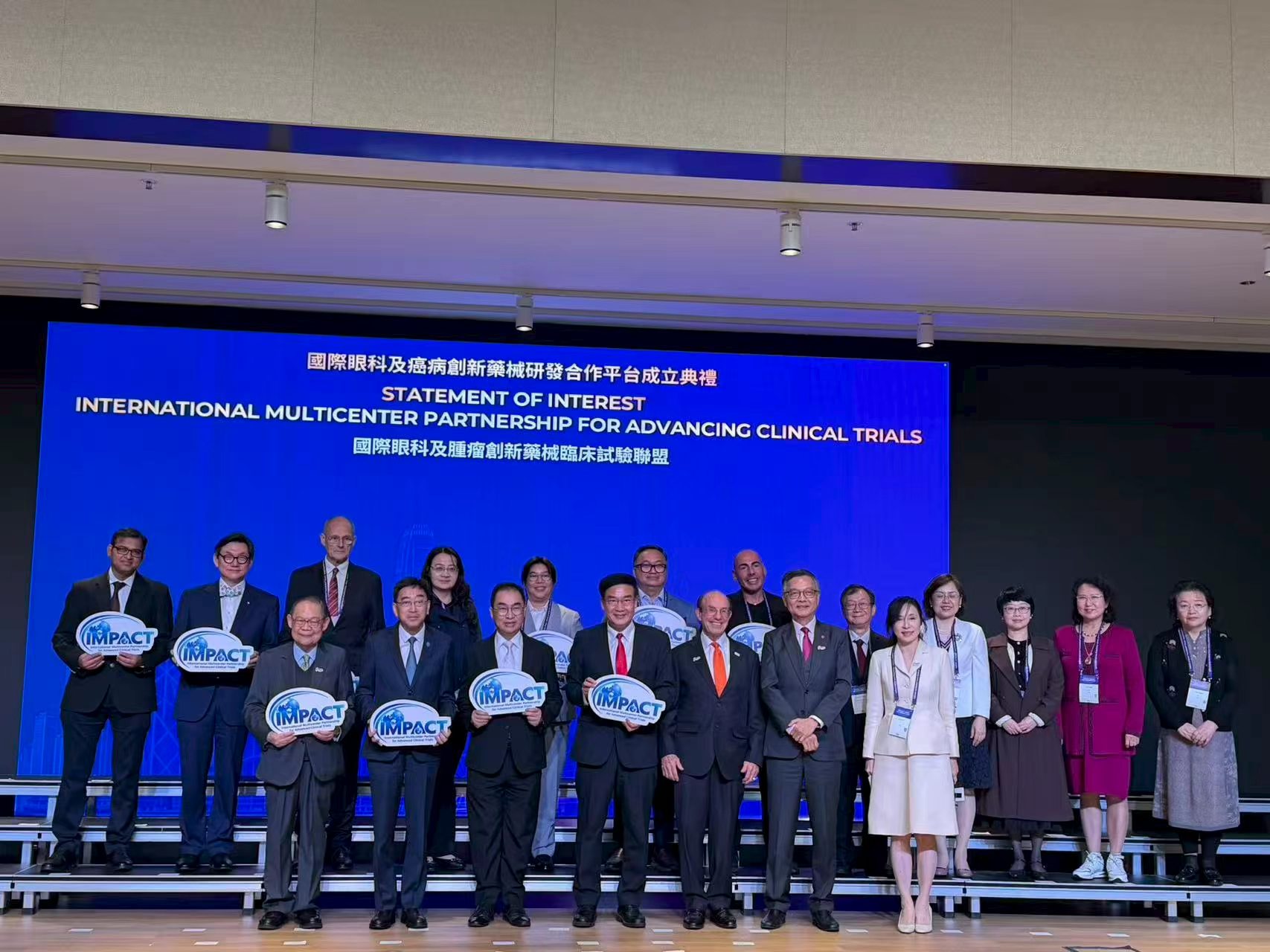
A new international platform was launched in Hong Kong on Monday to support the development of innovative drugs and medical devices in ophthalmology and oncology, with a focus on cross-border clinical research and commercialization.
The new platform, known as TRIPOD — the Trans-Region International Innovation Platform for Ophthalmic and Oncology Drug and Device Development — is designed to connect expertise in scientific research, clinical development, regulation, industry and investment. Organizers said it aims to speed up the path from laboratory discoveries to practical treatments and devices for patients.
More than 200 medical experts, researchers, clinicians and industry representatives from over 10 countries and regions attended the inauguration ceremony.
At the launch, TRIPOD introduced its flagship initiative, the International Multicenter Partnership for Advancing Clinical Trials, or IMPACT. The initiative brings together 33 universities, medical centers and research institutions across nearly 20 countries and regions, creating a network for international multicenter clinical trials and the translation of research results into clinical use.
Speaking at the ceremony, Kevin Choi Kit-ming, Hong Kong’s permanent secretary for innovation, technology and industry, said the government is committed to building Hong Kong into an international innovation and technology center, with life and health technology among its priority areas.
Dennis Lam Shun-chiu, an ophthalmologist and chairman of TRIPOD, said the platform comes at a time of growing opportunity for biomedical development. He noted that the country’s 15th Five-Year Plan (2026-30) identifies biomedicine as one of six emerging pillar industries, while Hong Kong’s own first five-year plan includes the goal of becoming an international medical innovation hub.
Lam said the long development timelines, high costs and risks involved in developing new drugs make collaboration essential. TRIPOD aims to support promising projects by pooling research, clinical, regulatory, industrial and investment resources across ophthalmology and oncology.
TRIPOD was jointly founded by the International Society of Oncology Prevention and Treatments, a nonprofit organization based in Houston, Texas; the Hong Kong Association for External Friendship; and the Asia-Pacific Journal of Ophthalmology, the official publication of the Asia-Pacific Academy of Ophthalmology, whose secretariat is based in Hong Kong.
Priscilla Leung Mei-fun, founding president and CEO of the Hong Kong Association for External Friendship and a co-chair of TRIPOD, said Hong Kong’s links with both the Chinese mainland and the wider world position it well for building healthcare partnerships.
Charles Balch, founder and president of the International Society of Oncology Prevention and Treatments and also a TRIPOD co-chair, said collaboration between ophthalmology and oncology could lead to clinically proven breakthrough therapies and devices that preserve sight, reduce suffering and save lives.
Michael Houghton, winner of the 2020 Nobel Prize in Physiology or Medicine and an honorary president of TRIPOD, said scientific discoveries can only become effective treatments and vaccines through cooperation across borders, institutions and disciplines. He referred to his own work with Hong Kong Baptist University on a hepatitis C vaccine, and welcomed TRIPOD’s push for international multicenter clinical research.
The event also included the launch of a biomedical innovation collaboration program featuring more than 10 projects from the mainland, Hong Kong and overseas in areas such as gene therapy, new cancer drugs and precision diagnostics.
