

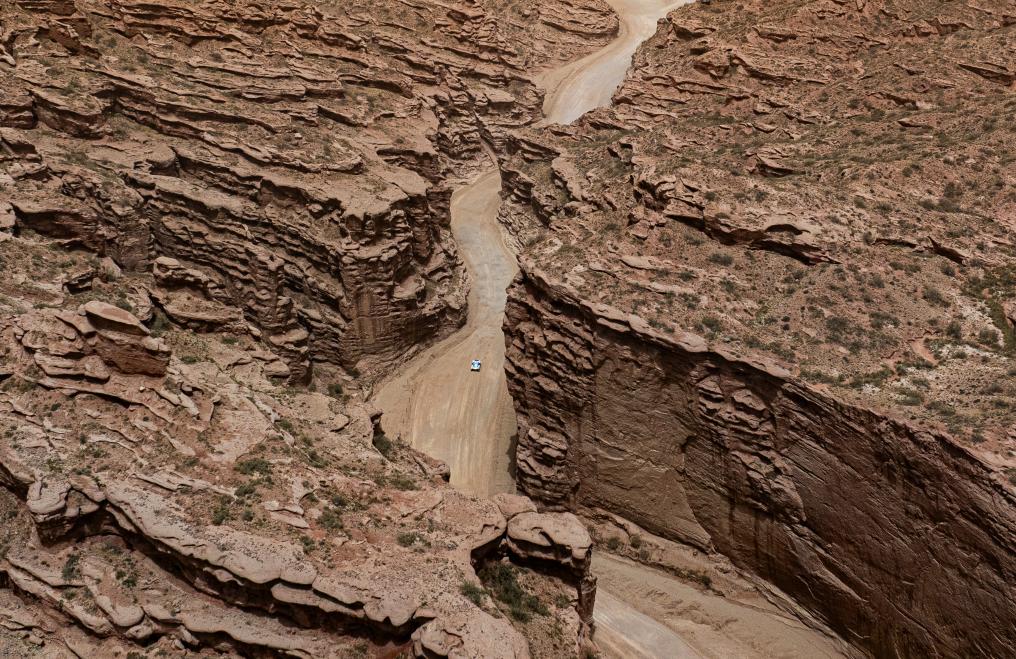
China has discovered a major zircon sand deposit in Baicheng county, Aksu prefecture, Xinjiang Uygur autonomous region, with a confirmed resource scale equivalent to more than 40 large zircon deposits, and associated hafnium at a super-large scale, the Ministry of Natural Resources said on Saturday.
Zirconium is a silvery-gray transition metal with a high melting point, corrosion resistance and a small neutron absorption cross-section, making it a critical material for nuclear reactor fuel rod cladding and aerospace high-temperature alloys.
Hafnium, often found alongside zirconium, boasts a high density and melting point. It is a key material for nuclear reactor control rods and is also used in rocket engines and spacecraft heat shields.
The global distribution of zircon resources is uneven, with around 70 percent of reserves concentrated in Australia, while China holds less than 1 percent.
The discovery fills a national gap in the quest for super-large zircon deposits and will significantly enhance China's resource security for this mineral.
Zhu Yilin, chief engineer of Xinjiang's natural resources department, said at a news conference in Beijing that the discovery is the result of a two-decade sustained exploration effort.
Between 2006 and 2019, geologists reanalyzed legacy geochemical survey data from the Tianshan region and identified multiple zircon anomalies and prospective targets. Since 2024, the regional government has allocated 35.19 million yuan ($5.28 million) for five zircon exploration projects, achieving this significant breakthrough after intensive fieldwork, Zhu said.
The deposit was named Yuhai in recognition of the contributions made by geologists Peng Yu and Wang Haitao in the discovery.
