

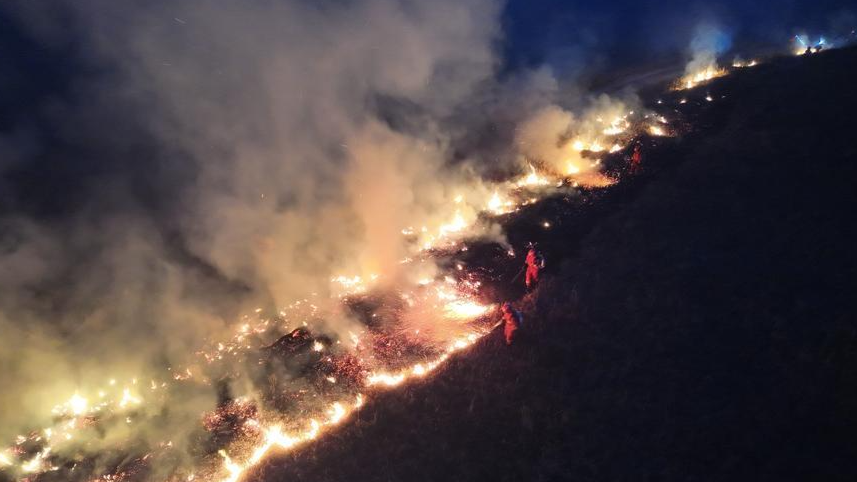
ULAN BATOR — A subsidiary of a Japanese telecom firm is under fire and facing legal consequences after its executives' activities sparked a massive wildfire in Mongolia near the Chinese border, which burned an area more than twice the size of Tokyo.
The fire broke out on Oct 8 in the Numrug Strictly Protected Area, one of eastern Mongolia's best-preserved natural ecosystems and a habitat for a wide range of wildlife, including rare and endangered species. It was extinguished on Oct 16, according to Mongolian media reports.
The wildfire burned for more than eight days, sweeping across approximately 530,000 hectares, destroying about 80 percent of the protected nature reserve, according to the country's Ministry of Environment and Climate Change.
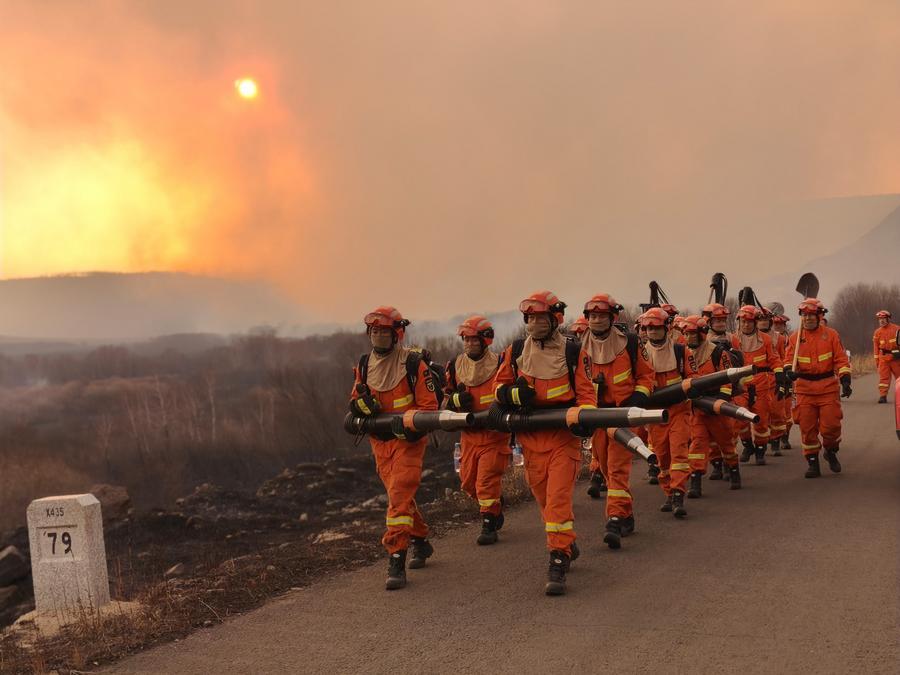
Some wild animals, among them rare and endangered species, fled across the border into China. More than 2,000 personnel were deployed in north China's Inner Mongolia Autonomous Region to contain a grassland fire spreading from Mongolia. As Chinese firefighters worked to contain the blaze, they also left a passage open for the fleeing animals to escape.
Outrage and unanswered questions
Japanese telecommunications operator KDDI did not admit until Oct 20, almost two weeks after the fire broke out, that the disaster was linked to the activities of its subsidiary, Mobicom.
According to Mongolian media, a five-vehicle Mobicom convoy led by senior Japanese executives and carrying 13 people entered the restricted area. Dry grass beneath one vehicle caught fire, and strong winds quickly spread the flames across the grassland.
Mobicom claimed the trip was an official survey for telecom infrastructure construction, describing the fire as an operational accident.
However, Mongolian government officials and local media have strongly questioned the explanation, pointing out that the proposed fibre-optic project lacked technical and economic justification.
Local media reports said the convoy may have entered the area for illegal hunting and fishing involving critically endangered species. Such activities are prohibited under Mongolian criminal law in specially protected areas, where starting a forest or steppe fire can also carry criminal penalties.
Although the company apologized for the fire, it did not directly address the allegations.
The incident has sparked widespread public outrage in Mongolia, with questions raised over whether the convoy had obtained the necessary permits to enter the ecologically sensitive reserve during the high-risk fire season.
ALSO READ: Wildfire haze shuts Malaysia schools, looms over Singapore F1
Amid mounting public anger over the delayed apology from the Japanese side and the lack of a plan and compensation to address the damage, Mongolia's Deputy Prime Minister Nyamtaishiryn Nomtoibayar said, "Strictly protected areas are not places that anyone can simply enter at will ... Mobicom's empty 'apology' means nothing to me."
Temuulen Ganzorig, Mongolia's minister of justice and internal affairs, said those involved, along with personnel from relevant border-port administrations, would be held accountable and ordered to compensate for the losses.
The incident was "not merely a private matter for one company," Kazuya Shimba, secretary-general of Japan's Democratic Party for the People, told a press conference, noting that "Japan as a nation must take it seriously."
"No one should be allowed to escape accountability for the damage. The investigation must establish who authorized entry into the protected area, for what purpose, who was responsible for ensuring fire safety, and what measures were taken after the fire broke out," said Mongolian Prime Minister Nyam-Osor Uchral.
"Any issues related to Mobicom's operations must also be investigated in accordance with the law and based on evidence," he stressed.
Ecological damage
Beyond the immediate damage, the fire's long-term ecological consequences could be far more difficult to assess.
A Mongolian government working group is assessing damage to the Numrug Strictly Protected Area. The country's environment ministry said the assessment should examine the fire's impacts on soil, water, air, vegetation, wildlife and ecosystem functions, as well as its long-term ecological consequences.
The grasslands in eastern Mongolia form a vital ecological barrier in Northeast Asia, Liu Zhiyan, a senior research fellow at the Research Institute for Eco-civilization of the Chinese Academy of Social Sciences, told the media.
The fire may have affected not only grasslands but also riverbanks, wetlands and other ecosystems, said Wang Qinxue, a researcher at Japan's National Institute for Environmental Studies who has long studied the region's ecological environment.
Even if vegetation regrows the following year, plant species composition and soil conditions may not recover at the same pace, said Wang, stressing that further assessment is needed to determine whether wildlife can safely survive the winter and whether ash, sediment or smoke from the fire has crossed national borders.
The wildfire also released smoke and particulate matter that could be carried across borders by air currents, said Liu.
ALSO READ: Wildfires, heat waves threaten to undermine air quality, UN weather agency says
The fire's potential transboundary ecological effects warrant further investigation, including whether ash and sediment could enter rivers and wetlands through surface runoff and whether smoke had crossed national borders, Wang said.
Citing research in Mongolia's Dornod province, Wang said fires occurring from autumn through the following spring were associated with the number of dust storm days in spring. Reduced vegetation cover leaves soil more vulnerable to wind erosion, making surface materials more susceptible to being carried away by the wind, he said.
Regular international cooperation on fire warnings, emergency response and ecological restoration is essential to containing cross-border disasters and reducing environmental risks, Liu said.
Kazuo Yawata, a former senior official at Japan's Ministry of International Trade and Industry and a history writer, reiterated that Mobicom should offer a sincere apology for the disaster, stressing that the fire had caused "a significant impact on the local ecosystem."
