

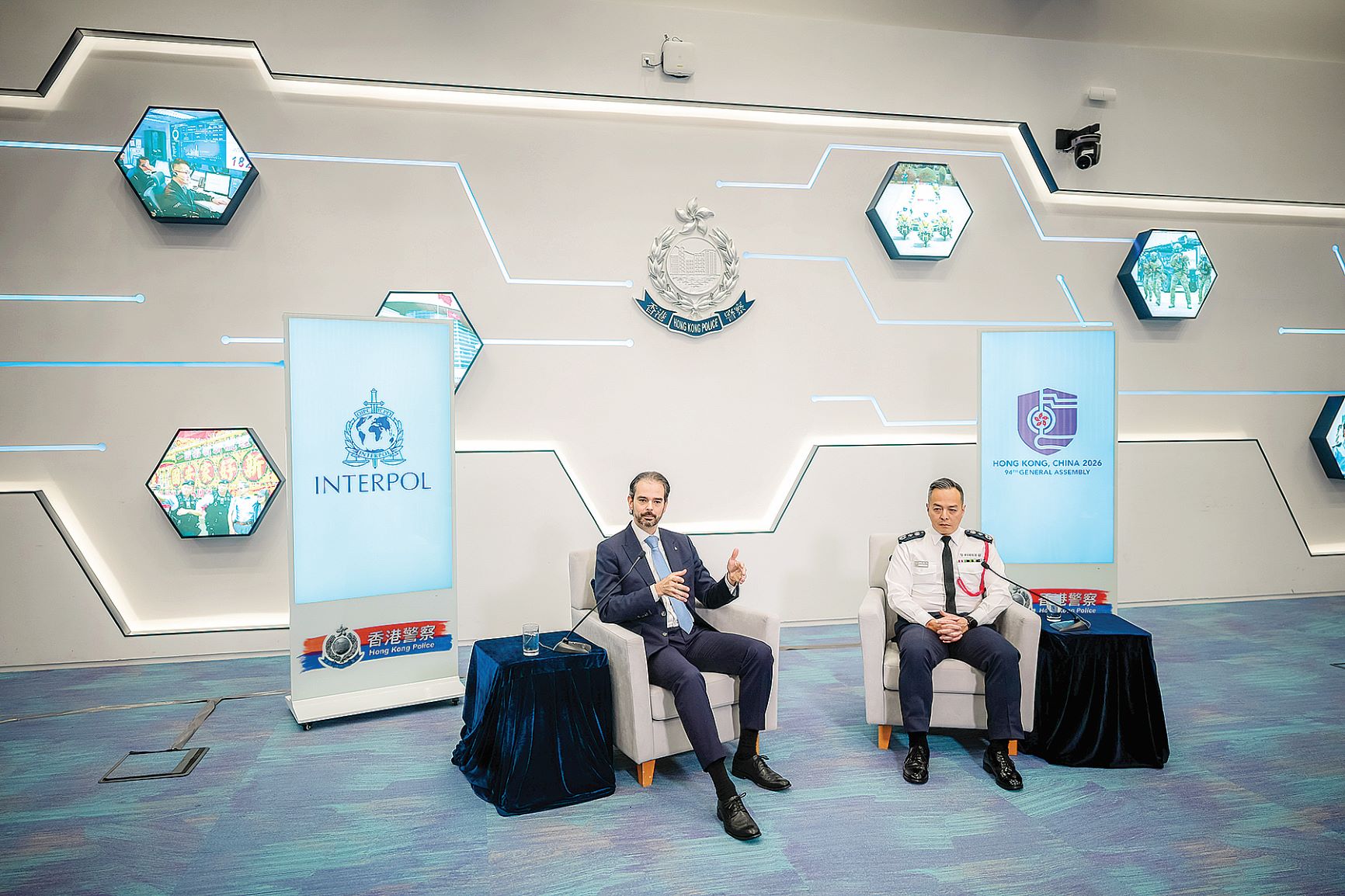
The heads of the Hong Kong Special Administrative Region’s police force and the International Criminal Police Organization are aiming for a successful Interpol assembly in the city late next month, calling the event a crucial window for global law enforcers to strengthen partnerships to crack down on transnational crime driven by the advent of high technology.
Interpol’s 94th General Assembly — to be held in the HKSAR for the first time from Nov 30 to Dec 3 — is expected to gather police chiefs and senior law enforcement representatives from all 196 members of the intergovernmental organization.
During a recent media interview in Hong Kong, the city’s Commissioner of Police Joe Chow Yat-ming and Interpol Secretary-General Valdecy Urquiza discussed preparations for the upcoming assembly, cooperation goals and global policing challenges.
Chow said preparations for the event had begun early last year, with drills and tests having been carried out this year, covering transportation, logistics and wireless connectivity, as well as other aspects, to identify areas for improvement.
He pledged to hold a “safe, secure, and simple” assembly, introduce Hong Kong’s “hospitality, vibe, charisma and energy” to visitors coming for the event, and forge stronger partnerships for the city’s police force.
ALSO READ: HK police arrests 8 over ‘compensated dating’ scam
“In fact, our team has been work Urquiza said the response to tech nology-driven crime required ing very, very hard to the best of our ability to prepare hospitality, so that when they arrive, when they step out of the plane, they can already feel it,” Chow said.
Urquiza credited the SAR with being both a good host and a committed international policing partner, noting that its officers temporarily posted to Interpol contribute expertise in financial investigations, among other fields, while the Hong Kong Police Force’s recent technological innovations support those efforts.
“Hong Kong is a hub for finance, trade and digital services, and is the perfect location for us to bring the international community of law enforcement to discuss integration, cooperation, and the future of law enforcement,” Urquiza said.
He said he hopes that delegates from around the world will find lessons in Hong Kong’s policing experience when they gather for the assembly. “I do see that this cooperation with the Hong Kong Police Force is strengthening and helping our organization a lot.”
Agenda priorities
The agenda of this year’s assembly includes identifying and disrupting transnational organized crime, developing new policing capabilities for fugitive investigations, and protecting child victims.
Delegates will also examine artificial intelligence-enabled crime and terrorism, and Interpol’s asset-tracing tool — the Silver Notice pilot project.
Chow said holding the assembly in Hong Kong is part of the Hong Kong Police Force’s sustained drive to broaden international cooperation.
READ MORE: Police crack down on illegal activities involving triads across HK
Under the SAR’s first Five-Year Plan for Economic and Social Development (2026-30), the force will aim to forge closer ties with law enforcement on the Chinese mainland and overseas, with the aim of identifying and tackling cross-border threats.
“Transnational crime is a problem that we just can’t take on by ourselves. We need to deal with it in a collaborative way, together with other countries and regions. We must learn to share,” Chow said.
Anti-fraud work and financial investigations rank among the Hong Kong Police Force’s “top priorities” in tackling transnational crime. Chow pointed to recent crime figures to explain the force’s priorities, which showed fraud accounting for around half of all crime in the city.
Anti-fraud operations and intelligence sharing require partner agencies across continents, Chow said, building on the force’s already close network in Asia.
At the assembly, the force will have a chance to strengthen existing relationships and meet new partners, he said.
Chow also said he hopes to seek greater engagement with Africa and other regions where contact has been limited, through exchanges of experience and expertise. “The signing of various memorandums of understanding and agreements. That’s exactly what we’re working on now,” he added.
Urquiza said the response to technology-driven crime required stronger intelligence sharing and joint operations, as well as efforts to narrow disparities in capabilities and resources that criminal groups could exploit.
He identified the challenges AI poses to law enforcement as a key focus. “The reality is that the use of AI makes the crime landscape more porous.
It gives criminal organizations the ability to reach different regions of the world that they could not before; and they use it at a scale that we have never seen,” he said.
READ MORE: HK police arrest 25, bust loan shark syndicate
Interpol is responding on multiple fronts, such as understanding how criminals exploit AI, equipping investigators to pursue those cases, and helping police use the technology systematically to improve efficiency.
It is also developing guidelines for responsible AI use in policing, Urquiza said. Launched in January last year, the Silver Notice pilot project helps trace suspected criminal assets across borders.
As part of Interpol’s color-coded notices and diffusion system, the project allows law enforcement agencies to circulate alerts and information requests across Interpol’s 196-member network.
Interpol reported in May that more than 200 active requests were being used across 81 members participating in the pilot to trace about $2.2 billion in suspected criminal assets.
Urquiza said he hopes the assembly will approve measures to make the tool readily available to more Interpol members’ investigators.
“This will give more speed, more agility, and more efficiency to their financial investigation,” he said.
He urged the international police community to do more to close the gaps in investigative capacity, notably by helping under-resourced forces train officers and tackle cases that require outside expertise.
“Especially because of the trans national aspect of crimes nowadays, we need to have countries all across the world on a similar level of capabilities to investigate criminal activities. And unfortunately, this is not yet the reality,” he said.
Urquiza cited the work of Hong Kong police officers at Interpol headquarters as an example of such support, particularly that of financial investigation specialists who help the agency both investigate cases and train officers.
Hong Kong hopes to take that work further. The Hong Kong International Academy of Policing, set to open on Nov 11, will give the city a place both to tap outside expertise and share its own technical know-how, Chow said, adding he would like to work closely with Interpol on training programs.
Chow and Urquiza said the conference will combine the plenary meeting with hundreds of rounds of bilateral talks, discussions on various policing issues, and cultural activities to enable delegates to dive deeper into Chinese culture and experience public safety in Hong Kong firsthand.
Contact the writer at wanqing@chinadailyhk.com
